
First question: is it pumping, or just running?
Open the pit and watch one full cycle with a flashlight. What you see sorts the problem into one of four patterns, and the pattern decides everything that follows.
- The pump runs, the water drops, the pump stops, and the pit refills quickly. The pump is working; the question is the inflow. If it has rained for days or the ground is thawing, this is a sump pump doing its job. If the ground is dry, water is arriving from a leak, a downspout, or your own discharge line.
- The pump runs but the water level does not fall. No water is leaving. The pump is air-locked, its intake or impeller is clogged, the discharge line is blocked or frozen, or the check valve is stuck or installed backward.
- The pump runs with the pit nearly empty. The float is stuck in the up position or the switch has failed closed. The pump will overheat and die if it stays this way.
- The pump turns on and off every few seconds. Water is falling back into the pit through a failed check valve after each cycle, or the float has so little travel that an inch of water starts it again.
The diagram below names the parts you are about to touch; the steps that follow test each one.
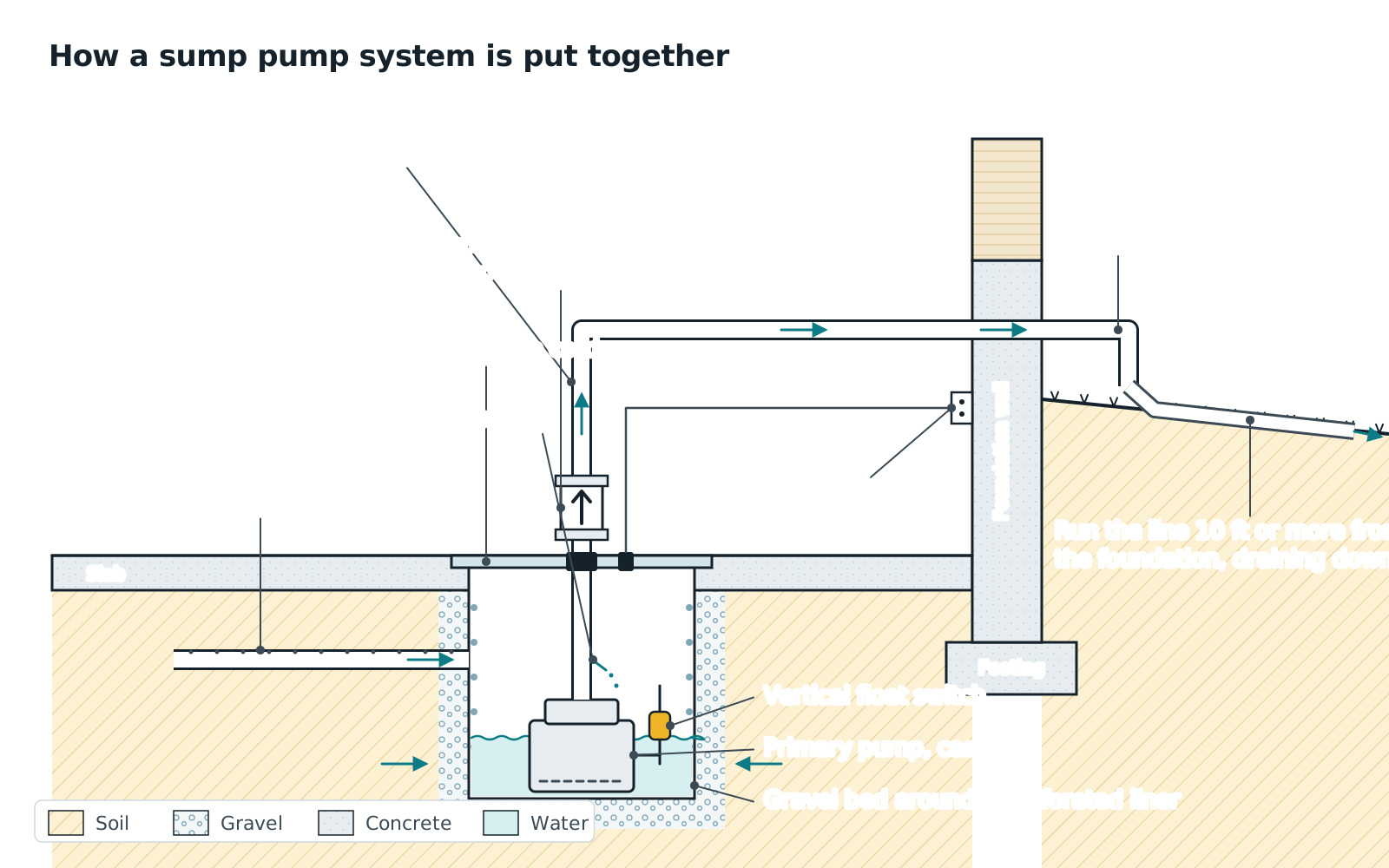
The 15-minute diagnosis
- 1
Unplug the pump and time the refill
Unplug the pump, mark the water level with a piece of tape on the riser, and time how long the water takes to rise 2 inches. In a dry week it should barely move; in a storm a fast pit can rise an inch a minute. Convert it to gallons: an 18 in pit holds about 1.1 gallons per inch of depth, a 24 in pit about 2 gallons, a 12 in pit about half a gallon. Two inches in a minute in an 18 in pit is roughly 2.2 gallons per minute, or 130 gallons an hour, which any pump handles; two inches every ten seconds is 800 gallons an hour, which starts to tax a 1/3 HP pump on a tall lift. Plug the pump back in before the pit gets high. Keep this number: the sump pump sizing calculator turns it into the pump you need.
- 2
Watch the float through a cycle
With the pump plugged in, watch the float rise and trip. A tethered float should swing freely without touching the pit wall, the riser or the power cords; if it hangs up against anything it can stick on, or stick off. A vertical float should slide on its rod without catching on debris or a crust of iron bacteria. If the pump is running with the water below the float, the float is stuck up or the switch has failed. Nudge the float with a stick; if the pump stops, you have found it.
- 3
Test the switch separately from the pump
Most pumps use a piggyback plug: the float switch's plug goes in the outlet and the pump's plug goes into the back of it. Unplug both, then plug the pump directly into the outlet. If it runs, the motor is fine and the switch is the problem; a replacement piggyback float switch costs a fraction of a pump. If the pump does not run plugged in directly, the motor or its thermal overload is the problem; let it cool twenty minutes and try again before condemning it.
- 4
Watch what happens when the pump stops
Let the pump run the pit down and listen as it shuts off. A short gurgle and a settle is normal. If the water level jumps back up 2 to 6 inches and the pump restarts within seconds, the check valve is leaking or missing and the whole discharge column is falling back into the pit every cycle. That is the most common cause of rapid cycling, and replacing the check valve is a half-hour job.
- 5
Check for an air lock
If the pump hums and the water does not move, look for the weep hole: a 1/8 to 3/16 in hole drilled in the riser between the pump and the check valve, inside the pit, usually a few inches above the pump outlet. If there is no hole, or it is plugged with scale, air trapped in the pump housing stops the impeller from pushing water. Unplug the pump, lift it enough to let the air burp out, and drill or clear the hole, angled slightly down so the spray goes back into the pit.
- 6
Follow the discharge outside
Go outside while the pump runs and find the outlet. Water should be leaving at a steady stream. A trickle or nothing means the line is frozen, crushed, clogged, or the outlet is buried under mulch, snow or a landscaping project. Then look at where that water goes: if it pools against the foundation or runs into a window well, it is soaking back into the drain tile and returning to the pit, and the pump is recirculating its own water. The line should discharge at least 10 ft from the house onto ground that slopes away.
- 7
Rule out a leak you are paying for
If the pit refills fast in dry weather and the water is clear and cool, check the water meter with everything in the house off; if the low-flow indicator is turning, a supply line under the slab or in the yard may be feeding the pit. Our hidden leak guide walks the test. Water that smells of sewage points at a broken drain line and a plumber with a camera. Water that arrives only when the irrigation runs or the neighbor's sump discharges tells its own story.
The causes and the fixes
Heavy inflow or a high water table. The most common reason and the one with no defect to fix. Drain tile around the footing collects ground water and delivers it to the pit; after days of rain or during snowmelt a pit can take hundreds of gallons an hour, and a pump that runs two minutes out of every three is doing what it was bought for. What matters is whether it keeps up. If the water stays below the top of the liner, leave it alone and read the next section on redundancy. If the level creeps up while the pump runs flat out, the pump is undersized for the inflow or the lift, and you need a bigger pump or a second one today.
Inflow that should not be there. In dry weather a busy pit means water from a source you can cut off: downspouts dumping at the foundation, grading that slopes toward the house, an irrigation zone soaking the wall, a sump discharge that lands next to the house and recirculates, a leaking supply line, or a neighbor's discharge pointed at your lot. Extend downspouts 6 ft or more and move the sump outlet 10 ft out, and the pump that ran all summer runs twice a day.
Float switch stuck or failed. Tethered floats hang up on the pit wall or a cord; vertical floats jam on silt and iron bacteria; any float can waterlog. Reposition the pump so the float swings clear, clean the pit, and replace a failed switch. If the pump is past seven or eight years and the switch has failed, replace the whole unit with a vertical-float pump, the switch type we trust most in a standard 18 in pit.
Check valve failed, missing or backward. The check valve holds the water in the discharge pipe between cycles. When it leaks, every cycle starts by re-pumping the same column of water, and the pump short-cycles until the motor overheats. A quiet-close valve above the lid, arrow pointing away from the pump, with a union so it can be serviced, is the fix. A valve installed backward or stuck shut gives the opposite symptom: the pump runs and nothing leaves.
Air lock. No weep hole, or a plugged one. The pump spins in a pocket of air and never primes. Drill the hole.
Discharge line frozen, crushed or clogged. In winter a line that runs flat or ends in a snowbank freezes; a freeze-relief fitting near the house lets water escape at the foundation rather than back up the pit. Buried lines get crushed by vehicles and filled by roots and rodents. Disconnect at the union, run a temporary hose out a window, and the pump will tell you immediately whether the line was the problem.
Undersized pump or too much head. A 1/3 HP pump such as the Zoeller M53 moves about 2,040 gallons an hour at 10 ft of lift, and a long horizontal run, several elbows and a 14 ft lift pull that number down fast. If the refill test says the pit takes more than the pump can lift away, step up to a 1/2 HP (the Zoeller M98 moves 3,660 GPH at 10 ft) or a 3/4 HP (the Wayne CDU980E, 4,600 GPH at 10 ft), or add a second pump on a higher float so the two share the storm.
Pit too small. A 12 in pit holds half a gallon per inch, so a pump with a 4 in float differential starts every time two gallons arrive, and short cycling wears the switch and the motor. The fixes are a pump with a wider on-off range (the M98 turns on at 9-1/2 in and off at 3 in) or a larger basin, a day's work with a jackhammer and worth it in a wet house.
A worn pump. Impellers wear, seals weep into the motor, and a pump at year ten moves far less water than it did at year one while drawing the same current. If everything above checks out and the pump still cannot keep up with an inflow it once handled, it is done.
When constant running is normal, and what to do about it anyway
A pit that fills fast every spring is a house that sits in ground water, and the pump is the only thing between that water and the floor. Running a lot is not the problem; running alone is. Three things make a hard-working pump a safe one:
- A second pump. A battery backup on a higher float takes over when the primary fails or the power goes out, which in a storm is when it will. Our battery backup install guide covers the layout. On a pit that runs for hours at a time, consider a second AC pump on a higher float as well, so a motor failure does not become a flood.
- An alarm you can hear and a message you will get. A high-water alarm in the pit, or a leak sensor on a probe an inch above the primary's turn-on level, is the difference between a pump failure at 2 a.m. and a pump failure you learn about at breakfast.
- Cut the inflow you can. Downspout extensions, grading, a longer discharge line and a cover on the window wells often cut a pump's run time in half.
If the pump is cycling every minute in spring and keeping up, size the next one for the pit, not the shelf. The two below are the pumps we recommend when a 1/3 HP cannot keep up.
Zoeller M98 Flow-Mate
Zoeller's 1/2 HP cast iron workhorse for high water tables.
Score breakdown
| Flow at 10 ft of head | 3660 | 6.9 |
| Build material | cast iron | 10.0 |
| Switch reliability | vertical float | 9.0 |
| Warranty | 3 | 5.0 |
| Head capability | 23 | 5.3 |
| Efficiency (lower amps) | 9.4 | 3.2 |
| Cord length | 9 | 0.6 |
| Solids handling | 0.5 | 10.0 |
| Thermal protection | n/a | — |
- 3,660 GPH at 10 ft and a 23-ft maximum head
- Draws only 9.4 A for 1/2 HP
- Longer 9-1/2 in on / 3 in off switch range reduces starts per hour
- Cast iron motor housing sheds heat
- 9-ft standard cord
- 3-year warranty
- Short-cycles if installed in a pit with low inflow
- Thermal overload not stated on the product page
The M98 is the pump we recommend when an M53 is cycling every minute in spring. It is a 1/2 HP, 1,725 RPM oil-filled permanent split capacitor motor in a powder-coated cast iron housing, pulling 9.4 A, less than the 3/10 HP M53. Zoeller rates it at 72 GPM (4,320 GPH) maximum and 3,660 GPH at 10 ft, with a 23-ft maximum head. That is nearly 80% more water at a basement lift than the M53 for roughly the same current.
The switch is the snap-action vertical float with a 9-1/2 in on and 3 in off range, a longer cycle than the M53's, which means fewer starts per hour in a fast pit. The vortex impeller passes 1/2-inch solids and the shipping weight is 31 lb, so it sits firmly on the bottom of the basin.
Where it falls short: 9 ft of cord on the standard model, a 3-year warranty when Wayne gives five on its stainless and cast iron pumps, and Zoeller's performance at 10 ft is lower than Wayne's 3/4 HP CDU980E on paper. If you need lift above 20 ft, the M98's 23-ft head is the reason to pick it over the Wayne.
Buy it for a high water table, a long or tall discharge run, or any pit where a 1/3 HP pump cannot keep up during storms. Run our sizing calculator first; a 1/2 HP pump in a slow pit just short-cycles.
Wayne CDU980E
The most water per dollar at a real basement lift.
Score breakdown
| Flow at 10 ft of head | 4600 | 10.0 |
| Build material | cast iron/stainless | 10.0 |
| Switch reliability | vertical float | 9.0 |
| Warranty | 5 | 10.0 |
| Head capability | n/a | — |
| Efficiency (lower amps) | n/a | — |
| Cord length | 8 | 0.0 |
| Solids handling | n/a | — |
| Thermal protection | true | 10.0 |
- 4,600 GPH at 10 ft on Wayne's own curve
- Stainless motor housing on a cast iron volute
- Fits basins 11 in and larger
- 5-year limited warranty
- Top-suction design pulls less silt
- 8-ft cord
- Running amps and solids handling not published
- Overkill for a slow pit; will short-cycle
- Wayne's own 10-ft figures differ between manual and web page
The CDU980E is a 3/4 HP submersible with a stainless steel motor housing on a cast iron volute, and Wayne's own curve puts it at 5,490 GPH at zero head and 4,600 GPH at 10 ft, still 3,500 GPH at 20 ft. That is more than double what a Zoeller M53 moves at the same lift, usually for similar money, which is why it is our value pick.
The design is top-suction: water enters above the base, so the pump is less prone to pulling in the silt that settles on the floor of a pit. The integrated vertical float turns on at 9 in and off at 4 in, with a solid polypropylene float that cannot waterlog. Wayne specifies it for basins 11 in in diameter and larger, which makes it one of the few 3/4 HP pumps that fits a narrow pit, and backs it with a 5-year limited warranty.
Where it falls short: the cord is 8 ft, the oil-filled motor has an automatic resetting thermal protector but Wayne does not publish running amps or solids handling, and the manual's performance table and the product page disagree slightly at 10 ft (4,600 vs 4,743 GPH; we use the lower manual figure). A 3/4 HP pump in a slow pit will short-cycle; size it with our calculator first.
Buy it if your pit fills fast in spring, you have a long discharge run, or you simply want the longest warranty on the shelf.
We don't copy Amazon reviews. Read customer reviews on Amazon (paid link).
When to call a pro
Call a plumber or waterproofer today if the water level is rising while the pump runs and you have no backup, if the pump trips the breaker or its thermal overload repeatedly, if the discharge line is buried and you cannot find where it ends, or if the pit fills fast in dry weather and the meter test points at a leak under the slab. Call a waterproofing contractor if the pit cannot keep up even with a correctly sized pump; the drain tile may be clogged or the lot may need exterior grading, a larger basin, or a second pit on the other side of the house. If the pit has already overflowed onto a finished floor, the 72-hour guide starts the drying, and the form below reaches vetted local plumbers, waterproofers and restoration contractors through HelpMeNow.com.
Frequently asked questions
Is it normal for a sump pump to run constantly?
During and after heavy rain or snowmelt, yes: drain tile delivers hundreds of gallons an hour to the pit in a wet week, and a pump that runs most of the time while keeping the water below the top of the liner is working correctly. It is not normal in dry weather; a busy pit then means water from a downspout, grading, an irrigation zone, your own discharge recirculating, or a leaking supply line. A pump that runs without the water level dropping, or with the pit nearly empty, has a fault regardless of the weather.
Why does my sump pump turn on and off every few seconds?
Almost always a failed or missing check valve. When the pump stops, the water in the discharge pipe falls back into the pit, the level rises, and the float starts the pump again within seconds. Watch the pit as the pump shuts off: if the level jumps back up 2 to 6 inches, replace the check valve. The other cause is a float with very little travel in a small pit; a pump with a wider on-off range or a larger basin fixes that.
Why is my sump pump running but not pumping water?
Either air is trapped in the pump or the water has nowhere to go. Check for a weep hole in the riser between the pump and the check valve; without one the pump air-locks. Then follow the discharge outside: a frozen outlet, a crushed buried pipe, a clogged line or a check valve installed backward all leave the pump spinning against a wall. Disconnect the riser at the union and run a temporary hose; if the pump moves water, the line was the problem. A clogged intake screen or a worn impeller are the remaining suspects.
How do I know if my sump pump float switch is stuck?
The pump runs with the water below the float, or does not start when the water is above it. Open the lid and watch: a tethered float caught on the pit wall, the riser or a cord, or a vertical float jammed by silt or iron bacteria, is visible. Nudge the float; if the pump responds, reposition the pump so the float swings clear and clean the pit. To test the switch itself, plug the pump directly into the outlet, bypassing the piggyback plug: if the pump runs, the switch is the failed part.
Can a sump pump burn out from running constantly?
Yes. A pump that runs without moving water, or short-cycles every few seconds, overheats; the thermal overload shuts it down and restarts it until the windings or the seal fail. A pump that runs long cycles while actually pumping is under far less stress, especially a cast iron one that sheds heat into the water, but any pump that runs for hours at a time should have a second pump or a battery backup beside it. The storm that makes it run that hard is the storm that finds its limit.
Do I need a bigger sump pump if it runs all the time?
Only if it cannot keep up. Unplug the pump and time how fast the pit rises 2 inches; an 18 in pit holds about 1.1 gallons per inch. Compare that inflow, in gallons per hour, with the pump's rating at your actual lift: a 1/3 HP Zoeller M53 moves about 2,040 GPH at 10 ft, a 1/2 HP M98 about 3,660, a 3/4 HP Wayne CDU980E about 4,600. If the inflow approaches the pump's number, step up or add a second pump. If the pump keeps up easily and still runs constantly, fix the inflow or the switch.
The seasonal checklist, by email
One email when the season changes — freeze week, spring thaw, hurricane season — with the checklist for that month. No weekly newsletter, no selling your address.
We send one confirmation link first. Every email has a one-click unsubscribe. Privacy.
Check your inbox for the confirmation link; the checklist follows as soon as you click it.
You are on the list. The next email arrives when the season changes.
That did not go through. Check the address and try again.
DryHomeLab is written and reviewed by the team behind HelpMeNow.com, a marketplace that connects homeowners with vetted local contractors for water-damage restoration, plumbing and waterproofing. Before HelpMeNow the same team ran a 24/7 water-damage restoration company in the Seattle area; the equipment on this site is what we specified, bought and ran on real water losses. We publish the rubric behind every score.
- Ran a 24/7 water-damage restoration company, Seattle area
- Operate HelpMeNow.com, a contractor marketplace
- Publishes its scoring rubric