
Read the symptom first
The clue you noticed points at a kind of leak, and the kind of leak decides where to start.
- A high water bill, a meter that never stops, or the sound of water running with everything off. A pressurized supply leak. It runs 24 hours a day and it shows on the meter. Start at the meter.
- A stain or soft spot that appears only after a shower, a flush, or a load of laundry. A drain, a shower pan, a toilet wax ring or an appliance. It never shows on the meter because the water was already past it. Start by using the fixture above the stain and watching.
- A stain that grows after rain, or a damp basement wall in spring. Roof, flashing, a window, grading or ground water. Not plumbing at all, and the meter test will come back clean.
- A warm patch of floor, hot water that arrives faster than it used to, or a water heater that runs all day. A hot-side leak, often under a slab.
- Sweating pipes and ducts in summer, drips under an air handler. Condensation or a blocked condensate drain, which looks like a leak and is cured by insulation and a drain line, not a plumber.
- A musty smell with no stain. Water inside a cavity. A moisture meter finds it; your nose only narrows the room.
The EPA's WaterSense program estimates household leaks waste nearly 10,000 gallons a year in the average home and that about one home in ten has a leak wasting 90 gallons or more a day. Most of that is toilets and dripping fixtures, which is why the cheap tests come first.
The hunt, in order
- 1
The two-hour meter test
Make sure nothing is using water: no washer, dishwasher, icemaker, irrigation, humidifier, softener regeneration or filling toilet. Find the meter (basement wall or the box at the curb) and look for the low-flow indicator, a small triangle, star or dial that turns with the slightest flow. If it is moving with everything off, you have a leak; go to the next step. If it is still, photograph the reading, leave the house alone for two hours, and photograph it again. EPA WaterSense puts it plainly: if the meter changes at all over a period of no use, you probably have a leak. Meters that read in cubic feet convert at 7.48 gallons per cubic foot. If your utility has an hourly-use portal, a line that never reaches zero overnight is the same answer.
- 2
Split the house at the main
Close the main shutoff (our shutoff guide covers finding it) and look at the indicator again. Still moving: the leak is between the meter and the valve, in the service line under the yard, or the valve is not sealing. Look for a strip of lawn greener or soggier than the rest, water in the meter box, or a sunken patch along the line from the curb to the house. Stopped: the leak is inside the house, downstream of the valve, and the rest of this list applies.
- 3
Isolate one branch at a time
Reopen the main and close valves one at a time, checking the indicator after each. Irrigation first (the valve before the backflow preventer outside); a weeping zone valve is the most common leak that never shows indoors. Then the water heater's cold inlet: if the indicator stops, the leak is somewhere on the hot side. Then the softener (bypass lever), the refrigerator line, the furnace humidifier, and every toilet and sink stop in turn. Each valve that stops the indicator cuts the house in half. Write down the result for each; you will need it when you call someone.
- 4
The toilet dye test
Toilets leak silently from the flapper into the bowl and refill in short hisses you tune out. Put a few drops of food coloring in each tank, do not flush, and come back in 10 minutes. EPA WaterSense uses the same test: any color in the bowl means the flapper is leaking. Also look at the water level in the tank; if it sits at or above the top of the overflow tube, the fill valve is set too high and the toilet runs into the overflow around the clock. A flapper and a fill valve are a hardware-store fix.
- 5
The pressure-drop test
Screw the gauge onto an outside hose bib or a washer valve and open that valve. Note the static pressure; 40 to 80 psi is normal, and above 80 psi is a problem in itself. Push the lazy hand onto the needle, close the main, and leave everything alone for 15 minutes. If the needle falls while the lazy hand marks where it started, water is leaving the house piping somewhere; if it holds, the piping is tight and the meter movement you saw came from a fixture, the service line or the main valve itself. Repeat with the water heater inlet closed to rule the hot side in or out.
- 6
Walk the house and listen
At night, main open, nothing running. A pressurized leak hisses, and it is loudest nearest the hole. Put the stethoscope or the tip of a long screwdriver (handle to your ear) on the main valve, each fixture stop, the water heater fittings and, for a suspected slab leak, the floor itself in a grid. Feel the floor for warm spots while you are down there; a hot-side slab leak warms the tile above it. Trace the hiss toward where it gets louder and mark the spot.
- 7
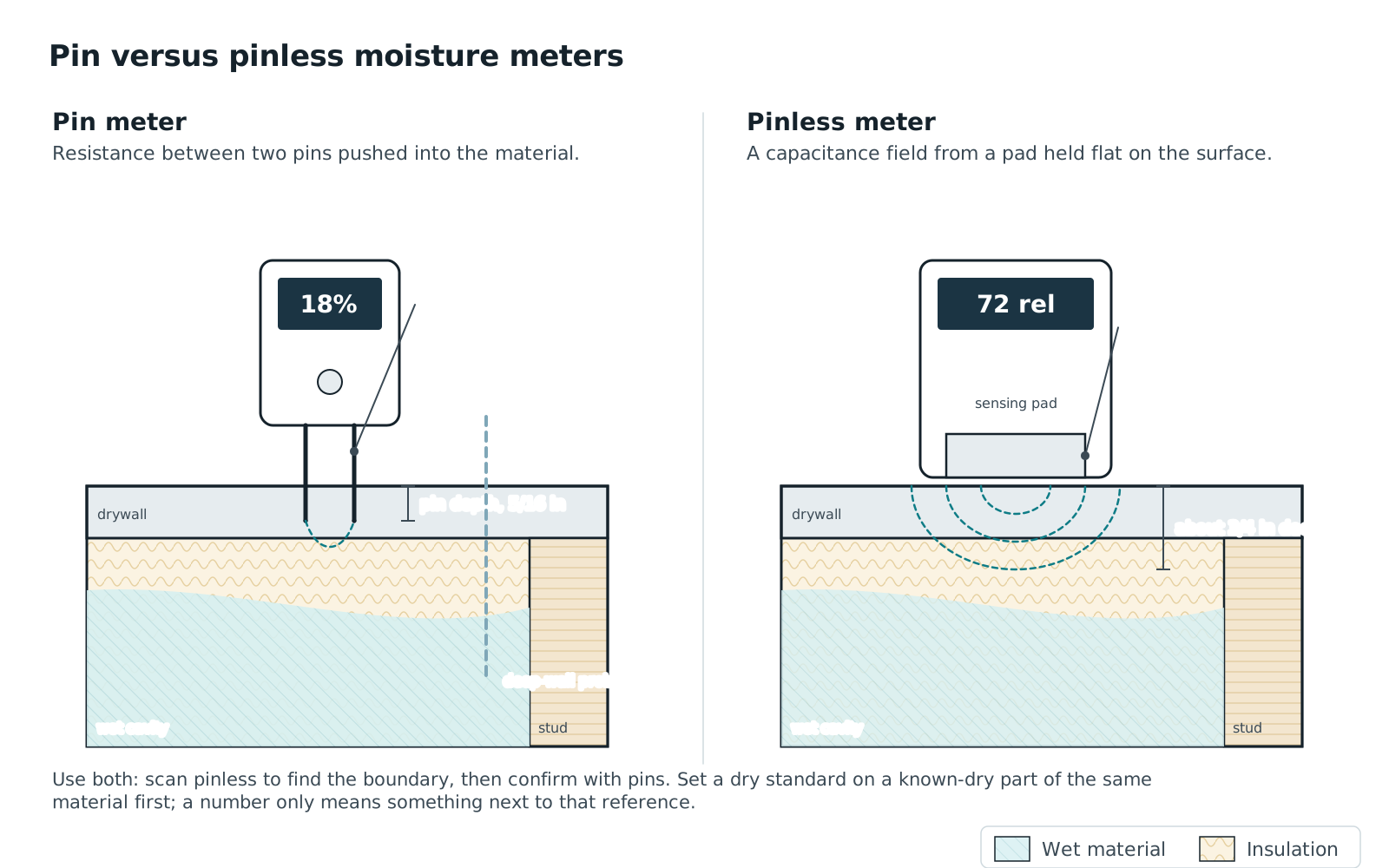
Sweep the walls and floors with a moisture meter
First set a dry standard: read a part of the same wall or floor you are sure is dry and write that number down. Then sweep a pinless meter in a grid, every foot or so, up the wall from the floor and across the ceiling near any stain, marking readings on painter's tape. Where readings return to the dry standard is the edge of the wet area; the highest reading is where to look. Push a pin meter into the wettest spot to confirm with a percentage. The shape of the wet area tells you the source: a vertical stripe from the ceiling is a pipe or drain above; a band along the bottom of the wall that fades with height is water on the floor wicking up; a circle around a pipe penetration is that pipe; a patch under a window after rain is the window, not plumbing. Metal corner bead, nail plates and foil-faced insulation read wet on a pinless meter when they are not; confirm anything surprising with pins.
- 8
Open one small hole where the readings peak
Turn off the breaker for any circuit in that wall. Cut a 4 by 4 in inspection hole with a drywall saw at the wettest reading, shallow, so the blade cannot reach a pipe or cable, and look in with a flashlight or your phone's camera. You will usually see the drip, the wet insulation or the stain trail that points to it. A 4 in hole patches in twenty minutes; guessing at the wrong section of wall takes a weekend.
Leaks the meter never shows
If the two-hour test came back clean and the stain is real, the water was not under pressure when it escaped. These are the usual suspects, and the test for each is to make the water run and watch from below.
- Shower pan or tub. Plug the drain, fill the pan an inch deep, and wait 30 minutes with someone watching the ceiling below. Dry means the pan is fine and the leak is the drain or the valve; run the shower against the walls next.
- Toilet wax ring. Water at the base after a flush, a floor that gives, or a stain below that darkens after flushing. Rock the toilet; any movement means the ring has failed.
- Drain lines. Fill a sink or tub and let it go all at once. A joint that leaks only under full flow shows a drip in the cavity within a minute; a pinless meter on the ceiling below the trap finds it without a hole.
- Dishwasher and washer. The door gasket, drain hose and pump leak only during a cycle. Run one and look with a flashlight at the kick plate and behind the washer.
- Air conditioning condensate. A clogged drain line overflows the pan every afternoon in summer and stops at night. Clear the line and add a float switch.
- Roof, flashing, windows and siding. Stains that grow after rain and dry out between storms. Hose-test one element at a time from the bottom up while someone watches inside.
- Condensation. Cold pipes and ducts sweat in humid weather, and the drips land where a leak would. Dry the pipe, wrap it, and check the room's humidity; above 60 percent, the fix is a dehumidifier.
Slab and under-floor leaks
A leak in a line under a concrete slab announces itself as a meter that will not stop, a warm or damp patch of floor, a hiss with the stethoscope on the slab, buckled flooring, or a crack with moisture at its edge. The isolation steps above tell you hot or cold side; from there the locating is specialist work. A leak-detection contractor uses electronic listening equipment, line tracing, thermal imaging and sometimes tracer gas to mark the spot within a foot or two before anyone cuts concrete. The fix is a spot repair through the slab or, more often, a reroute of that line overhead, abandoning the buried section. Do not let anyone break concrete before the leak has been located.
Which meter to buy for this
You want both kinds, and together they cost less than one hour of a leak-detection service. A pinless meter sweeps a wall fast without leaving a mark and finds the boundary of the wet area; a pin meter confirms the wettest point with a number you can write down. Klein's ET140 is the pinless scanner we hand homeowners, and the General Tools MMD4E is the pin meter with a built-in calibration check that we trust to decide whether to open a wall. If you want one tool, Extech's MO55 does both. Our moisture meter roundup covers the professional options and what the scales mean.
Klein Tools ET140 Pinless Moisture Meter
A no-holes scanner for finding the edge of a wet area; not a meter you can verify.
Score breakdown
| Accuracy | 4 | 2.5 |
| Versatility | pinless | 8.0 |
| Professional grade | false | 0.0 |
| Warranty | n/a | — |
| Calibration check | false | 0.0 |
| Scan depth | 0.75 | 2.5 |
| Reading hold | true | 10.0 |
| Backlight | n/a | — |
| Temperature / RH | false | 0.0 |
- Scans to 3/4 in with no holes
- Separate hardwood and softwood scales, ±4% stated for wood
- Hold button and ten-minute auto-off
- Inexpensive for a pinless meter
- No calibration check
- Drywall and masonry readings are relative only
- Reads metal and pipes behind the surface as moisture
- Warranty term not stated in the manual
Klein's ET140 is a pinless meter that reads up to 3/4 in (19 mm) into the surface without leaving a mark. Klein's manual lists four modes: hardwood (0 to 35%), softwood (0 to 55%), and drywall and masonry on a 0 to 100 relative scale, with ±4% accuracy stated for wood. It holds a reading at the press of a button and shuts off after ten minutes. It runs on a 9 V battery.
This is the kind of meter you sweep across a wall to find where the wet stops. Because it reads through paint and does not puncture anything, you can map a whole room in a few minutes and mark the boundary with painter's tape, then confirm the wettest spot with a pin meter. That workflow is exactly how we scope a loss.
Its weaknesses are the ones pinless meters share, plus one of its own. All pinless meters read anything conductive within their field: a metal corner bead, a pipe, a nail plate, or even your hand around the back of a thin panel will spike the reading. The drywall and masonry readings are relative, not percentages, so the number only means something against a dry reference. And the ET140 has no calibration check, so there is no way to prove it still reads true a year from now. Klein's manual does not state the warranty term, referring instead to its website.
Buy it as the fast scanner alongside a pin meter. Do not buy it as your only meter if an insurer or a buyer will be looking at your readings.
General Tools MMD4E Digital Pin Moisture Meter
The cheap pin meter that is accurate enough to tell you whether to open a wall.
Score breakdown
| Accuracy | 2 | 7.5 |
| Versatility | pin | 7.0 |
| Professional grade | false | 0.0 |
| Warranty | 1 | 0.0 |
| Calibration check | true | 10.0 |
| Scan depth | n/a | — |
| Reading hold | true | 10.0 |
| Backlight | true | 10.0 |
| Temperature / RH | false | 0.0 |
- Manufacturer-rated ±2% accuracy, unusual at this price
- Calibration check holes in the pin cap (18.3% reference)
- Backlight, hold, audible alarm and auto power-off
- Two scales: wood 5–50% and building materials 1.5–33%
- Pin holes in every surface you test
- No species or temperature correction
- One-year warranty
- Reads only the surface unless the pins penetrate
The MMD4E is the pin meter most homeowners end up with, and for once the popular choice is a sound one. General Tools rates it at ±2% across a 5 to 50% range for wood and 1.5 to 33% for building materials, with a backlit LCD, a hold button, an audible alarm that trips at 16% in wood and 20% in building materials, and auto power-off after three minutes. It runs on a 9 V battery and the pins are replaceable.
The feature that earns it a place on a professional's list is the calibration check built into the pin cap: press the pins into the two holes and the meter should read 18.3% ±1% in wood mode. That is a real check against a fixed resistor, not a self-test light, and it is why we trust this meter more than pinless meters at the same price that cannot be verified at all.
What it will not do: it reads only where the pins touch, so you leave two small holes per reading and you only learn about the surface layer unless you drive the pins through paint into the paper and gypsum. It has no species or temperature correction, so treat wood readings as approximate and always compare with a dry reference area in the same house. The one-year warranty is short.
Buy it if you want to know, today, whether the drywall behind the washing machine is wet. Pair it with a pinless meter if you need to scan a whole room without leaving marks.
We don't copy Amazon reviews. Read customer reviews on Amazon (paid link).
After you fix it: make the next leak announce itself
Every hunt in this guide started with damage that had already happened. Two things turn the next leak into a notification instead.
A whole-house monitor on the main watches flow and pressure around the clock. Moen's Flo and Phyn's Plus both learn the household's pattern and close the valve on abnormal flow, and both run a nightly pressure test on the closed system that catches the pinhole and weeping-valve leaks that take months to show up as a stain. Phyn's version reads pressure waves finely enough to tell a running toilet from a dishwasher, which is exactly the diagnosis you just did by hand. Flume's strap-on meter sensor does the detection without a valve, for renters and anyone who cannot touch the main. Our smart shutoff valve roundup compares them.
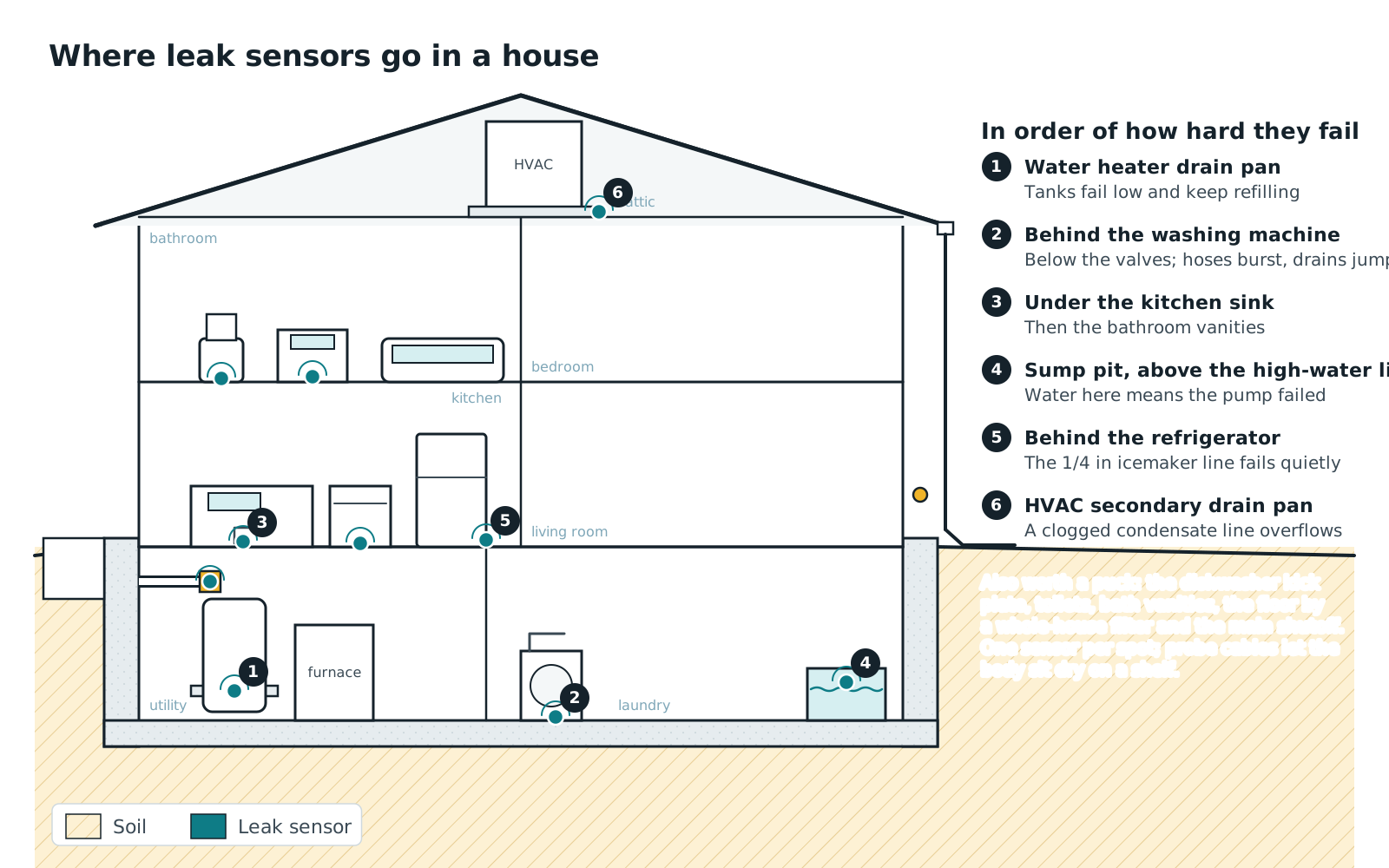
Point sensors cover the leaks that do not show on the meter: the drain pan under the water heater, behind the washer, under sinks, behind the refrigerator, the air handler pan, and the sump pit. A sensor with phone alerts in each of those spots catches the drain leak, the condensate overflow and the wax ring before they are a ceiling. Where to put leak sensors is the placement map.
Phyn Plus Smart Water Assistant + Shutoff (2nd Gen)
Pressure-wave leak detection with no subscription attached.
Score breakdown
| Detects leaks from flow | true | 10.0 |
| Shuts the main automatically | true | 10.0 |
| Micro-leak pressure testing | true | 10.0 |
| Warranty | 2 | 2.5 |
| No subscription for core protection | false | 10.0 |
| Works in a power outage | false | 0.0 |
| Insurance discounts | true | 10.0 |
| No extra hub | false | 10.0 |
| Expands with point sensors | true | 10.0 |
- Pressure-wave analysis plus a no-moving-parts ultrasonic flow sensor
- Plumbing Check pressure test finds pinhole leaks and weeping seals
- No subscription for automatic shutoff or alerts
- Two-year warranty from delivery
- Insurer bundle pages for Nationwide and Chubb; Amica partnership announced
- No battery backup; valve holds its last state in an outage
- 1-in NPSM threads mean buying adapters for 3/4-in or 1-1/4-in mains
- Among the most expensive in the group, roughly $550-$650 before install
- Needs strong 2.4 GHz Wi-Fi at the main line
Phyn Plus (Phyn now sells it as Phyn Protect) reads the main line differently from Flo. Instead of relying mainly on a flow meter, it analyzes high-definition pressure waves in the pipe, which lets it tell a running toilet from a dishwasher by the signature each fixture leaves. Flow is measured by an ultrasonic sensor built by Badger Meter with no moving parts, so there is no turbine to foul. Its Plumbing Check closes the valve briefly and watches pressure decay to find pinhole leaks and poor seals.
The device is rated to 125 psi and 25 GPM and installs on mains up to 1-1/4 in; the body has 1-in NPSM threads and you buy the adapters for your pipe. Phyn recommends a licensed plumber and quotes one to two hours. Power comes from an included adapter on a 12-ft cord, and the FAQ is explicit that the valve stays in whatever state it was in when power is lost. A manual shutoff tool on the bracket covers an outage.
Automatic shutoff unlocks after a learning period and there is no subscription. Phyn's warranty page sets coverage at two years from delivery, double Moen's base term. A Phyn Smart Water Sensor can be configured to close the valve when it gets wet.
On the insurance side Phyn runs bundle pages for Nationwide (15% off the device, installed at the policy address) and Chubb (15% off), and has announced a program with Amica. Buy Phyn if you want pressure-based micro-leak testing and a longer warranty without a monthly plan. Buy Flo if your insurer names it specifically or you want the broader accessory ecosystem.
When to call, and whom
A plumber once you have narrowed it to a fixture, a valve, a visible run of pipe, or a branch you isolated with a valve. Hand them your notes from the isolation steps; it shortens the visit.
A leak-detection specialist when the meter proves a leak but the isolation steps leave it under a slab, in a buried service line, or in a wall you cannot narrow further. Their listening gear, line tracing and thermal imaging locate it before anyone cuts. Ask that the quote separate locating from repair.
A restoration contractor if the moisture meter shows materials that have been wet for more than a couple of days, if there is visible growth over about 10 square feet (the EPA's threshold for professional mold remediation), or if the wet area involves a ceiling, insulation or more than one room. What gets dried within 48 hours is what gets saved. The form below reaches vetted local plumbers, leak-detection and restoration contractors through HelpMeNow.com.
Frequently asked questions
How do I know if I have a hidden water leak?
Turn off every fixture and appliance that uses water and look at the low-flow indicator on the water meter, the small triangle or dial that turns with any flow. If it moves, water is leaving the system. If it is still, photograph the meter reading, use no water for two hours, and read it again; any change means a leak. Other signs are a water bill that climbs with no change in habits, a hiss from pipes at night, a warm patch of floor, a musty smell, or a stain that grows.
How do I check my water meter for a leak?
With all water off, watch the low-flow indicator for a minute. Then record the reading, wait two hours without using water, and record it again. Meters in cubic feet convert at 7.48 gallons per cubic foot. To learn which side of the main the leak is on, close the main shutoff and look again: if the indicator still moves, the leak is in the service line or the valve is not sealing; if it stops, the leak is inside the house.
Why is my water bill high when I cannot see a leak?
The common culprits are invisible: a toilet flapper leaking into the bowl, a fill valve set above the overflow tube, an irrigation zone valve weeping into the lawn, a hot-side leak under the slab, or a softener stuck in regeneration. Run the dye test on every toilet, close the irrigation valve and check the meter, then close the water heater inlet and check again. Each one you close that stops the meter tells you where the water is going.
Can a moisture meter find a leak behind a wall?
It finds where the water is ending up, which is usually within a few feet of where it is coming from. Take a dry-standard reading on a known-dry part of the same wall, sweep a pinless meter in a grid and mark the readings on tape, then confirm the wettest point with a pin meter. The shape of the wet area points to the source: a vertical stripe from above is a pipe or drain overhead; a band along the floor is water wicking up; a circle around a penetration is that pipe. Metal corner bead and foil insulation give false positives on pinless meters, so confirm with pins.
How do plumbers find leaks under a slab?
First by isolation: closing the water heater inlet tells them hot or cold side, and a pressure gauge on an isolated line confirms it is losing pressure. Then a leak-detection specialist uses electronic listening equipment on the slab, line tracing to map the pipe, thermal imaging for a hot-side line, and sometimes tracer gas, and marks the spot within a foot or two before anyone cuts concrete. The repair is a spot fix through the slab or, more often, a reroute of that line overhead.
Does a leak in a wall always show on the water meter?
Only if the leaking pipe is on the pressurized supply side. Drain lines, shower pans, toilet wax rings, tub overflows, appliance drain hoses, condensate drains, roofs and windows all leak without any meter movement because the water has already passed the meter or never went through it. For those, run the fixture above the stain and watch, use a moisture meter on the ceiling below, and hose-test roofs and windows one element at a time.
The seasonal checklist, by email
One email when the season changes — freeze week, spring thaw, hurricane season — with the checklist for that month. No weekly newsletter, no selling your address.
We send one confirmation link first. Every email has a one-click unsubscribe. Privacy.
Check your inbox for the confirmation link; the checklist follows as soon as you click it.
You are on the list. The next email arrives when the season changes.
That did not go through. Check the address and try again.
DryHomeLab is written and reviewed by the team behind HelpMeNow.com, a marketplace that connects homeowners with vetted local contractors for water-damage restoration, plumbing and waterproofing. Before HelpMeNow the same team ran a 24/7 water-damage restoration company in the Seattle area; the equipment on this site is what we specified, bought and ran on real water losses. We publish the rubric behind every score.
- Ran a 24/7 water-damage restoration company, Seattle area
- Operate HelpMeNow.com, a contractor marketplace
- Publishes its scoring rubric