
Our picks

Zoeller Home Guard Max 503
The most water per hour of the water-powered backups, with a published curve.
1,140 GPH at 10 ft and 60 psi on a published pressure-and-head table, removing up to 2 gallons per gallon of city water used.
Liberty SumpJet SJ10A
Runs on as little as 20 psi, with the alarm included.
Rated to run on inlet pressure from 20 psi up, with a 2:1 water ratio, the alarm included and a 3-year warranty.
Basepump RB750-EZ
Backflow preventer, alarm and push-fit connection in the box, with a 5-year warranty.
Built-in ASSE 1024 backflow preventer, 85 dB alarm, push-fit supply connection, ceiling mount and a 5-year warranty.
Who a water-powered backup is for
A water-powered backup is a venturi ejector. City water at pressure flows through a nozzle, creates suction, and draws pit water up with it out the discharge. There is no motor, no battery and no charger, so there is nothing to wear out sitting idle for three years and nothing that runs down at hour 40 of an outage. As long as the municipal mains hold pressure, it pumps.
It is the right choice if:
- You are on municipal water. This is not optional. A well pump is off in the same outage that stops your primary. If you are on a well, go straight to our battery backup guide.
- You have 40 psi or better at the pit, or 20 psi for the Liberty. Measure static pressure with a gauge on a hose bib; do not guess.
- Outages at your house run long. A battery backup is rated in hours; a water-powered unit is not. After an ice storm that takes the grid down for four days, this is the pump that is still working.
- You will not maintain a battery. Be honest. Half the failed battery backups we find died of neglect. A water-powered unit asks for a yearly test and nothing else.
- You want a second layer. Under a finished basement we often install a battery backup for the first night and a water-powered unit behind it with no clock.
It is the wrong choice if your pit takes more than about 15 to 20 GPM during storms. The units here move 750 to about 1,140 GPH at 60 psi, less than half of a good battery backup's 1,850 to 2,400 GPH at 10 ft. Measure inflow with our sizing calculator first. It is also the wrong choice where the water utility prohibits it or where drought restrictions apply, and it is not a primary pump; it is intermittent-duty insurance behind a good primary.
Compared at a glance
Scroll sideways on small screens. Scores are DryHomeLab scores out of 10; specs are from manufacturer documentation.
| Product | Score | Flow at 10 ft head (60 psi) (GPH) | Gallons pumped per gallon used | Minimum supply pressure (psi) | Backflow preventer included | Warranty (years) | |
|---|---|---|---|---|---|---|---|
| Zoeller Home Guard Max 503 Best overall | 4.5 | 1,140 | 2 | 40 | No | — | |
| Liberty SumpJet SJ10A Best for low water pressure | 7.6 | — | 2 | 20 | — | 3 | |
| Basepump RB750-EZ Best for simple installation | 5.8 | 750 | — | 40 | Yes | 5 |
Paid links.
Zoeller Home Guard Max 503
The most water per hour of the water-powered backups, with a published curve.
Score breakdown
| Flow at 10 ft | 1140 | 3.9 |
| Water efficiency | 2 | 6.7 |
| Works on low pressure | 40 | 6.7 |
| Alarm | false | 0.0 |
| Backflow protection included | false | 0.0 |
| Warranty | n/a | — |
- 1,140 GPH at 10 ft and 60 psi, with a published pressure/head table
- Up to 2 gallons pumped per gallon used
- Holds 20 GPM to 20 ft of head at 80 psi
- 1-1/2 in discharge matches standard sump piping
- Alarm sold separately
- Backflow preventer and filter supplied by others; some districts require an RPZ
- Warranty term not stated on the current data sheet
- Needs 40 psi minimum; flow drops by a third at 40 psi
The Home Guard Max is Zoeller's water-powered backup and the only one in this class with a full performance table we could verify. At 60 psi it pumps 19.0 GPM, 1,140 GPH, at both 5 and 10 ft of head, 15 GPM at 15 ft and 11.1 GPM at 20 ft, with a 34-ft shutoff. At 40 psi that falls to 12.7 GPM (760 GPH) at 10 ft, and at 80 psi it holds 20 GPM out to 20 ft. Zoeller rates it to remove up to 2 gallons of sump water per gallon of city water used and specifies 40 to 80 psi municipal supply through a 3/4-inch NPT inlet to a 1-1/2 inch slip discharge.
That flow is why it is our top pick: at typical 60 psi it moves half again as much water as the Basepump RB750, which is the difference between keeping up with a steady spring inflow and slowly losing.
Where it falls short: the alarm is optional and sold separately, and Zoeller's data sheet states that the backflow preventer and filter are supplied by others, noting that some districts require a reduced-pressure-principle (RPZ) assembly to ASSE 1013. Budget for both. Zoeller's technical data sheet for the 503 is marked obsolete pending a revision and does not state a warranty term, so that field is unverified. It also mounts at the pit, so it needs basin room.
Buy it if you have 60 psi or better and a pit that fills fast enough that a 750 GPH backup would lose ground. Pair it with a high-water alarm and get the backflow assembly your water utility requires.
Liberty SumpJet SJ10A
Runs on as little as 20 psi, with the alarm included.
Score breakdown
| Flow at 10 ft | n/a | — |
| Water efficiency | 2 | 6.7 |
| Works on low pressure | 20 | 10.0 |
| Alarm | true | 10.0 |
| Backflow protection included | n/a | — |
| Warranty | 3 | 5.0 |
- Operates on 20 to 100 psi inlet pressure
- 2:1 water ratio stated by Liberty
- 115 V alarm with 9 V battery backup and auxiliary contacts included
- 3-year warranty; -EYE version adds wireless alerts
- Flow at head published only as a chart; unverified here
- Backflow preventer inclusion not stated on the product page
- Needs pit space beside the primary
The SumpJet SJ10A is Liberty's water-powered backup with the alarm included, and it is the one we point to when a house has weak municipal pressure. Liberty rates it to accept inlet pressure from 20 psi up to 100 psi, half the 40 psi floor that Basepump and Zoeller specify, and it removes 2 gallons of sump water for every gallon of supply water used. The 3/4-inch NPT inlet feeds a 1-1/2 inch discharge.
The included alarm is a 115 V indoor unit with a 9 V battery backup and a compact probe-mounted sensor, with auxiliary contacts for a security panel; Liberty also offers the SJ10A-EYE for wireless alerts. The warranty is Liberty's standard 3 years.
Where it falls short: Liberty publishes the SumpJet's performance only as a chart we could not read from text, so flow at 10 ft is unverified here, and the product page does not state whether a backflow preventer is included, so that field is unverified too. Like every water-powered pump, it needs an uninterrupted municipal supply and will not run on a well during an outage. It also mounts in or just above the pit, so check your basin has room beside the primary.
Buy it if your static water pressure measures under 40 psi, or if you want the alarm and the pump from one manufacturer with one warranty. Confirm your municipality's backflow requirement before you buy; some require an RPZ assembly on any water-powered pump.
Basepump RB750-EZ
Backflow preventer, alarm and push-fit connection in the box, with a 5-year warranty.
Score breakdown
| Flow at 10 ft | 750 | 1.1 |
| Water efficiency | n/a | — |
| Works on low pressure | 40 | 6.7 |
| Alarm | true | 10.0 |
| Backflow protection included | true | 10.0 |
| Warranty | 5 | 10.0 |
- Built-in ASSE 1024 / CSA B64.6 backflow preventer
- 85 dB alarm with relay output included
- Ceiling mount keeps the pit free for other pumps
- 5-year warranty
- 3/4-in push-fit supply connection
- Lowest flow in this class: 750 GPH at 60 psi
- Water-usage ratio not published for this model
- Needs 40 psi minimum and a 3/4-in meter
The RB750-EZ is the water-powered backup that ships closest to code-ready. The backflow preventer is built in and listed to ASSE 1024 and CSA B64.6 (the -V vent version carries ASSE 1012 / CSA B64.3), the 3/4-inch supply connects with a no-sweat push fitting, and an 85 dB water alarm with a relay output and 9 V battery is included. Basepump backs it with a 5-year warranty, the longest in this class.
It mounts to the ceiling joists above the pit, not in it, so it works in crowded basins and does not compete with the primary and a battery backup for floor space. Basepump's brochure rates it at 700 GPH at 40 psi, 750 GPH at 60 psi, 800 GPH at 80 psi and 900 GPH at 90 psi; the company's own comparison page lists 725 GPH at a 10-ft lift and 50 psi. Minimum supply pressure is 40 psi on municipal water, and Basepump requires a 3/4-inch water meter.
Where it falls short: the RB750 is the smallest Basepump, and the brochure does not publish its water-usage ratio (Basepump's general claim of 2 gallons pumped per gallon used is stated at 90 psi and 10 ft, and its chart gives the HB1000 as 1.5–2 to 1), so we show that field as unverified. If your pit takes more than about 12 GPM, the HB1000-PRO or CB1500 is the right Basepump.
Buy it for a modest-inflow pit on municipal water where you want the install to be simple and the warranty long. Many municipalities still require an RPZ assembly regardless of built-in protection; see our water-powered guide.
Water ratio and what an outage costs
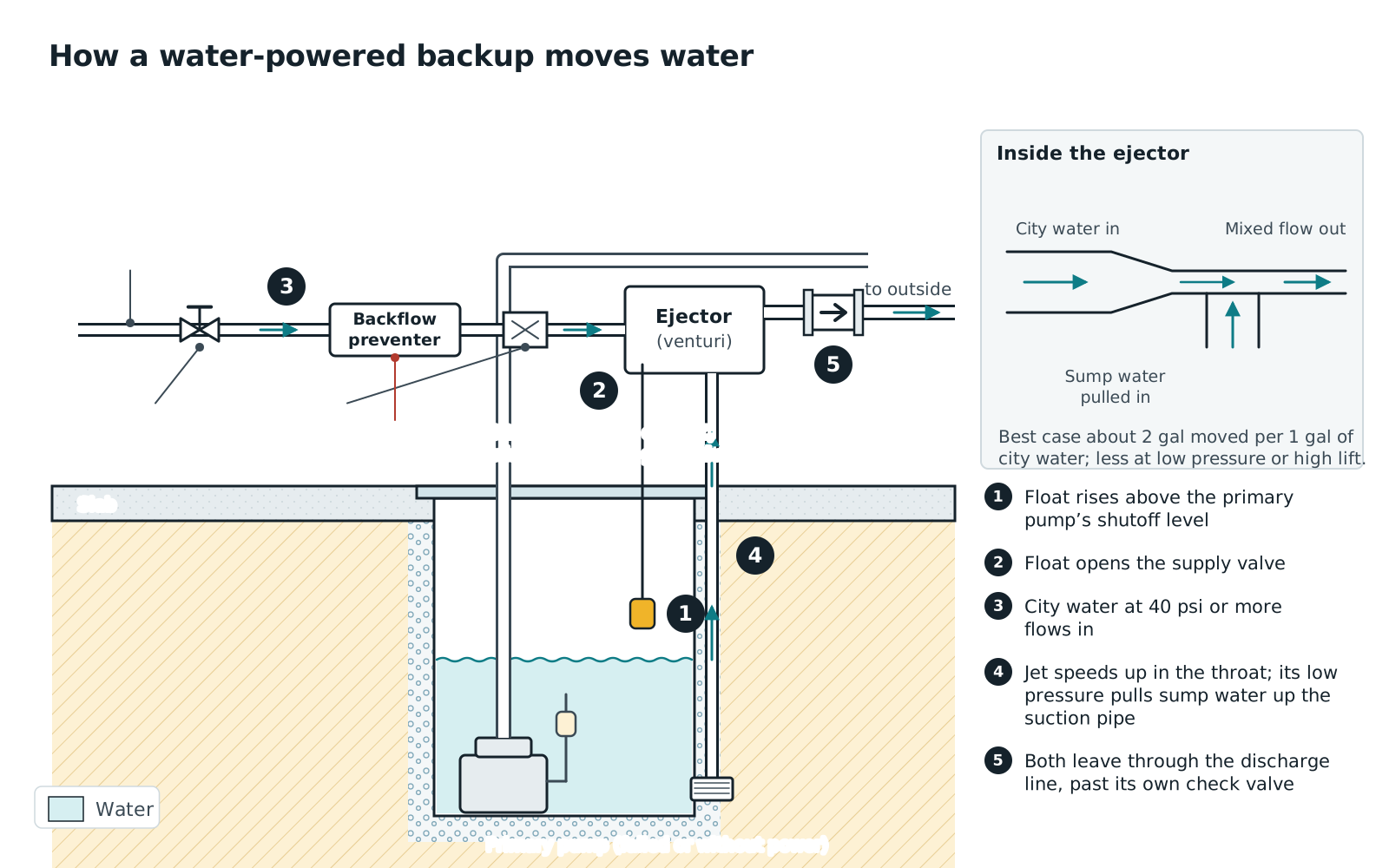
Every gallon a water-powered pump removes costs you a fraction of a gallon of treated city water, and you pay for that water, usually with a sewer charge on top. The ratio is the efficiency spec: Zoeller rates the Home Guard Max at up to 2 gallons removed per gallon used, Liberty rates the SumpJet at 2 to 1, and Basepump states a general 2-to-1 figure at 10 ft and 90 psi but does not publish a ratio for the RB750 specifically, so we leave that field unverified. Real-world ratios fall as pressure drops and as lift rises; treat 2:1 as the ceiling.
The arithmetic for your bill: at 60 psi the Home Guard Max moves 1,140 GPH at a 2:1 ratio, so it consumes about 570 gallons of city water per hour of running. Combined water and sewer rates vary widely by utility; check your bill. At an illustrative $10 per 1,000 gallons, an hour of continuous pumping costs about $5.70. A 24-hour outage with the pump running continuously would be roughly $137 of water; the same outage at a 10% duty cycle, which is what most pits actually do, is about $14. Set against a flooded finished basement, that is a rounding error, but you should know the number before the bill arrives.
Two details. First, a lower-flow pump with the same ratio does not save water; it just removes less per hour, and if it cannot keep up, the basement floods anyway. Second, some utilities will credit sewer charges for water that did not go to the sanitary sewer if you ask, and a few require a deduct meter to do it; a 3/4-inch meter is the minimum Basepump specifies regardless.
Minimum pressure, and what happens below it
Flow from a venturi falls fast with pressure. Zoeller's table for the Home Guard Max shows it plainly: 19 GPM at 10 ft on 60 psi, 12.7 GPM on 40 psi, a third less. Basepump's RB750 goes from 750 GPH at 60 psi to 700 at 40. Zoeller and Basepump both set 40 psi as the minimum; Liberty rates the SumpJet from 20 psi, which is why it is the low-pressure pick.
Measure before you buy. A gauge that threads onto a hose bib costs very little. Read it with no water running in the house (static pressure), then again with a shower and a faucet open (dynamic). If dynamic pressure is under 40 psi, the Liberty is your choice or none of these is. Houses on a pressure-reducing valve can sometimes raise the setting; check the plumbing fixtures' limits first.
Also think about what pressure does during a regional outage. Most municipal systems hold pressure from elevated storage and have backup power at pumping stations, which is why water-powered backups work at all, but neighborhoods at the end of a long main or at high elevation can see pressure sag when the grid is down and demand spikes. If your utility has issued boil-water notices after outages, that is a sign the system struggles, and a battery backup should be your first layer.
Backflow prevention and code
A water-powered backup connects your drinking water supply to a pit of groundwater. If supply pressure ever drops below the pressure in the pump, sump water can be siphoned back into the house plumbing and, in the worst case, the municipal main. That cross-connection is why every installation needs backflow protection, and why rules vary.
What the manufacturers provide differs. Basepump builds an ASSE 1024 dual-check backflow preventer into the RB750-EZ, and its -V vent model carries an ASSE 1012 device. Zoeller's data sheet for the Home Guard Max states that the backflow preventer and filter are supplied by others and notes that some districts require a reduced-pressure-principle assembly to ASSE 1013. Liberty's SJ10A page does not state what is included, so we show that field as unverified.
What your municipality requires is the deciding factor, and it genuinely varies. Some water utilities accept the manufacturer's integral dual-check device. Many require a reduced-pressure-zone (RPZ) assembly, installed by a licensed plumber, with annual testing by a certified tester at your cost. Some require a plumbing permit for any water-powered pump. A few prohibit them outright, usually where supply is constrained. Call your water utility's cross-connection control program, not the plumbing counter, and ask three questions: is a water-powered sump pump permitted, which ASSE device is required, and is annual testing required. Do that before you buy, because an RPZ assembly and its installation can cost as much as the pump.
Two more code items that come up on inspections: the discharge should run on its own line with its own check valve rather than teeing into the primary's riser, and the supply must come from the house side of the meter through a dedicated shutoff so the pump can be isolated for service.
What we skipped and why
Basepump HB1000-PRO and CB1500. Larger Basepumps rated 1,000 and 1,450 GPH at 10 ft. They are good options for faster pits and we will add them when we have documented their ratios; for this launch we covered the entry model each maker sells most.
Zoeller Home Guard 540. Zoeller's smaller water-powered model; the Max 503 is the one with the published performance table.
Generic and store-brand ejectors. Several sell on a zero-pressure or zero-head number with no table, no listed backflow device and no stated minimum pressure. A water-powered pump without a published pressure-and-head table cannot be sized, and one without a listed backflow device cannot be installed to code.
How we score
Every product gets a DryHomeLab score out of 10 from a published rubric for its category: the specs that matter (capacity, coverage, flow at head height, sensor response, warranty) are verified against manufacturer documentation and weighted by how much they affect real-world drying and protection. Where our restoration crews have run the gear, field notes can move a score by at most 1.5 points, and the note is published. We never use Amazon star ratings. Read the full methodology.
Frequently asked questions
Do water-powered sump pumps actually work?
Yes, within their limits. On 60 psi municipal water the Zoeller Home Guard Max moves 1,140 GPH at 10 ft of lift and the Basepump RB750 about 750 GPH, with no battery and no runtime limit. That covers a typical pit's storm inflow but not a high water table pit taking 20 GPM or more. They need municipal water (a well is off in the same outage), at least 40 psi for most models, and a backflow device your utility accepts.
How much water does a water-powered sump pump use?
Roughly one gallon of city water for every two gallons removed at best; Zoeller, Liberty and Basepump all quote up to 2:1 at good pressure, and the ratio falls as pressure drops or lift rises. A pump moving 1,140 GPH at 2:1 uses about 570 gallons per hour while running. At an illustrative combined water and sewer rate of $10 per 1,000 gallons, that is under $6 per hour of actual pumping, and most pits run a small fraction of each hour.
Do I need a backflow preventer for a water-powered sump pump?
Always, and the type depends on your water utility. Basepump builds an ASSE 1024 dual check into the RB750-EZ; Zoeller says the device for the Home Guard Max is supplied by others and that some districts require an ASSE 1013 reduced-pressure (RPZ) assembly. Many municipalities require an RPZ with annual certified testing regardless of what the pump includes, some require a permit, and a few prohibit water-powered pumps. Call your utility's cross-connection program before buying.
Can I use a water-powered backup on a well?
No. The pump runs on supply pressure, and a well pump needs electricity, so in the outage that stops your primary sump pump the well is off too. If you are on a well, your options are a battery backup sized for your inflow, a generator, or both. Our battery backup guide at /best/battery-backup-sump-pump covers runtime math and the systems we recommend.
Battery backup or water-powered: which should I install?
On a well, battery. On municipal water with 40 psi or more and long outages, water-powered is the lower-maintenance choice, but its flow is less than half a good battery unit's, so measure your inflow first. Under a finished basement we often install both: the battery backup moves more water for the first night and the water-powered unit keeps going after the battery is flat. If the basement is already wet, our crews respond 24/7 at /emergency.
DryHomeLab is written and reviewed by the team behind HelpMeNow.com, a marketplace that connects homeowners with vetted local contractors for water-damage restoration, plumbing and waterproofing. Before HelpMeNow the same team ran a 24/7 water-damage restoration company in the Seattle area; the equipment on this site is what we specified, bought and ran on real water losses. We publish the rubric behind every score.
- Ran a 24/7 water-damage restoration company, Seattle area
- Operate HelpMeNow.com, a contractor marketplace
- Publishes its scoring rubric