
Our picks

Zoeller M53 Mighty-Mate
The pump plumbers install in their own basements.
Cast iron, 1,550 RPM, 2,040 GPH at 10 ft, and the longest field life of any pump we see; the standard for a normal pit.
Wayne CDU980E
The most water per dollar at a real basement lift.
4,600 GPH at 10 ft, stainless and cast iron, 11-inch pit clearance and a 5-year warranty for about the price of a 1/3 HP pump.
Wayne CDU1000
The most flow at 10 ft of any pump we could document.
5,100 GPH at 10 ft and 3,840 GPH at 20 ft, the most flow at head we could document from a manufacturer curve.
Liberty Pumps 257
A one-piece cast iron 1/3 HP that fits where float arms will not.
A one-piece cast iron body with a vertical magnetic float that needs no swing room, drawing only 5.2 A.
Who this is for
This guide is for anyone replacing a primary sump pump, the AC pump that handles every gallon of groundwater that enters the pit, day in and day out. It is not about backups; those are covered in our battery backup and water-powered backup guides.
We approach this from the other end of the hose. Our crews extract and dry basements after pumps fail, and after enough of those jobs you learn which pumps you find still running at year twelve and which you find seized at year four with a cracked plastic housing. That experience shapes the picks here, but every number on this page comes from the manufacturers' own spec sheets and pump curves, and we score flow at 10 ft of head because that is what a basement discharge actually looks like.
If you do not know how much water your pit takes, stop and measure it first with our sizing calculator. The most common mistake we see is not a bad pump; it is a 1 HP pump short-cycling itself to death in a pit that needed a 1/3 HP, or a 1/3 HP pump running flat out in April in a pit that needed a 1/2. Ten minutes with a stopwatch during a hard rain tells you which pump on this page is yours.
A note on what we left out: pedestal pumps, thermoplastic budget pumps and anything whose maker publishes flow only at zero head. The reasons are at the end.
Compared at a glance
Scroll sideways on small screens. Scores are DryHomeLab scores out of 10; specs are from manufacturer documentation.
| Product | Score | Motor (HP) | Flow at 10 ft head (GPH) | Max head (ft) | Switch | Housing | Warranty (years) | |
|---|---|---|---|---|---|---|---|---|
| Zoeller M53 Mighty-Mate Best overall | 5.4 | 0.3 | 2,040 | 19.25 | vertical float | cast iron | 3 | Check price |
| Wayne CDU980E Best value | 9.1 | 0.75 | 4,600 | — | vertical float | cast iron/stainless | 5 | Check price |
| Wayne CDU1000 Best for high inflow | 9.1 | 1 | 5,100 | — | vertical float | cast iron/stainless | 5 | |
| Liberty Pumps 257 Best for narrow pits | 7.9 | 0.33 | — | — | vertical float | cast iron | 3 |
Paid links.
Zoeller M53 Mighty-Mate
The pump plumbers install in their own basements.
Score breakdown
| Flow at 10 ft of head | 2040 | 0.9 |
| Build material | cast iron | 10.0 |
| Switch reliability | vertical float | 9.0 |
| Warranty | 3 | 5.0 |
| Head capability | 19.25 | 2.8 |
| Efficiency (lower amps) | 9.7 | 2.9 |
| Cord length | 9 | 0.6 |
| Solids handling | 0.5 | 10.0 |
| Thermal protection | true | 10.0 |
- Cast iron switch case, motor housing and base shed heat into the water
- Slow 1,550 RPM motor runs cool and quiet
- Vortex impeller passes 1/2-inch solids without clogging
- Auto-reset thermal overload protects a pump that runs dry
- 9-ft cord is short for deep pits; longer-cord versions cost more
- 9.7 A draw is high for the flow it delivers
- Flow falls off steeply above 15 ft of lift
- 3-year warranty trails Wayne's 5 years
The M53 is the pump we find most often when we open a pit on a water loss in an older home, and usually it is still running. It is a 3/10 HP, 1,550 RPM cast iron submersible with a non-clogging vortex impeller that passes 1/2-inch solids, an integral float switch, and an auto-reset thermal overload. Zoeller rates it at 43 GPM (2,580 GPH) at zero head and 2,040 GPH at 10 ft, with a 19.25-ft shutoff.
Where it shines is longevity, not peak numbers. Cast iron on the switch case, motor housing and base dumps motor heat into the water, and the slow 1,550 RPM shaded-pole motor runs cool and quiet. On a typical basement lift of 8–12 ft it moves plenty of water for a normal pit fed by 4-inch drain tile.
Where it falls short: the 9-ft cord is short for a deep pit, the 9.7 A draw is high for a 3/10 HP motor, and once your lift gets near 15 ft the curve drops hard. If your inflow test on our sizing calculator shows more than about 30 GPM at 10 ft, step up to the M98 or a 3/4 HP Wayne.
Buy it if you have a standard 18-inch pit, under 12 ft of lift, and want the pump most plumbers install in their own basements. The 3-year warranty is shorter than Wayne's five, but field survival is the better number.
We don't copy Amazon reviews. Read customer reviews on Amazon (paid link).
Wayne CDU980E
The most water per dollar at a real basement lift.
Score breakdown
| Flow at 10 ft of head | 4600 | 10.0 |
| Build material | cast iron/stainless | 10.0 |
| Switch reliability | vertical float | 9.0 |
| Warranty | 5 | 10.0 |
| Head capability | n/a | — |
| Efficiency (lower amps) | n/a | — |
| Cord length | 8 | 0.0 |
| Solids handling | n/a | — |
| Thermal protection | true | 10.0 |
- 4,600 GPH at 10 ft on Wayne's own curve
- Stainless motor housing on a cast iron volute
- Fits basins 11 in and larger
- 5-year limited warranty
- Top-suction design pulls less silt
- 8-ft cord
- Running amps and solids handling not published
- Overkill for a slow pit; will short-cycle
- Wayne's own 10-ft figures differ between manual and web page
The CDU980E is a 3/4 HP submersible with a stainless steel motor housing on a cast iron volute, and Wayne's own curve puts it at 5,490 GPH at zero head and 4,600 GPH at 10 ft, still 3,500 GPH at 20 ft. That is more than double what a Zoeller M53 moves at the same lift, usually for similar money, which is why it is our value pick.
The design is top-suction: water enters above the base, so the pump is less prone to pulling in the silt that settles on the floor of a pit. The integrated vertical float turns on at 9 in and off at 4 in, with a solid polypropylene float that cannot waterlog. Wayne specifies it for basins 11 in in diameter and larger, which makes it one of the few 3/4 HP pumps that fits a narrow pit, and backs it with a 5-year limited warranty.
Where it falls short: the cord is 8 ft, the oil-filled motor has an automatic resetting thermal protector but Wayne does not publish running amps or solids handling, and the manual's performance table and the product page disagree slightly at 10 ft (4,600 vs 4,743 GPH; we use the lower manual figure). A 3/4 HP pump in a slow pit will short-cycle; size it with our calculator first.
Buy it if your pit fills fast in spring, you have a long discharge run, or you simply want the longest warranty on the shelf.
We don't copy Amazon reviews. Read customer reviews on Amazon (paid link).
Wayne CDU1000
The most flow at 10 ft of any pump we could document.
Score breakdown
| Flow at 10 ft of head | 5100 | 10.0 |
| Build material | cast iron/stainless | 10.0 |
| Switch reliability | vertical float | 9.0 |
| Warranty | 5 | 10.0 |
| Head capability | n/a | — |
| Efficiency (lower amps) | n/a | — |
| Cord length | 8 | 0.0 |
| Solids handling | n/a | — |
| Thermal protection | true | 10.0 |
- 5,100 GPH at 10 ft, 3,840 GPH at 20 ft
- Stainless motor housing on a cast iron volute
- Fits 11-in basins despite 1 HP
- 5-year limited warranty
- Short-cycles in ordinary pits
- Running amps not published; needs its own circuit
- 8-ft cord
- 1-1/2 in pipe throttles it on long runs
The CDU1000 is the 1 HP version of Wayne's stainless-and-cast-iron CDU line. Wayne's performance table gives 6,100 GPH at zero head, 5,100 GPH at 10 ft and 3,840 GPH at 20 ft, the highest 10-ft figure of any residential sump pump we could verify from a manufacturer document. The motor housing is stainless steel, the volute cast iron, the impeller glass-reinforced thermoplastic, and the oil-filled motor carries an automatic resetting thermal protector.
The switch is the same integrated vertical float as the CDU980E (on at 9 in, off at 4 in) with a solid polypropylene float, and Wayne specifies basins 11 in in diameter and larger. The discharge is 1-1/2 inch NPT, the cord is 8 ft, and the warranty is 5 years limited.
Where it falls short: 1 HP is more pump than most houses need. In a pit with modest inflow it will empty the basin in seconds and start again a minute later, which is hard on the switch and the check valve. Wayne does not publish running amps, and a 1 HP motor on a shared 15 A circuit is a bad idea. The cord is short and you will likely need a longer discharge pipe of 2 inch to get the rated flow over a long run.
Buy it for a pit that takes serious groundwater, a house on a hillside with a long or tall discharge, or as the primary in a duplex alternating setup. For everyone else, the CDU980E does the job for less.
Liberty Pumps 257
A one-piece cast iron 1/3 HP that fits where float arms will not.
Score breakdown
| Flow at 10 ft of head | n/a | — |
| Build material | cast iron | 10.0 |
| Switch reliability | vertical float | 9.0 |
| Warranty | 3 | 5.0 |
| Head capability | n/a | — |
| Efficiency (lower amps) | 5.2 | 8.5 |
| Cord length | 10 | 1.2 |
| Solids handling | 0.5 | 10.0 |
| Thermal protection | true | 10.0 |
- Vertical magnetic float needs no swing clearance; Liberty specifies it for smaller pits
- One-piece Class 25 cast iron body with no motor housing seal ring
- Draws only 5.2 A
- 10-ft cord standard, 25-ft optional
- Thermally protected PSC motor
- Flow at head is published only as a curve graphic; unverified here
- 1/3 HP is not enough for fast pits
- 3-year warranty
The 257 is Liberty's 1/3 HP sump pump with the Vertical Magnetic Float (VMF) switch, which Liberty specifies for smaller pits. Instead of a float on an arm swinging out from the pump, the float rides straight up a rod against the body, so the pump needs little more clearance than its own footprint. That is the reason it is our narrow-pit pick.
The body is a single casting of Class 25 cast iron with an epoxy powder coat, which eliminates the motor housing seal ring that leaks on two-piece pumps. The permanent split capacitor motor is thermally protected, permanently lubricated, and draws 5.2 A at 115 V, the lowest current of any pump in this class, which matters if the pump shares a circuit with a dehumidifier. It passes 1/2-inch solids through a 1-1/2 inch discharge, weighs 21 lb, and ships with a 10-ft cord (a 25-ft version is the 257-2). Liberty backs it with a 3-year warranty.
Where it falls short: Liberty publishes the performance curve only as a graphic, so we could not verify flow at 10 ft or shutoff head from text and show those fields as unverified rather than guess. A 1/3 HP pump is also not the answer for a high water table.
Buy it for a tight pit, a shallow lift, or a finished basement where low draw and a quiet one-piece body matter more than peak flow.
How to choose
Cast iron vs thermoplastic
A sump pump motor makes heat, and the only place that heat can go is into the water around the pump. Cast iron conducts it there; thermoplastic insulates it in. That is why cast iron pumps run cooler, cycle without tripping their thermal overload, and last longer. All four of our picks use cast iron where it matters: the Zoeller M53 and Liberty 257 are cast iron throughout, and the Wayne CDU980E and CDU1000 pair a stainless steel motor housing with a cast iron volute. Thermoplastic pumps are lighter and cheaper, and in a pit that runs a few times a week they can last; in a pit that runs every ten minutes in spring they are the ones we replace.
Within cast iron, the Zoeller M63 adds a cast iron impeller (the M53's is engineered plastic) and a 5-year warranty for a modest premium. The Liberty 257's one-piece casting eliminates the motor housing seal ring, a leak point on two-piece pumps.
Switch types
The switch is the usual failure point, so it is worth understanding the four kinds.
- Vertical float. A float rides up a rod or arm close to the pump body. It needs little clearance, which makes it the right choice for pits under 18 inches, and it cannot wander. All four picks use a vertical float; Liberty's VMF uses a magnet instead of a mechanical lever. Weaknesses: a short on-off range (the M53 turns on at 7-1/4 in and off at 3 in) means more cycles per hour in a fast pit.
- Tethered float. A float on a cord swings out from the pump and gives a long, adjustable cycle, which is good for big pits. It is the switch we most often find jammed against the pit wall or tangled in the discharge pipe. Fine in a 24-inch pit with nothing else in it; a liability in a crowded 18-inch pit.
- Diaphragm. A pressure-sensing diaphragm with no moving float. Compact and immune to snagging, but the diaphragm fatigues and fails closed or open with no warning.
- Electronic. Solid-state sensors with no moving parts, often with a controller that adds alarms. Reliable when well designed, but sensors foul with iron bacteria and oil film and need cleaning.
Flow at head, not at zero
Every box prints the zero-head number because it is the biggest. No installed pump sees zero head. Compare pumps at 10 ft, which is close to a typical basement discharge, and look at how fast the curve falls. Zoeller's M53 drops from 2,580 GPH at zero to 2,040 GPH at 10 ft and shuts off at 19.25 ft. Wayne's CDU980E goes from 5,490 to 4,600 at 10 ft and is still moving 3,500 GPH at 20 ft. If your lift is 15 ft or more, the slope of the curve matters more than its starting point, and the M98's 23-ft shutoff head or the Wayne curves become the deciding spec.
Horsepower
Horsepower is a loose proxy for flow and a poor one for current draw. Zoeller's 3/10 HP M53 pulls 9.7 A; its 1/2 HP M98 pulls 9.4 A and moves 3,660 GPH at 10 ft against the M53's 2,040. Liberty's 1/3 HP 257 pulls 5.2 A. Choose the class from your measured inflow: 1/3 HP for design flows under about 2,000 GPH at a 10-ft lift, 1/2 HP for 2,000 to 3,500 GPH or lifts of 12 to 18 ft, 3/4 to 1 HP above that or for long, tall discharges. Oversizing is not insurance; it is short-cycling, and short-cycling kills switches.
Cord length
All of these pumps ship with short cords: 8 ft on the Waynes, 9 ft on the Zoellers, 10 ft on the Liberty. The cord has to reach from the bottom of the pit to an outlet without an extension cord, which is both a code issue and the single most common source of a nuisance-tripped GFCI. Measure before you buy. Zoeller sells the M53 with 15, 25 and 35-ft cords and Liberty sells the 257-2 with 25 ft; if the outlet is more than about 6 ft from the pit rim, order the long cord.
Check valves
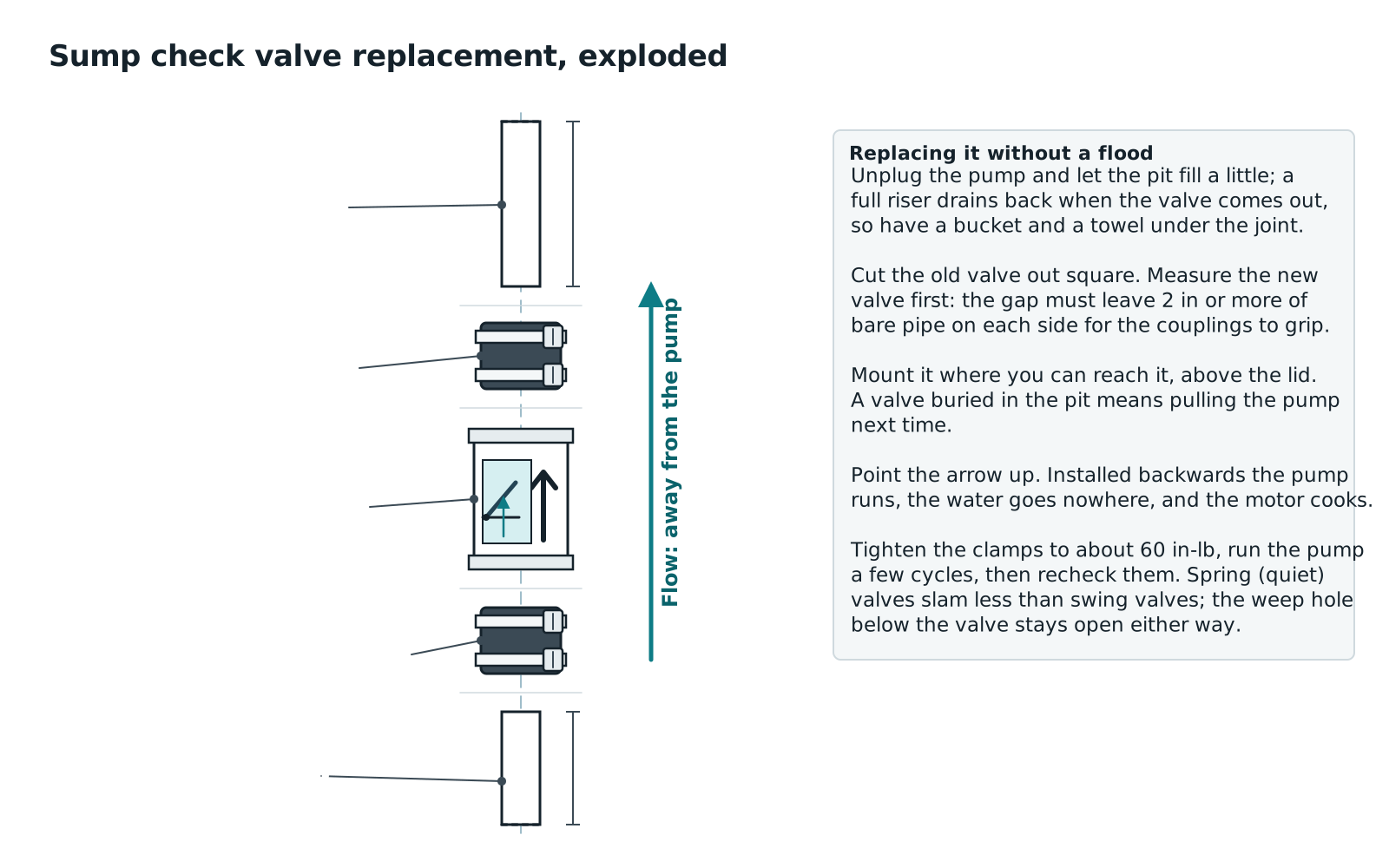
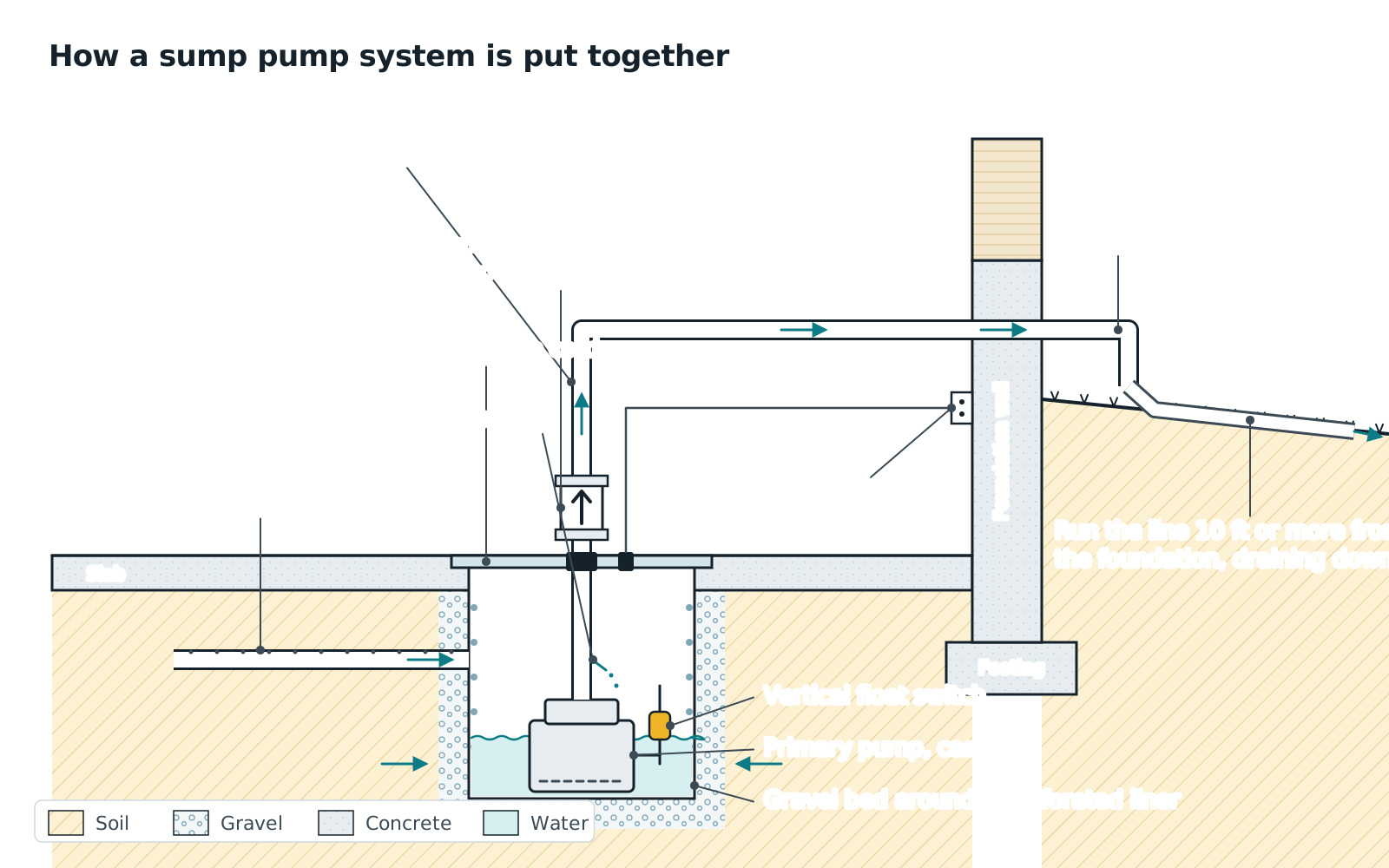
A check valve keeps the water in the discharge pipe from falling back into the pit when the pump stops. Without one the pump re-pumps the same column of water every cycle and short-cycles. Install it 12 to 18 inches above the pump with unions so it can be replaced, use a quiet spring-loaded valve under finished rooms, and note that it adds the equivalent of 10 to 12 ft of pipe friction to your head calculation. Wayne states a check valve is required and not included; the same is true in practice for every pump here.
Replacement interval
Plan on 7 to 10 years for a quality cast iron pump in a normal pit, less in a pit that runs constantly or takes grit, and replace on schedule rather than on failure. A pump that is ten years old and still running is a pump that is going to stop in a storm. The warranty tells you something about the maker's confidence: 3 years on the Zoeller M53 and M98 and the Liberty 257, 5 years on the Zoeller M63 and on Wayne's stainless and cast iron CDU line. In our experience the Zoellers outlast their warranty by the widest margin, which is why the M53 is the overall pick despite the shorter paper coverage.
Sump pump sizing calculator
Measure once during a hard rain: unplug the pump, time the rise for 60 seconds, plug it back in. Then enter the discharge path.
- Measured inflow 1.1 GPM; design flow with storm factor 10.0 GPM.
- Total dynamic head 13.0 ft (lift 9 ft + pipe friction 0.0 ft + fittings). Read the pump's curve at this head, not the headline GPH.
- For a finished basement add a battery backup rated for at least this flow, and a high-water alarm.
- Wayne CDU980EScore 9.1 · 0.75 HP · 4600 GPH @10 ftCheck price
- Wayne CDU1000Score 9.1 · 1 HP · 5100 GPH @10 ft
- Liberty Pumps 257Score 7.9 · 0.33 HP · ? GPH @10 ft
- Zoeller M98 Flow-MateScore 6.7 · 0.5 HP · 3660 GPH @10 ft
- Paid links.
Installing it right
- 1
Clean and level the pit
Pull the old pump, scoop the silt and iron sludge off the bottom, and set the new pump on a flat paver or the basin floor, never on loose gravel that can be drawn into the impeller. Make sure the float can travel its full range without touching the wall, the pipe or a second pump.
- 2
Plumb 1-1/2 inch PVC with a serviceable check valve
Use the pump's full 1-1/2 inch discharge size all the way out of the house. Install the check valve 12 to 18 inches above the pump with unions on both sides, drill a 3/16-inch weep hole in the riser below the check valve and above the pump to prevent air lock, and use long-sweep elbows.
- 3
Get the discharge away from the foundation
Run the outside line at least 10 ft from the house and downhill, with a freeze-resistant outlet or an air gap so an iced-over pipe does not dead-head the pump. Water dumped at the foundation is back in the pit in minutes.
- 4
Power, lid, alarm, test
Plug into a dedicated outlet, not an extension cord, following your local code on GFCI protection. Fit a sealed lid to keep debris and radon out and noise in. Add a high-water alarm, then test by filling the pit with a hose until the pump starts, stops, and the check valve holds. Write the install date on the lid.
What we skipped and why
Zoeller M98 and M63. Both are in the comparison table and both are pumps we install. The M98 is the heavy-duty cast iron answer for 15 to 20 ft lifts and is a fine alternative to the Wayne CDU980E; it lost the high-inflow slot on documented flow at 10 ft (3,660 GPH against Wayne's 4,600 and 5,100) and on warranty (3 years against 5). The M63 is an M53 with a cast iron impeller and a 5-year warranty; if the price gap is small, buy it instead of the M53.
Superior Pump 92341. A popular budget cast iron pump that we could not verify against a manufacturer spec sheet; Superior's product pages blocked retrieval. We do not publish specs we cannot source, so it is out until we can document it.
Pedestal pumps. The motor sits above the pit on a column, which makes them cheap and easy to service, and loud, prone to float snags, and limited in flow. They have a place in a shallow pit that runs rarely. We do not put them under finished space.
Thermoplastic budget pumps. Lighter, cheaper, and the ones we most often find cracked or thermally tripped on water-loss calls. In a pit that runs a few times a week they can last; for anything that cycles in spring, spend the extra on cast iron.
How we score
Every product gets a DryHomeLab score out of 10 from a published rubric for its category: the specs that matter (capacity, coverage, flow at head height, sensor response, warranty) are verified against manufacturer documentation and weighted by how much they affect real-world drying and protection. Where our restoration crews have run the gear, field notes can move a score by at most 1.5 points, and the note is published. We never use Amazon star ratings. Read the full methodology.
Frequently asked questions
Is a 1/3 HP sump pump enough?
For most basements, yes. A quality 1/3 HP cast iron pump like the Zoeller M53 moves about 2,040 GPH at 10 ft of head, which covers a typical suburban pit through a hard rain. Step up to 1/2 HP when a stopwatch test during a storm shows design flow above roughly 2,000 GPH, when the lift is more than 12 to 15 ft, or when the pump already runs more than about six minutes per hour. Our calculator at /tools/sump-pump-sizing-calculator walks through the measurement.
How long do sump pumps last?
A good cast iron submersible lasts 7 to 10 years in a normal pit, and we regularly find Zoeller M53s running at 12 to 15. Pumps in pits that cycle constantly, take grit, or short-cycle because they are oversized fail sooner, often at the switch rather than the motor. Replace proactively at around the 10-year mark; a pump that has never failed is still a pump that will fail during a storm.
Cast iron or stainless steel sump pump?
Both beat thermoplastic. Cast iron conducts motor heat into the pit water best and is the traditional choice; stainless resists corrosion and is used by Wayne for the motor housing over a cast iron volute. We rate cast iron and cast iron/stainless equally. What you want to avoid is a thermoplastic motor housing on a pump that runs often, because it traps heat and trips the thermal overload during exactly the storms you bought it for.
What is the difference between the Zoeller M53 and the M63?
They share the same 3/10 HP, 9.7 A motor, 43 GPM maximum flow, 2,040 GPH at 10 ft and 19.25-ft shutoff. The M63 is Zoeller's Premium Series: it uses a cast iron impeller instead of engineered plastic, stainless hardware, and carries a 5-year warranty instead of 3. Buy the M63 for a gritty pit or if the price gap is small; the water moved is identical.
Do I need a check valve on a sump pump?
Yes. Without one, the water standing in the discharge pipe drains back into the pit every time the pump stops, so the pump re-lifts the same water and short-cycles. Install the valve 12 to 18 inches above the pump with unions, drill a small weep hole in the riser below it to prevent air lock, and account for its friction (roughly the equivalent of 10 to 12 ft of pipe) when you size the pump.
Why does my sump pump run constantly?
Either the pit is taking more water than the pump can move at your head, or the pump is moving water that comes right back. Check the discharge: a failed check valve, a discharge that dumps next to the foundation, or a frozen outlet all recycle water. Then measure inflow with the pump unplugged for one minute. If the inflow genuinely exceeds the pump's flow at your lift, you need the next class up, a second pump, or a larger pit. If the basement is already wet, call our crews at /emergency.
What size pit do these pumps need?
Wayne specifies 11 inches or larger for the CDU980E and CDU1000, and the Liberty 257's vertical magnetic float is designed for small pits. Zoeller does not publish a minimum for the M53. In practice an 18-inch diameter basin is the minimum we recommend for a primary pump with room for a backup and a second float, and a 24-inch basin gives a longer cycle and fewer starts per hour.
DryHomeLab is written and reviewed by the team behind HelpMeNow.com, a marketplace that connects homeowners with vetted local contractors for water-damage restoration, plumbing and waterproofing. Before HelpMeNow the same team ran a 24/7 water-damage restoration company in the Seattle area; the equipment on this site is what we specified, bought and ran on real water losses. We publish the rubric behind every score.
- Ran a 24/7 water-damage restoration company, Seattle area
- Operate HelpMeNow.com, a contractor marketplace
- Publishes its scoring rubric