
Before you start: what kind of water is this?
The first decision on every water loss is not which fan to buy. It is whether you should be in the room at all.
Electricity. If water is anywhere near outlets, the furnace, the water heater or an extension cord, do not step in it until the power to the basement is off at the panel. If the panel itself is in the basement and you would have to wade to reach it, call the utility or an electrician; this is not a judgment call. Once the power is off, a flashlight and rubber boots are the minimum.
Category of water. The IICRC S500 standard, the document restoration contractors and insurers work from, sorts water into three categories, and the category decides whether this is a project or a phone call.
- Category 1, clean water: a broken supply line, a water heater, a tub overflow with no soap or contamination. This is what you can dry yourself.
- Category 2, significantly contaminated: a washing machine or dishwasher discharge, a toilet overflow with urine but no feces, a sump pit backing up, or Category 1 water that has sat for a couple of days in a warm basement. You can still do much of this yourself with gloves, eye protection and an N95, but porous materials it touched (carpet pad, particleboard, drywall) generally come out rather than dry.
- Category 3, grossly contaminated: sewage, a toilet overflow with feces, water that rose from outside (river, storm, ground water through the wall), or any water that has been standing for days. Do not dry this yourself. Everything porous it touched is removed under containment, and the structure is cleaned and disinfected before drying. Call a crew.
A good rule: if the water came up from a drain or in from outside, or if you cannot say when it started, treat it as Category 3.
Volume. Our line for a homeowner project is one room, under about 2 in of clean water, found within a day. More than that is a crew job, and the sooner they start the less gets demolished.
If you are past any of those lines, skip to the end of this page and call. If not, here is the 72-hour plan.
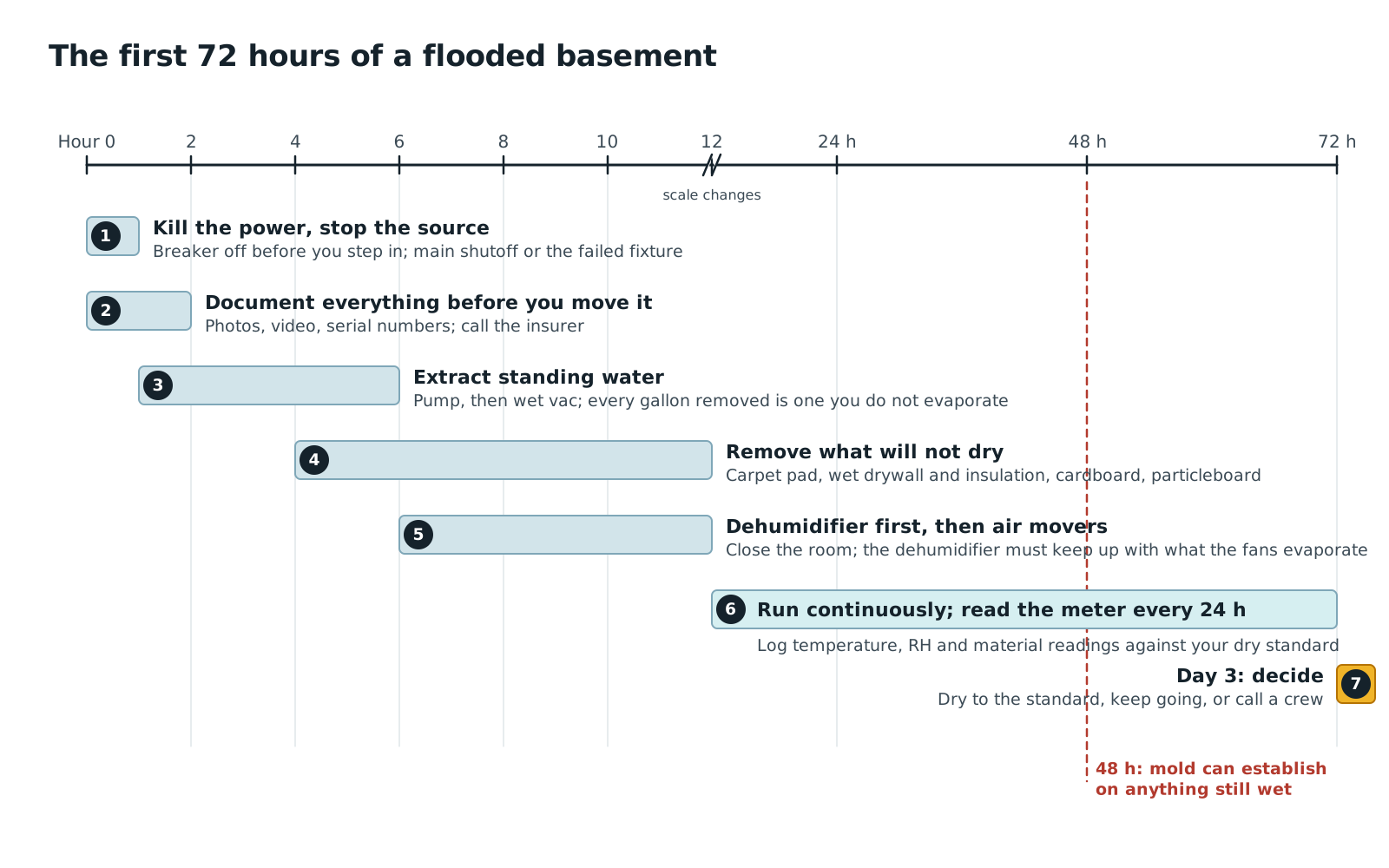
The 72-hour sequence
- 1
Hour 0–1: kill the power, stop the source
Power off at the panel for any circuit serving the wet area, or the whole basement if you are not sure. Then stop the water. For a supply-line failure, close the fixture valve or the main shutoff, which is usually where the water line enters the house near the meter or the water heater. For a water heater, close the cold inlet valve on top of the tank and turn off its gas or breaker. For a sump failure, do not touch a pump standing in water with the power on. For ground water coming through the walls, there is nothing to shut; your job is to pump faster than it comes in, and that usually means a crew.
- 2
Hour 0–2: document everything before you move it
Your insurance adjuster was not there. Photograph the whole room from each corner, then every damaged item, then the water line on the walls and on furniture legs, then the source of the water. Take video walking through. Note the date and time you found it and the date and time you stopped the source. Keep every receipt from here on: rental equipment, a wet-dry vac, contractor bags, a moisture meter. Do not throw anything out until it is photographed; set ruined items in the garage or driveway in a pile the adjuster can see. Call the insurer the same day; most policies require prompt notice and reasonable steps to prevent further damage, and renting fans is exactly that step.
- 3
Hour 1–6: extract standing water
Every gallon you pull out with a pump or a vacuum is a gallon your dehumidifier does not have to pull out of the air over the next three days. For more than an inch of standing water, a submersible utility pump with a garden hose to a floor drain, a laundry sink or outdoors. For the rest, a wet-dry vacuum, emptied often. On carpet, go slowly and overlap passes; a wand pushed down hard pulls water out of the pad. Keep extracting until the vacuum stops pulling water, then do the wettest areas once more. Move furniture out of the room or put foil or plastic under its legs; furniture stain and rust wick into wet carpet within hours.
- 4
Hour 4–12: remove what will not dry
This is the step homeowners skip and regret. Carpet pad holds water like a sponge and does not dry in place; pull the carpet back from the walls, cut the pad into strips, bag it and photograph it. The carpet itself can often be dried and relaid over new pad if the water was clean. Baseboard comes off every wet wall; score the caulk line, pry gently, number the pieces. Behind it, drill 3/8 in holes through the drywall every 16 in just above the sole plate so air can get into the wall cavity. Drywall that has wicked water more than a few inches up is removed in a flood cut: find the highest wet reading with a moisture meter, and cut a straight line 12 to 24 in above the visible water line so the cut lands above the wet zone and on a line that is easy to patch. Pull the wet insulation behind it; wet fiberglass does not dry in a wall. Particleboard and MDF (cabinet toe kicks, shelving, some baseboard) swell and are done. Bag debris in contractor bags and get it out of the house, not into the garage next to the furnace return.
- 5
Hour 6–12: set the dehumidifier first, then the air movers
Close the room off from the rest of the house: doors shut, HVAC supply and return in that room taped over so you are not pulling wet air through the furnace. Set the dehumidifier in the middle of the room with its drain hose running to a sink, a floor drain or a window, and start it before the fans so the air is already drying when evaporation picks up. Then place air movers around the perimeter: one per 10 to 16 linear feet of wet wall, each angled 15° to 45° to the wall so the air runs along it, all pointing the same direction so the air circles the room, plus one for each closet or alcove. For wet carpet that is staying, tuck the outlet of one centrifugal fan under the carpet edge to float it. Keep fans and dehumidifier on separate circuits; see the counts in the air mover guide. Use the planner below to size the dehumidifier and count the fans.
- 6
Day 1–3: run continuously and read the meter every 24 hours
Do not turn anything off at night. Mark a grid of reading points on painter's tape (every 2 ft along each wall at 6 in, 18 in and 30 in up, plus the subfloor at the wettest corner) and read them at the same time each day with the same meter on the same setting, photographing the display. Readings should fall every day. Empty or check the dehumidifier drain. If the room feels cold and clammy, the dehumidifier is undersized or the room is not sealed; if it is hot and muggy, add dehumidification, not fans. Expect drywall and carpet in a clean loss to approach dry standard on day three; framing and subfloor take longer.
- 7
Day 3: decide
Compare every reading with your dry standard from an unaffected area of the house. Done means the wet readings match the dry standard within a couple of points and hold there the next day. If most points are done and one wall is not, leave two fans and the dehumidifier on that wall and keep reading. If readings have stopped falling for two days anywhere, there is still a source or there is trapped water in a cavity you have not opened, and it is time to call. Once everything is dry, leave the dehumidifier running another two days, then rebuild: new pad, drywall patches, primer rated for stain blocking, baseboard.
Drying planner: how many fans and how much dehumidifier
The same math our crews use on a water loss. It also tells you when to stop and call someone.
- Run 5 air movers aimed along the walls at 15–45°, one every 10–16 ft of wet wall, with a large dehumidifier rated at least 48 pints/day in the closed room.
- Pull the carpet pad if it is wet; pad does not dry in place. Lift carpet edges and float air under it.
- Check with a moisture meter daily; you are done when readings match an unaffected area, usually 3–5 days.
- Dri-Eaz Velo Pro Low Profile Air MoverScore 6.2 · 885 CFMCheck price
- Paid links.
See our dehumidifier picks.
Placement, in more detail
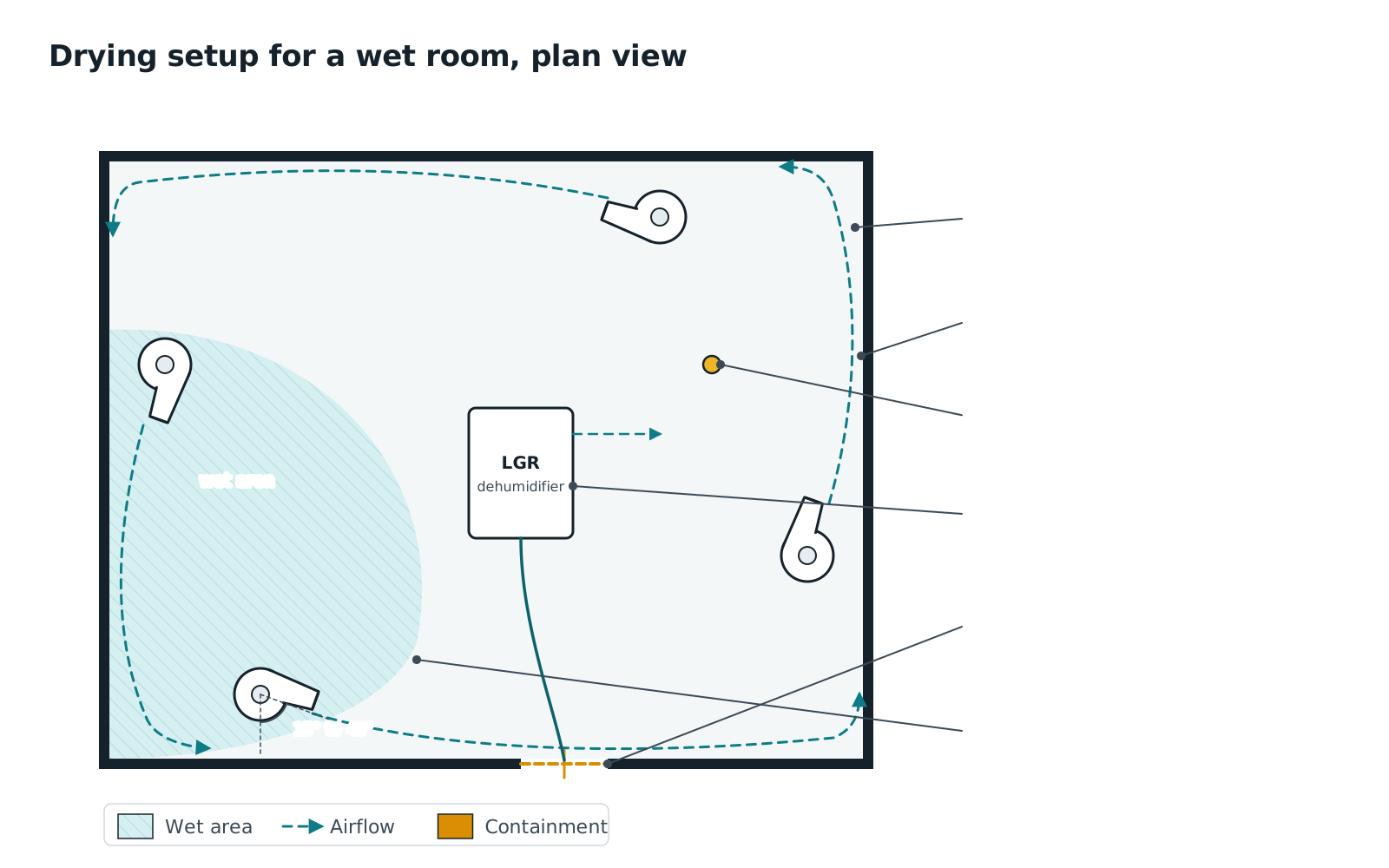
The S500 sizes drying by placement and by the class of the loss, not by the CFM on the fan; the drying planner explains the four classes. Most basement losses from a supply line are Class 2; ground-water and overhead losses are usually Class 3.
For a Class 2 room, the air mover count is one per 10 to 16 linear feet of wet wall plus one per closet or offset, with the dehumidifier sized from the room volume. A 20 x 14 ft room with three wet walls has about 48 linear feet of wet wall: three to five air movers. The dehumidifier for that room, 2,240 cu ft at 8 ft ceilings, is an LGR in the 45 to 80 pints-per-day range at the AHAM rating, which is why consumer dehumidifiers rated 50 pints at the newer DOE test (a less humid test condition) often fall short on an active loss. Our drying planner does the arithmetic.
A few placement rules that matter more than the count:
- Fans go along walls, not in the middle of the room. The wet material is at the base of the wall and under the carpet, so that is where the air should run.
- Angle the outlet at the wall, 15° to 45°, so the airstream sweeps the surface. Blowing straight at a wall leaves a dead spot and pushes moisture into the cavity.
- Everything points the same direction around the room. Opposing fans cancel each other out.
- Keep air movers out of standing water and off GFCI outlets that are tripping.
Equipment list
For a one-room clean-water loss, this is the kit:
- A submersible utility pump with a garden-hose fitting, or a wet-dry vacuum of at least 12 gallons, or both.
- Three to five air movers. Rent them for a one-time loss; buy compact units if your basement has done this before.
- One LGR or a large consumer dehumidifier with a drain hose, sized from the planner. Rent an LGR if the room is bigger than about 300 sq ft.
- A moisture meter; buy it, you will use it for years. See the best moisture meters.
- A utility knife, a flat bar, a drill with a 3/8 in bit, contractor bags, painter's tape, nitrile gloves, eye protection and an N95.
- Twelve-gauge extension cords, enough to reach a second and third circuit.
The two pieces we are asked to recommend most often are below: the air mover our crews buy, and the dehumidifier that makes sense for a homeowner to own rather than rent.
Dri-Eaz Velo Pro Low Profile Air Mover
The fan restoration crews buy by the pallet, with an amp dial that fits ten on one circuit.
Score breakdown
| Airflow | 885 | 0.4 |
| Amps per fan | 1.9 | 8.9 |
| Warranty | n/a | — |
| Positioning options | 5 | 10.0 |
| Daisy-chain outlets | true | 10.0 |
| Portability | 18.6 | 6.6 |
| Durability | plastic | 5.0 |
| Stackable | true | 10.0 |
| Quietness | 69 | 4.4 |
- Adjustable 1.2–1.9 A draw lets you balance several fans on one 15 A circuit
- Five operating positions cover floors, walls, stairs and cabinets
- Daisy-chain dual outlet; Dri-Eaz says up to ten units per 15 A circuit
- 18.6 lb with a built-in handle, and they stack six high on a hand truck
- 69 dB average is quiet for a professional air mover
- 885 CFM maximum is far less than a centrifugal unit; it needs company on big carpet
- Priced for contractors, roughly three times a hardware-store utility fan
- Dri-Eaz does not publish the warranty term on the product page; check the warranty document before buying
This is the fan on our trucks and in most rental yards. Buy it if your basement has flooded more than once; otherwise rent this exact model. The adjustable 1.2–1.9 A draw lets five or six run around a basement room on one circuit with the dehumidifier on another, and the five positions cover carpet, wall bases and stairs. For small one-time jobs, a pair of XPOWER P-230ATs costs far less.
AlorAir Storm LGR Extreme Dehumidifier
The LGR homeowners can actually afford to own: 85 pints at AHAM, 5.4 amps, five-year warranty.
Score breakdown
| Moisture removal | 85 | 2.5 |
| Saturation capacity | 180 | 3.3 |
| Current draw | 5.4 | 9.4 |
| Warranty | 5 | 8.0 |
| Portability | n/a | — |
| Internal pump | true | 10.0 |
| Stackable | n/a | — |
| Drain hose length | n/a | — |
- 85 pints/day AHAM and 180 at saturation for about a third of the price of the big names
- 5.4 A, the lowest draw in our list
- Internal condensate pump
- Five-year warranty
- Capacity suits one or two rooms; two units for a whole basement
- Manufacturer documents we verified omit weight and hose length
- Build quality and pump longevity trail Dri-Eaz and Phoenix
- Saturation rating has changed between spec sheet versions (190 vs 180)
For a homeowner who will own the dehumidifier rather than rent, the Storm LGR Extreme is the one that makes sense: 85 pints a day at the AHAM rating, 180 at saturation, a 5.4 A draw that shares a circuit with air movers, an internal pump and a five-year warranty, at about a third of the cost of the Dri-Eaz and Phoenix units crews use. It covers a Class 2 room up to roughly 350 sq ft alone; a whole finished basement needs two, or a rented Dri-Eaz LGR 7000XLi.
What the readings mean, and when you are done
A basement is dry when a moisture meter says the materials have returned to their dry standard, the reading you took in an unaffected part of the house before you started, and not before. Typical numbers, with your dry standard overriding them: framing and subfloor read about 8 to 14% when dry and are wet above 16%; wood above roughly 19 to 20% can support mold; dry drywall reads under about 1% on a gypsum scale. Concrete readings are relative. The moisture meter guide covers the scales.
The surface of a carpet or a wall feels dry within a day. That tells you nothing about the pad, the sole plate or the back of the drywall, which is where the mold grows. The meter does. Read the same marked points daily, photograph the display, and keep the log; it is the evidence that the drying worked if a claim or a sale comes up later.
The mold timeline
The EPA's guidance on mold and moisture in homes puts the start of mold growth on wet materials at 24 to 48 hours, and restoration practice treats 72 hours as the point where a clean-water loss that has not been dried becomes a mold job as well. That is where the title of this guide comes from. It does not mean a basement must be bone dry by hour 72; it means the standing water must be out, the materials that cannot be saved must be gone, and the air must be drying by then, so that the materials that remain are below the moisture level mold needs before colonies establish.
If you are already past 72 hours when you read this, do not scrub visible growth with bleach and call it done. The EPA's guidance is that areas of growth larger than about 10 sq ft, or any growth from contaminated water or inside HVAC, call for professional remediation. Smaller patches on hard surfaces can be cleaned by a homeowner wearing an N95, gloves and eye protection, after the moisture problem is fixed. Growth on drywall or insulation means those materials come out.
When to stop and call a crew
Call if any of these are true:
- The water is Category 3: sewage, rising ground water, or water that has been standing for days.
- The wet area is more than one room, or finished walls are wet on more than two sides.
- Water reached the furnace, the electrical panel or a gas appliance.
- Readings stop falling for two days while fans and the dehumidifier run.
- You find mold growth larger than a bath mat, or any growth inside a wall cavity or duct.
- The loss is going through insurance and the adjuster asks for drying logs, psychrometric readings or a moisture map you cannot produce.
- You have hardwood floors, plaster walls or a slab with flooring over it that got wet. These are Class 4 materials and need specialty equipment.
A restoration crew brings extraction, a moisture map, the right count of equipment on day one, and the paperwork the insurer expects. The cost of a crew on day one is usually less than the cost of a crew on day six, because less has to come out.
Rebuilding and preventing the next one
Once everything reads dry and holds for a day, leave the dehumidifier running two more days while you rebuild: new pad, cleaned and relaid carpet, new drywall with a stain-blocking primer, the numbered baseboard with fresh caulk. Then fix the cause: braided stainless supply hoses, a battery backup on the sump, a water heater past ten years replaced, and for a basement that is damp every spring, a permanent unit from our basement dehumidifier picks. Keep the moisture meter and check the same spots after the next heavy rain.
Frequently asked questions
How long does it take to dry out a flooded basement?
With standing water extracted, wet pad and saturated drywall removed, and air movers plus a dehumidifier running continuously, drywall and carpet in a clean-water loss usually reach their dry standard in three to five days. Framing, subfloor and hardwood take a week or more. Without equipment, a basement does not reliably dry at all; it just stops looking wet, which is how mold and rot start behind finished walls.
Can I dry a flooded basement myself?
If the water was clean (a supply line, a water heater), the area is about one room, it was found within a day, and you can rent three or four air movers and a large dehumidifier, yes. If the water came from a drain or from outside, has been standing for days, covers more than one room, or reached the furnace or panel, no. The IICRC S500 category and class of the loss, explained at the top of this guide, is the line.
How high should I cut wet drywall?
Find the highest wet reading with a moisture meter, then cut a straight line 12 to 24 in above the visible water line so the cut is above the wicked zone and on an even line that is easy to patch. Remove wet insulation behind it. Drywall that wicked only an inch or two can sometimes be dried in place by pulling the baseboard and drilling vent holes near the floor, but drywall that has been soaked rarely reads dry again and comes out.
Do I need a dehumidifier or are fans enough?
You need both. Air movers move water out of the materials into the air; a dehumidifier takes it out of the air. Fans alone in a closed basement raise the humidity until evaporation stalls and the moisture condenses on cold walls and windows. For one room a large consumer unit draining to a sink can work; for anything bigger rent an LGR, and size it with the drying planner rather than by the number on the box.
Will my insurance cover a flooded basement?
Usually for sudden, accidental water from inside the house (a burst pipe, a failed water heater) and usually not for ground water, surface flooding or sewer backup unless you bought those endorsements. Either way, document before you clean, call the insurer the same day, keep receipts for rental equipment and materials, and keep a daily log of moisture readings with photos. Policies require you to take reasonable steps to prevent further damage; renting fans is that step.
How do I know if mold is already growing?
You cannot see early growth behind drywall, and a moisture meter does not detect mold, only the wetness it needs. Assume that any porous material that has been wet for more than 48 to 72 hours has growth starting, which is consistent with EPA guidance on how quickly it begins. A musty smell, staining that spreads, or visible fuzz on the back of baseboard confirms it. Small patches on hard surfaces can be cleaned by a homeowner with protective gear after the moisture is fixed; growth on drywall or insulation means removal, and areas larger than about 10 sq ft are a job for a remediation contractor.
DryHomeLab is written and reviewed by the team behind HelpMeNow.com, a marketplace that connects homeowners with vetted local contractors for water-damage restoration, plumbing and waterproofing. Before HelpMeNow the same team ran a 24/7 water-damage restoration company in the Seattle area; the equipment on this site is what we specified, bought and ran on real water losses. We publish the rubric behind every score.
- Ran a 24/7 water-damage restoration company, Seattle area
- Operate HelpMeNow.com, a contractor marketplace
- Publishes its scoring rubric