
Our picks

Basement Watchdog Big Dog CONNECT
The strongest charger and the most water of the dedicated backups.
2,200 GPH at 10 ft, a 20 A multistage charger and a weekly self-test; the backup that is ready for the second storm.
Basement Watchdog Special CONNECT
The affordable backup that still moves real water.
1,850 GPH at 10 ft and 48 hours of intermittent runtime on one battery for the least money of any real backup.
Zoeller Aquanot Fit 508 ProPak with M53
A pre-piped M53 and a Wi-Fi backup, built by the same company.
A factory pre-piped M53 primary and Wi-Fi 508 backup that keeps the primary's full 2,040 GPH at 10 ft when the power is out.
PumpSpy PS2000 Wi-Fi Battery Backup System
The backup that watches your primary pump too.
2,400 GPH at 10 ft and a controller that monitors your primary pump's power draw, not just its own battery.
Who needs a backup sump pump
A primary sump pump fails in exactly the conditions you bought it for. Heavy rain saturates the ground, the pit fills faster than it has all year, and the same storm drops a line somewhere and the pump goes quiet. On the spring water losses we respond to, a primary pump that lost power or quit is the most common cause we find, ahead of burst supply lines. The water does not need a dramatic failure: a tripped GFCI, a float stuck against the pit wall, or a 12-year-old motor that finally seized will do it.
You need a backup if any of these describe your house:
- The basement is finished. Carpet, drywall and a family room turn a two-inch pit overflow into a five-figure loss and a two-week drying job. Bare concrete and a floor drain forgive a lot; finished space forgives nothing.
- Outages come with storms. If your utility drops power during the same weather that fills the pit, a primary pump alone is a plan to flood.
- The pit runs year-round. A high water table means the pump is the only thing between you and groundwater every day, not just during a cloudburst. A backup covers the failure of the pump itself, not only the power.
- You travel, or the house is a rental. A pump that dies on a Tuesday in March will not be found until the weekend.
- The primary is over 7 years old. Switch and motor failures climb sharply in year seven to ten, and the backup buys you time to replace it on your schedule.
You can reasonably skip a backup if the pit stays dry most of the year, only runs during a downpour, and the basement is unfinished concrete with a working floor drain. Even then, a high-water alarm costs very little and tells you the day the primary quits. If you are deciding on the primary pump itself, start with our best sump pump guide and our sizing calculator.
Compared at a glance
Scroll sideways on small screens. Scores are DryHomeLab scores out of 10; specs are from manufacturer documentation.
| Product | Score | Flow at 10 ft head (GPH) | Runtime, intermittent (hours) | Battery | Battery included | App alerts | Warranty (years) | |
|---|---|---|---|---|---|---|---|---|
| Basement Watchdog Big Dog CONNECT Best overall | 4.4 | 2,200 | 40 | 12 V deep-cycle, AGM (BW-27AGM) or wet-cell, Group 27 | No | No | 2 | |
| Basement Watchdog Special CONNECT Best value | 3.3 | 1,850 | 48 | 12 V deep-cycle, AGM (BW-27AGM) or wet-cell, Group 27 | No | No | 2 | |
| Zoeller Aquanot Fit 508 ProPak with M53 Best combo system | 5.9 | 2,040 | 48 | 12 V deep-cycle, Group 27/29/31 (AGM compatible) | No | Yes | 3 | |
| PumpSpy PS2000 Wi-Fi Battery Backup System Best with app alerts | 7.3 | 2,400 | — | — | — | Yes | — | See it at PumpSpy |
Paid links.
Basement Watchdog Big Dog CONNECT
The strongest charger and the most water of the dedicated backups.
Score breakdown
| Flow at 10 ft of head | 2200 | 6.0 |
| Runtime | 40 | 1.7 |
| Warranty | 2 | 2.5 |
| App alerts | false | 0.0 |
| Audible alarm | true | 10.0 |
| Charger strength | 20 | 10.0 |
| Battery included | false | 0.0 |
| Automatic self-test | true | 10.0 |
| Primary pump included | false | 0.0 |
- 2,200 GPH at 10 ft, the most of the dedicated backups we checked
- 20 A multistage charger recovers the battery between storms
- Weekly automatic self-test and battery-percent display
- Dual-float switch with dual reed switches
- Dry-contact terminal for a security system
- Battery sold separately
- Wi-Fi alerts require the BW-WiFi2 module, sold separately
- 2-year base warranty unless you buy the Watchdog battery and register
- Draws 20 A at 10 ft, so runtime depends on battery capacity
The Big Dog CONNECT is Basement Watchdog's heavy backup: a 12 V pump rated 3,500 GPH at zero head and 2,200 GPH at 10 ft, with a 16-ft maximum head and a 20 A draw at 10 ft. That is enough to keep up with most primary pumps' real-world duty, not just trickle water out while you wait for the utility.
The part most people overlook is the charger. The Big Dog ships with a 20 A multistage smart charger, more than ten times the 1.6 A unit in the Special. After a long outage a 20 A charger refills a Group 27 battery in hours rather than days, which matters when storms come in pairs. Watchdog rates runtime at 40 hours on one BW-27AGM battery at a 10% duty cycle, 80 hours with two, and the controller runs a weekly self-test, sounds an alarm you can silence for 24 hours, shows battery charge percentage, and flags a loose cable, a discharged battery, a failed pump, or a blown fuse. The switch is a dual-float with dual micro-reed switches.
Where it falls short: the battery is not included, Wi-Fi alerts need the BW-WiFi2 module sold separately, and the base warranty is 2 years (buying with a Watchdog AGM battery adds one year and registering within 60 days adds another, for 4). Pit size is not published; plan on an 18-inch basin if you are adding this beside a primary.
Buy it if your basement is finished and the primary pump cycles hard in spring. Add the Wi-Fi module.
Basement Watchdog Special CONNECT
The affordable backup that still moves real water.
Score breakdown
| Flow at 10 ft of head | 1850 | 4.3 |
| Runtime | 48 | 2.5 |
| Warranty | 2 | 2.5 |
| App alerts | false | 0.0 |
| Audible alarm | true | 10.0 |
| Charger strength | 1.6 | 0.7 |
| Battery included | false | 0.0 |
| Automatic self-test | true | 10.0 |
| Primary pump included | false | 0.0 |
- 1,850 GPH at 10 ft at a low price
- 48 hours intermittent on one Group 27 battery, 96 on two
- Weekly self-test and audible alarm
- Accepts the BW-WiFi2 module and a security-panel dry contact
- 1.6 A charger is slow to recover after a long outage
- Does not alert on backup pump failure or show battery percentage
- Battery and Wi-Fi module sold separately
- 2-year base warranty
The Special CONNECT (model BWSP) is the backup we see most often in the field, because it is cheap enough that plumbers add it without a conversation. The 12 V pump is rated 2,600 GPH at zero head and 1,850 GPH at 10 ft, with a 16-ft maximum head and an 18 A draw at 10 ft. Watchdog rates runtime at 48 hours on one BW-27AGM battery at a 10% duty cycle and 96 hours with two, and because it draws less current than the Big Dog, it runs longer on the same battery.
The controller tests the pump weekly, sounds an alarm that can be silenced for 24 hours, and warns of pump activation, a discharged or worn-out battery, a loose cable, or a power or fuse problem. A remote terminal connects to a security panel, and newer units (serial 375000 and up) accept the BW-WiFi2 module for text, email and push alerts.
Where it falls short: the charger is a 1.6 A unit, so a deeply discharged Group 27 battery takes a day or more to recover. The controller does not alert if the backup pump itself fails and does not show battery percentage. The battery is not included, and the base warranty is 2 years (4 with the Watchdog AGM battery and registration).
Buy it if outages at your house are short and rare and you want a real backup rather than nothing. If storms come in clusters, the Big Dog's 20 A charger is worth the step up.
Zoeller Aquanot Fit 508 ProPak with M53
A pre-piped M53 and a Wi-Fi backup, built by the same company.
Score breakdown
| Flow at 10 ft of head | 2040 | 5.2 |
| Runtime | 48 | 2.5 |
| Warranty | 3 | 5.0 |
| App alerts | true | 10.0 |
| Audible alarm | true | 10.0 |
| Charger strength | n/a | — |
| Battery included | false | 0.0 |
| Automatic self-test | true | 10.0 |
| Primary pump included | true | 10.0 |
- Backup rated 2,040 GPH at 10 ft, matching the M53 primary
- Built-in Wi-Fi alerts and remote test through Z-Control
- Pre-piped at the factory; one drop-in install
- Self-test on an adjustable schedule
- Available with M63 or M98 primaries
- Battery sold separately
- Charger amperage not published
- M53 primary limits the system in high-inflow pits
- Pit diameter not stated; plan on a full-size basin
The ProPak is Zoeller's pre-piped combination: an M53 primary and an Aquanot Fit 508 12 V backup, plumbed together at the factory so the pit work is a single drop-in. The 508 pump is rated at approximately 34 GPM, 2,040 GPH, at 10 ft of head at 12.7 V, which is the same 10-ft figure Zoeller publishes for the M53 itself. In other words, when the power fails you keep essentially the primary pump's capacity instead of a fraction of it.
Zoeller rates the 508 for up to 5.5 hours of continuous pumping on a fully charged battery and 48+ hours at a 10% duty cycle. The battery box takes Group 27, 29 or 31 deep-cycle batteries, including Zoeller's maintenance-free AGM, and batteries are sold separately. The Fit 508 controller has built-in Wi-Fi with Zoeller's Z-Control platform: it alerts on power loss and restoration, pump activation, pump fault, switch fault and connection fault, monitors high water, an air-locked pump, a stuck switch and charger faults, and runs a self-test on an adjustable schedule. The system carries a 3-year limited warranty.
Where it falls short: Zoeller does not state charger amperage on the product page, pit diameter is not published, and the M53's 2,040 GPH at 10 ft limits the whole system in a fast pit. Zoeller offers the same ProPak with the M63 (5-year warranty) or the M98 (3,660 GPH at 10 ft) if you need more.
Buy it if you are replacing the primary anyway and want one warranty, one manufacturer and app alerts without add-on modules.
PumpSpy PS2000 Wi-Fi Battery Backup System
The backup that watches your primary pump too.
Score breakdown
| Flow at 10 ft of head | 2400 | 7.0 |
| Runtime | n/a | — |
| Warranty | n/a | — |
| App alerts | true | 10.0 |
| Audible alarm | n/a | — |
| Charger strength | n/a | — |
| Battery included | n/a | — |
| Automatic self-test | true | 10.0 |
| Primary pump included | false | 0.0 |
- Monitors the primary pump's power draw, not just the backup
- 2,400 GPH at 10 ft
- Native Wi-Fi app, text and email alerts with no add-on module
- Automatic self-test
- Runtime, charger amps, warranty and alarm not published on the product page
- Battery sold separately
- Depends on your Wi-Fi staying up during the outage
The PS2000 is a 12 V backup pump built around a Wi-Fi controller, and the monitoring is the reason to buy it. You plug your existing 120 V primary pump into the PumpSpy controller, and it watches the primary, the backup and the battery, then pushes alerts by app notification, text and email. A primary that stops drawing current, a stuck float, a tired battery or a lost connection all generate an alert, and the app shows real-time status. Most backups only tell you about themselves; this one tells you about the pump that does 99% of the work.
The pump itself is strong: PumpSpy rates it at 3,600 GPH at zero lift and 2,400 GPH at 10 ft, the highest 10-ft figure among the backups we checked. The controller self-tests the pump automatically (PumpSpy's page says both every 2 days and 3 times a week) and charges the battery as needed.
Where it falls short is documentation. PumpSpy's product page does not publish runtime hours, charger amperage, a recommended battery or whether one is included (a 75 Ah AGM is sold separately), an audible alarm spec, or a warranty term, so those fields are unverified here. Plan on buying a Group 27 or larger AGM.
Buy it if you travel, own a rental, or simply want to know the day your primary pump dies instead of the day the carpet is wet. Pair it with a good primary from our best sump pumps list.
Battery vs water-powered vs generator
There are three ways to keep the pit pumping when the primary cannot, and they are not interchangeable.
Battery backup. A 12 V DC pump on a deep-cycle battery with a charger that keeps it topped up from the wall. It works in any house, on well or city water, and the good ones publish flow at 10 ft of head and runtime at a stated duty cycle, so you can size them. The costs are a battery that needs replacing every 3 to 5 years and a runtime that is finite: the units here run roughly 40 to 50 hours on one battery at a 10% duty cycle, and far less if the pit is running hard. Flow is substantial: 1,850 to 2,400 GPH at 10 ft for the picks on this page.
Water-powered backup. A venturi ejector that uses municipal water pressure to pull water out of the pit, with no battery and no runtime limit as long as the city mains hold pressure. The catch is that it only works on municipal water (a well pump is off in the same outage), it needs 40 psi minimum for most models, it consumes roughly one gallon of city water for every one to two gallons it pumps, and local code often requires a backflow assembly. Flow is lower: 750 to about 1,140 GPH at 60 psi for the units in our water-powered backup guide. It is an excellent second layer behind a battery backup in a finished basement, and a reasonable first layer where outages run for days.
Generator or power station. Backup power runs the primary pump at full capacity, plus the refrigerator and the furnace blower. A standby generator with an automatic transfer switch is the only option here that needs no one home, and it costs several thousand dollars installed. A portable generator must be started and refueled by a person who is awake. A battery power station with a pure sine inverter will run a 1/3 HP pump, but a 2 kWh unit gives you roughly an hour and a half of continuous pumping; on a light duty cycle that stretches to a night, not a weekend.
Our recommendation on the losses we see: a battery backup is the baseline for any finished basement. Add a water-powered unit as a second layer if you are on municipal water and code allows it. Treat a generator as a way to extend both, not replace them.
Runtime math: how long will it really run?
Manufacturers quote runtime at a 10% duty cycle, meaning the pump runs six minutes out of every hour. Your pit may not agree. Here is the arithmetic so you can check a claim against your own basement.
Runtime in hours = battery amp-hours ÷ pump draw in amps ÷ duty cycle.
Take a Group 27 deep-cycle battery. Nameplate capacity varies by brand, but 90 Ah is typical; read the label on yours. The Big Dog CONNECT draws 20 A at 10 ft of head, so 90 ÷ 20 = 4.5 hours of continuous pumping. At a 10% duty cycle, 4.5 ÷ 0.10 = 45 hours. Basement Watchdog's published figure is 40 hours on one BW-27AGM, which is consistent once you allow for the battery delivering less than nameplate at a 20 A draw. The Special CONNECT draws 18 A: 90 ÷ 18 = 5 hours continuous, about 50 hours at 10%, against a published 48. Zoeller rates the Aquanot 508 at up to 5.5 hours continuous and 48+ hours at 10% duty, which implies a similar draw.
Now measure your own duty cycle. During the next heavy rain, sit by the pit for 15 minutes with a stopwatch. Count the runs and time them. Three runs of 20 seconds each in 15 minutes is a 7% duty cycle; the 10% claims hold. Six runs of 40 seconds each is 27%, and your 45-hour backup is a 17-hour backup. A high water table in April can push a pit to 50% duty, and then you have roughly nine hours on one battery.
Three corrections to make after that:
- Battery age. A four-year-old battery that has been through a few deep discharges may hold 60% of nameplate. Multiply accordingly.
- Depth of discharge. Deep-cycle batteries live longest when you do not take them below about 50%. In an emergency you will use all of it; just know that each full drain costs life.
- Head. Draw and flow both change with lift. The amps above are quoted at 10 ft; a 14-ft lift pulls more current for less water.
If the math lands under 24 hours for a storm you have actually seen, add a second battery (both Watchdog units publish doubled runtime with two) or step up to a water-powered second layer.
Charger quality and battery life
The charger decides whether you have a backup for the second storm. Charging amps are the number to compare:
- Basement Watchdog Special CONNECT: 1.6 A
- Liberty StormCell 442-10A: 10 A
- Basement Watchdog Big Dog CONNECT: 20 A
- Zoeller Aquanot Fit 508, PumpSpy PS2000, Wayne WSS30Vn: not published
Suppose a night of pumping takes a 90 Ah battery down by half, so 45 Ah has to go back in, plus charging losses of around 15%. At 1.6 A that is roughly 30 hours or more; the battery is still well short when the next front arrives the following afternoon. At 10 A it is about 5 hours. At 20 A, under 3. That difference is the whole argument for the Big Dog over the Special when storms arrive in clusters, which in most of the country is how they arrive.
A multistage charger (bulk, absorption, float) also extends battery life. The cheap alternative, a permanent trickle charge, slowly boils the electrolyte out of a flooded battery and overcharges an AGM. Every system on this page except the unknowns is multistage; that is a minimum, not a feature.
On battery type: AGM batteries are sealed, do not need water, do not vent gas in normal use, and cost more. Flooded wet-cell batteries cost less, need distilled water checked every two to three months, and vent hydrogen while charging, so the box lid stays on and the box stays away from the furnace and water heater. Both types are done in 3 to 5 years whether or not they ever ran a storm. Write the install date on the case. Controllers that display charge percentage (the Big Dog does; the Special does not) or run a weekly load test are the only early warning you will get. If you have no such display, put a voltmeter on the battery once a season: a resting 12 V battery reading under about 12.4 V is already below 75% and worth looking at.
Alarms and Wi-Fi
A backup you do not know is running is a backup you do not know is failing. Every system here except the Wayne WSS30Vn (unpublished) has an audible alarm on the controller, but a controller in a basement corner is not loud upstairs with the HVAC running. Use the dry-contact or remote terminal that the Watchdog and Liberty units provide to wire the alarm into a security panel, or add a separate high-water alarm on the floor beside the pit.
For phone alerts, the Zoeller Aquanot Fit 508 and the PumpSpy PS2000 have Wi-Fi built into the controller. The Basement Watchdog CONNECT units need the BW-WiFi2 module, sold separately, plugged into the controller's USB port. Liberty's StormCell needs the -EYE version. The alerts that matter, in order: utility power lost, backup pump activated, battery low or needs replacement, pump or switch fault, and high water. The PumpSpy is unusual in also watching the primary pump's current draw, so it can tell you the primary died while the power is still on, which is the failure the other systems only report once the backup is already running.
One gotcha: Wi-Fi alerts need your router and modem to be powered during the outage. A small UPS on the network gear buys an hour or two; after that only a cellular monitor keeps talking.
Installation gotchas
- 1
Measure the pit before you buy
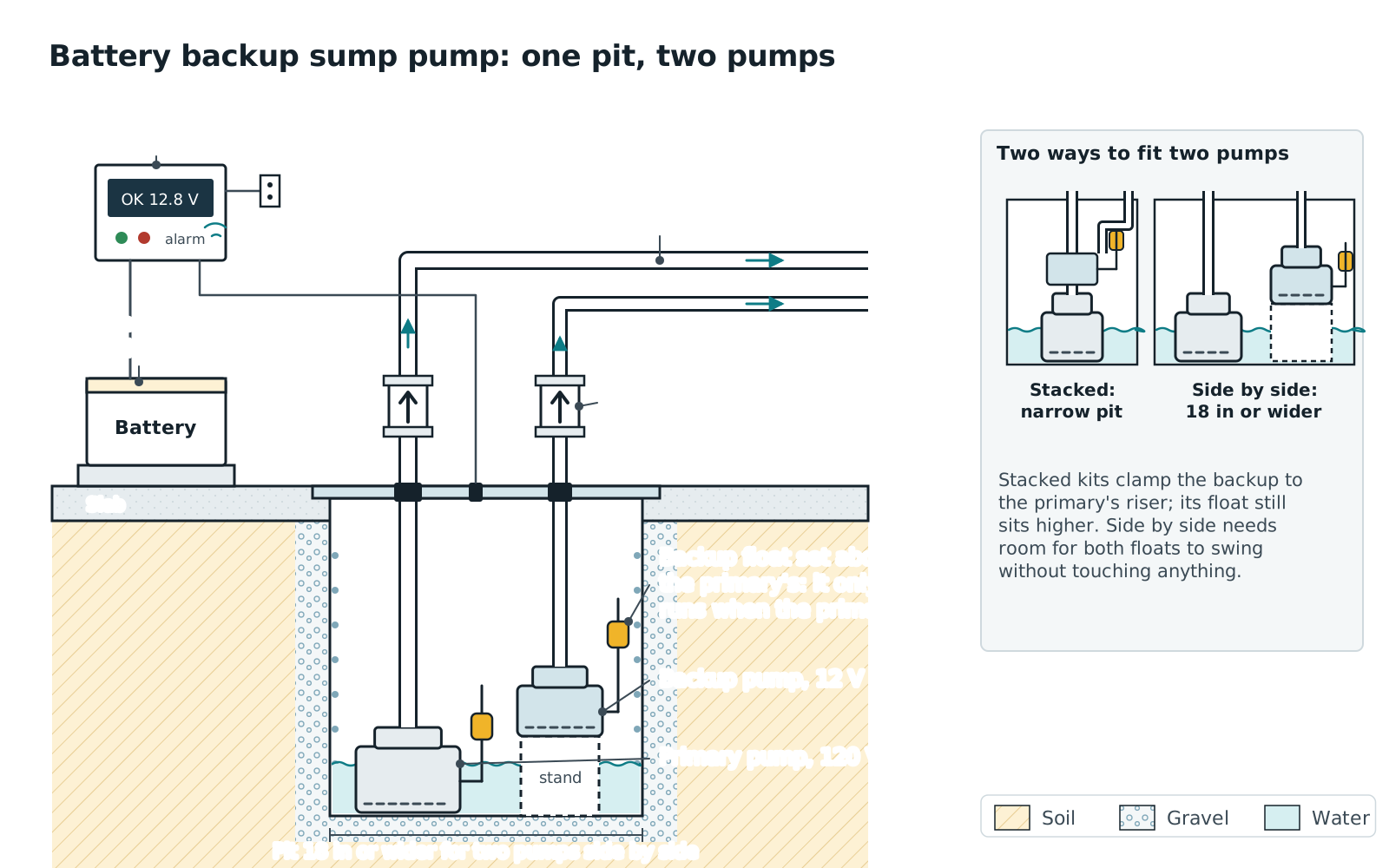
Two pumps, two floats and two discharge pipes need room. Plan on an 18-inch diameter basin for a primary plus a separate backup; Liberty specifies 18 by 18 inches for its 442 combos, and Wayne's pre-assembled WSS30Vn fits a 16-inch basin. Floats must swing or rise without touching the other pump, the pipe or the wall. If the pit is 14 inches or smaller, a combo on a single stand or a water-powered unit mounted above the pit is the realistic path.
- 2
Set the backup float above the primary's
The backup should start only when the primary has failed or cannot keep up. Set the backup's turn-on level 2 to 3 inches above the primary's turn-on level, and confirm by unplugging the primary and letting the pit fill. If the backup runs on every cycle it will drain its battery during an ordinary rain and be empty when the power actually fails.
- 3
Give the backup its own check valve, and ideally its own discharge
Without a check valve on the backup line, the primary's discharge flows backward through the idle backup pump into the pit, and the primary runs forever. A separate discharge pipe through the rim joist is the cleanest install and is required by some local codes. If you must tee into the primary's line, tee in above the primary's check valve and put a second check valve on the backup riser, so neither pump pushes water back through the other.
- 4
Put the check valve where it belongs
Mount check valves 12 to 18 inches above the pump with unions so they can be serviced, and so there is not a tall column of water slamming the valve shut on every cycle. A check valve installed at the ceiling holds the whole riser and causes the loud bang homeowners complain about. Use a quiet spring-loaded valve if the pit is under a bedroom.
- 5
Mind the outlet and the battery box
A tripped GFCI is one of the most common reasons we find a dead sump system. Follow your local code on GFCI requirements, but do not share the circuit with a freezer or a dehumidifier, and put a power-loss alarm on it. Set the battery box where a pit overflow will not reach it, away from the furnace and water heater, and leave the lid on. Then test the whole system monthly by pulling the primary's plug and watching the backup take over.
Sump pump sizing calculator
Measure once during a hard rain: unplug the pump, time the rise for 60 seconds, plug it back in. Then enter the discharge path.
- Measured inflow 1.1 GPM; design flow with storm factor 10.0 GPM.
- Total dynamic head 13.0 ft (lift 9 ft + pipe friction 0.0 ft + fittings). Read the pump's curve at this head, not the headline GPH.
- For a finished basement add a battery backup rated for at least this flow, and a high-water alarm.
- PumpSpy PS2000 Wi-Fi Battery Backup SystemScore 7.3 · ? HP · 2400 GPH @10 ftCheck price
- Zoeller Aquanot Fit 508 ProPak with M53Score 5.9 · ? HP · 2040 GPH @10 ft
- Liberty StormCell 442-10AScore 5.0 · ? HP · ? GPH @10 ft
- Basement Watchdog Big Dog CONNECTScore 4.4 · ? HP · 2200 GPH @10 ft
- Paid links.
What we skipped and why
Wayne WSS30Vn. It is in the comparison table because it is a popular pre-assembled combo and the install is genuinely easy, but Wayne's product page publishes no runtime hours, charger amperage, battery recommendation, alarm or warranty term, and its backup moves 1,500 GPH at 10 ft and only 660 GPH at 15 ft, the lowest of the group. We will not recommend a backup whose runtime we cannot show you.
Liberty StormCell 442-10A. The 10 A charger is excellent and Liberty's primaries are good pumps, but the performance curve is published only as a graphic and the literature does not state runtime or warranty. It stays in the table as an option for people already running a Liberty 257 or 457.
Generic 12 V kits. The no-name backups sold on their zero-head GPH number typically do not publish flow at any head, ship with a trickle charger, and have no self-test. They are better than nothing in an unfinished basement and not something we would put under a finished one.
Inverter-only systems. A battery and inverter powering your existing AC pump keeps the primary's full flow, but the starting surge of a 10 A motor drains the battery fast and runtime is a fraction of a dedicated DC pump's. Full capacity on backup power is a generator's job.
How we score
Every product gets a DryHomeLab score out of 10 from a published rubric for its category: the specs that matter (capacity, coverage, flow at head height, sensor response, warranty) are verified against manufacturer documentation and weighted by how much they affect real-world drying and protection. Where our restoration crews have run the gear, field notes can move a score by at most 1.5 points, and the note is published. We never use Amazon star ratings. Read the full methodology.
Frequently asked questions
How long does a battery backup sump pump run?
The systems on this page are rated for roughly 40 to 50 hours on one Group 27 battery at a 10% duty cycle, meaning the pump runs about six minutes per hour. Continuous runtime is much shorter: around 4.5 to 5.5 hours for pumps drawing 18 to 20 A. Your real number depends on how hard your pit runs. Time the primary's cycles during a heavy rain, work out the duty cycle, and divide. Two batteries double it; both Basement Watchdog units publish 80 and 96 hours with a second battery.
Can I use a car battery for a backup sump pump?
No. A car battery is built to deliver a short, high-current burst and then be recharged immediately; a sump backup drains it slowly over hours, which destroys starting batteries in a handful of cycles. Use a 12 V deep-cycle battery, Group 27 or 31, either AGM (sealed, no maintenance) or flooded wet-cell (cheaper, needs distilled water). Basement Watchdog, Zoeller and Liberty all specify deep-cycle batteries and all sell their own AGM versions.
How often should I replace the backup battery?
Every 3 to 5 years, whether or not it has been used. Lead-acid batteries lose capacity sitting on a float charger, and a five-year-old battery may deliver half of its nameplate amp-hours when you finally need it. Write the install date on the case, keep the box lid on, check water levels in a flooded battery every two to three months, and replace it on schedule rather than after it fails a storm.
Does a backup sump pump need its own discharge pipe?
It is the better install, and some local codes require it. A separate line through the rim joist with its own check valve means neither pump can push water back through the other, and a blockage or frozen outlet on one line does not take both pumps down. If you must share, tee the backup in above the primary's check valve and install a second check valve on the backup riser. Never run a backup without a check valve of its own.
Will the backup run if the primary fails but the power stays on?
Yes. Backup pumps are triggered by water level, not by a power outage. If the primary's switch sticks, its motor burns out, or a GFCI trips, water rises past the primary's turn-on point and reaches the backup's float a couple of inches higher, and the backup starts on battery. That is why the controller alarm and app alerts matter: without them you can run on battery for a day without knowing the primary is dead.
Should I get a battery backup or a water-powered backup?
Start with a battery backup if you are on a well, your pit runs hard, or you want published runtime you can check. Choose water-powered if you are on municipal water with 40 psi or better, outages at your house last days rather than hours, and you do not want to maintain a battery. In a finished basement we often install both: the battery unit handles the first night and the water-powered unit has no clock on it. See our water-powered guide at /best/water-powered-backup-sump-pump.
How much does it cost to install a battery backup sump pump?
The systems here range from a couple of hundred dollars for a basic backup to roughly four figures for a combo with a primary, before the battery. A handy homeowner can add a dedicated backup to an 18-inch pit in an afternoon with PVC, a check valve and a drill. Plumber labor for an add-on in our market usually lands in the low hundreds; a full primary-plus-backup replacement with a new discharge line runs higher. If the pit is already overflowing, call our 24/7 line at /emergency first and plan the backup after the water is out.
Can a battery backup replace my primary pump?
No. Backup pumps are intermittent-duty DC pumps designed to cover a failure, not to run daily, and their batteries would be depleted in a day by a pit that cycles regularly. Install a good AC primary sized with our calculator at /tools/sump-pump-sizing-calculator, then add the backup above it. If both your primary and your backup are old, a pre-piped combo like the Zoeller ProPak replaces both at once.
DryHomeLab is written and reviewed by the team behind HelpMeNow.com, a marketplace that connects homeowners with vetted local contractors for water-damage restoration, plumbing and waterproofing. Before HelpMeNow the same team ran a 24/7 water-damage restoration company in the Seattle area; the equipment on this site is what we specified, bought and ran on real water losses. We publish the rubric behind every score.
- Ran a 24/7 water-damage restoration company, Seattle area
- Operate HelpMeNow.com, a contractor marketplace
- Publishes its scoring rubric