
What this calculates
A sump pump is sized on two numbers: how many gallons per hour enter the pit during the worst weather you expect, and how much total head the pump has to push against to get them outside. The box on the shelf prints neither. It prints flow at zero head, which is a number no installed pump ever sees.
This tool takes three inputs you can measure in a few minutes:
- Inflow: how many inches the water rose in the pit in one minute with the pump unplugged, and the pit diameter.
- Vertical lift: from the pump's inlet at the bottom of the pit to the highest point of the discharge pipe.
- Pipe run and fittings: the length of discharge pipe, its diameter, and the number of elbows and check valves.
It returns your design flow in GPH (measured inflow times a 1.5x storm factor), your total dynamic head in feet, and the horsepower class whose published curve delivers that flow at that head. The pump recommendations below it come from manufacturer pump curves, not retail flow claims. If the result tells you a 1/3 HP pump is plenty, believe it; see our best sump pump picks for the ones we trust. If it tells you that you need a backup sized for the same inflow, see our battery backup guide.
Sump pump sizing calculator
Measure once during a hard rain: unplug the pump, time the rise for 60 seconds, plug it back in. Then enter the discharge path.
- Measured inflow 1.1 GPM; design flow with storm factor 10.0 GPM.
- Total dynamic head 13.0 ft (lift 9 ft + pipe friction 0.0 ft + fittings). Read the pump's curve at this head, not the headline GPH.
- For a finished basement add a battery backup rated for at least this flow, and a high-water alarm.
No catalog match at that flow yet — see the picks on this page.
How the math works
Step 1: measure the inflow
Wait for a heavy rain or the spring thaw; a dry-weather measurement is useless. Unplug the pump when the pit is near its normal low level, start a timer, and measure the rise in inches after exactly one minute. Plug the pump back in.
Convert inches to gallons with the pit diameter. Gallons per inch of depth = (diameter in inches ÷ 2)² × 3.1416 ÷ 231. For common basins:
- 18-inch pit: 1.10 gallons per inch
- 24-inch pit: 1.96 gallons per inch
- 30-inch pit: 3.06 gallons per inch
A rise of 6 inches in one minute in an 18-inch pit is 6.6 GPM, or 396 GPH. A rise of 12 inches is 13.2 GPM, or 792 GPH. Those are ordinary numbers for a suburban basement in a storm. Pits in a true high water table during snowmelt run 20 to 40 GPM, and that is the case where pump choice really matters.
Step 2: apply the storm factor
Multiply measured inflow by 1.5. You measured one storm; you are buying a pump for a worse one. The margin also covers a check valve that is half-stuck with silt and a five-year-old impeller that has lost some edge. 792 GPH becomes 1,188 GPH of design flow. If you measured during a once-a-decade event, a factor of 1.25 is defensible; if you measured a routine rain, keep 1.5.
Step 3: work out total dynamic head
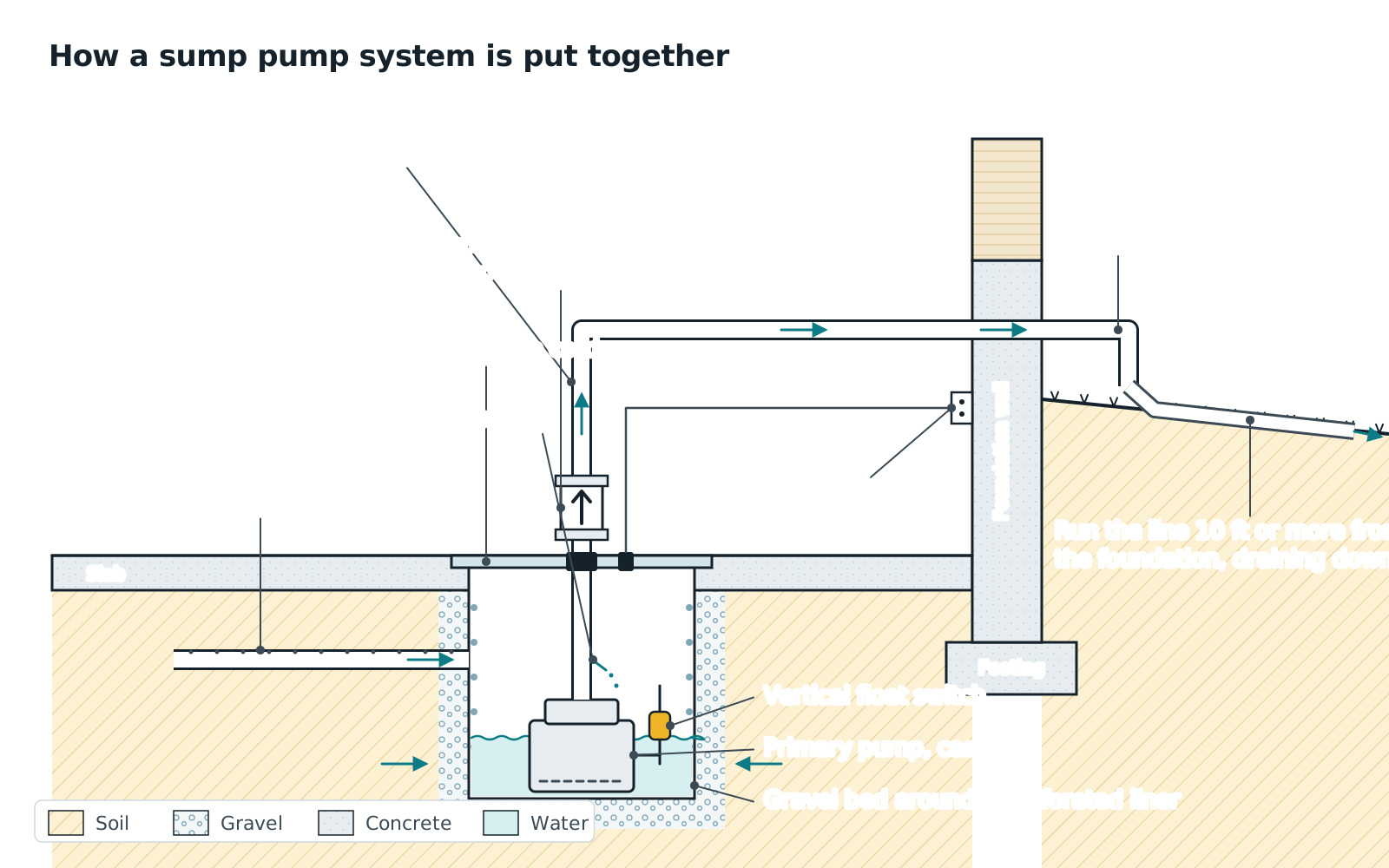
Total dynamic head (TDH) is vertical lift plus friction loss plus fitting losses.
Vertical lift is measured from the pump inlet at the bottom of the pit to the highest point of the discharge, usually where the pipe turns to exit through the rim joist. Typical basements run 8 to 12 ft. A deep pit under a walkout or a discharge that climbs to grade from a lower level can reach 15 to 20 ft.
Friction loss depends on flow, pipe size and length. Using the standard Hazen-Williams relationship for smooth PVC, 1-1/2 inch pipe loses roughly 4 ft of head per 100 ft of pipe at 25 GPM and about 9 ft per 100 ft at 40 GPM. Step down to 1-1/4 inch pipe and losses nearly double; step up to 2 inch and they fall by about three quarters. That is why a 3/4 HP pump on 1-1/4 inch pipe never delivers its curve.
Fitting losses are added as equivalent pipe length. For 1-1/2 inch PVC, count each 90-degree elbow as about 4 ft of pipe and a swing check valve as 10 to 12 ft. A typical install of 9 ft of lift, 30 ft of pipe, three elbows and one check valve has an equivalent length of 30 + 12 + 11 = 53 ft. At 25 GPM that is about 2 ft of friction, for a TDH of roughly 11 ft. At 40 GPM it is nearly 5 ft, for a TDH of 14 ft.
Step 4: read the pump curve
A pump curve plots flow against head. Flow is highest at zero head and falls to nothing at the shutoff head. You want a pump whose flow at your TDH is at least your design flow, and ideally one that is running in the middle third of its curve, where the motor is efficient and the switch is not cycling constantly.
Two real curves show why the zero-head number misleads. Zoeller rates the M53 at 2,580 GPH at zero head but 2,040 GPH at 10 ft, with a 19.25-ft shutoff; at 15 ft of head it is moving a fraction of the box number. Wayne's CDU980E is rated 5,490 GPH at zero head, 4,600 GPH at 10 ft and 3,500 GPH at 20 ft. Both are honest curves; the difference is that the Wayne keeps its flow as head climbs.
HP classes, from manufacturer curves at 10 ft
- 3/10 to 1/3 HP: 2,040 GPH (Zoeller M53, M63) to 3,060 GPH (Wayne CDU790 series). Enough for most pits measuring under about 20 GPM of design flow at a 10-ft lift.
- 1/2 HP: 3,660 GPH (Zoeller M98) to 3,840 GPH (Wayne CDU800 series and the primary in the WSS30Vn). The right class for 25 to 40 GPM, or for lifts of 15 to 20 ft, where the M98's 23-ft shutoff head matters.
- 3/4 HP: 4,600 GPH (Wayne CDU980E). For fast pits and long runs.
- 1 HP: 5,100 GPH (Wayne CDU1000), still 3,840 GPH at 20 ft. For severe groundwater, hillside discharges and duplex setups.
Note that horsepower is a loose guide. Zoeller's 3/10 HP M53 draws 9.7 A; its 1/2 HP M98 draws 9.4 A and moves nearly 80% more water. Compare curves, not nameplates.
Common mistakes
Sizing on the zero-head number. A pump advertised at 3,000 GPH may move 1,500 GPH at your 12-ft lift. Always compare at your TDH.
Buying the biggest pump on the shelf. A 3/4 or 1 HP pump in a pit that takes 8 GPM empties the basin in seconds and restarts a minute later. That short-cycling wears the switch, hammers the check valve and shortens motor life, and it does nothing for you in a storm. Match the pump to the inflow.
Ignoring the check valve and elbows. A check valve alone can add the equivalent of 10 to 12 ft of pipe. Two unnecessary elbows add 8 more. Use long-sweep fittings and run the pipe as straight as you can.
Running 1-1/4 inch pipe on a big pump. Most 1/2 HP and larger pumps have a 1-1/2 inch discharge for a reason. Reducing the pipe throws away the flow you paid for.
Measuring in dry weather. Inflow in August tells you nothing about April. If you cannot wait for a storm, ask a neighbor with a similar lot how often their pump runs, or size on the 1/2 HP class and accept some short-cycling.
Forgetting the backup. A backup pump faces the same inflow and the same head. The battery backups we recommend move 1,850 to 2,400 GPH at 10 ft; a water-powered unit moves 750 to about 1,140 GPH at 60 psi. If your design flow is above those numbers, a backup alone will lose ground during an outage, and you should plan for two batteries, a water-powered second layer, or a generator.
Forgetting the pit. A small or shallow pit forces short cycles no matter what pump is in it. An 18-inch by 22-inch basin is the practical minimum for a primary plus a backup; 24 inches is better.
What to do with the result
- Design flow under 2,000 GPH, TDH under 12 ft: a quality 1/3 HP cast iron pump. Our pick is the Zoeller M53; the Liberty 257 if the pit is narrow.
- Design flow 2,000 to 3,500 GPH, or TDH 12 to 18 ft: a 1/2 HP pump such as the Zoeller M98, or the 3/4 HP Wayne CDU980E if the budget is the same.
- Design flow above 3,500 GPH or TDH above 18 ft: the 3/4 HP Wayne CDU980E or the 1 HP CDU1000, 2-inch discharge pipe, and a second pump in the pit.
Whichever class you land in, add a check valve you can service, a high-water alarm, and a backup sized for the same inflow. If the pit is already overflowing while you read this, our crews answer 24/7 at /emergency.
Frequently asked questions
What size sump pump do I need for my house?
Size on measured inflow and total head, not square footage. Unplug the pump during a hard rain, measure the rise in one minute, convert to gallons using the pit diameter (an 18-inch pit holds 1.1 gallons per inch), multiply by 60 for GPH and by 1.5 for a storm margin, then pick a pump whose published flow at your total head meets that number. Most suburban basements land under 2,000 GPH at 10 ft, which a quality 1/3 HP pump covers.
Is a 1/3 HP or 1/2 HP sump pump better?
Neither is better; one is right for your pit. A 1/3 HP cast iron pump like the Zoeller M53 moves about 2,040 GPH at 10 ft and suits most pits with lifts under 12 ft. Move to 1/2 HP (Zoeller M98, 3,660 GPH at 10 ft) when design flow passes about 2,000 GPH or the lift exceeds 12 to 15 ft. Oversizing causes short-cycling, which wears switches and check valves faster than running a smaller pump more often.
How do I calculate sump pump head?
Total dynamic head is vertical lift plus friction. Measure lift from the pump inlet at the bottom of the pit to the highest point of the discharge pipe. Then add friction: in 1-1/2 inch PVC, roughly 4 ft per 100 ft of pipe at 25 GPM and 9 ft at 40 GPM, counting each elbow as about 4 ft of pipe and a check valve as 10 to 12 ft. A typical 9-ft lift with 30 ft of pipe, three elbows and a check valve comes to about 11 ft of total head.
What does GPH at 10 feet mean?
It is the flow the pump delivers when it has to push water 10 ft of total head, which is close to a typical basement discharge. Manufacturers also quote flow at zero head, a number no installed pump sees. The two can differ by half or more: Zoeller's M53 is rated 2,580 GPH at zero head and 2,040 GPH at 10 ft; Wayne's CDU980E is 5,490 and 4,600. We score every primary pump on the 10-ft figure from the manufacturer's curve.
How big should a sump pit be?
An 18-inch diameter by 22-inch deep basin is the practical minimum for a primary pump with room for a backup and two floats. A 24-inch basin gives a longer cycle, which means fewer starts per hour and a longer-lived switch. Wayne specifies 11 inches or larger for its CDU pumps alone, but a pit that small cannot take a second pump and will short-cycle a strong one. If you are replacing the pit, go bigger and use a sealed lid.
DryHomeLab is written and reviewed by the team behind HelpMeNow.com, a marketplace that connects homeowners with vetted local contractors for water-damage restoration, plumbing and waterproofing. Before HelpMeNow the same team ran a 24/7 water-damage restoration company in the Seattle area; the equipment on this site is what we specified, bought and ran on real water losses. We publish the rubric behind every score.
- Ran a 24/7 water-damage restoration company, Seattle area
- Operate HelpMeNow.com, a contractor marketplace
- Publishes its scoring rubric