
The first 30 minutes
- 1
Minute 0 to 2: kill the heat
Gas: turn the dial on the gas control valve at the bottom front of the tank to OFF (some controls go to VACATION or PILOT first; go all the way to OFF). If the dial is stiff or the control is in the water, close the gas shutoff on the supply pipe beside the tank instead: a quarter-turn lever, perpendicular to the pipe is closed. Electric: flip the breaker, usually a double-pole 30 A labeled water heater, or the disconnect box on the wall next to the tank. Heating an emptying tank burns out elements and can crack a gas tank's flue; this step comes before the water.
- 2
Minute 2 to 4: close the cold inlet
On top of the tank are two pipes. The cold inlet usually has a valve on it, a lever (quarter turn, perpendicular to close) or a round gate handle (clockwise, several turns). Close it. That stops the tank refilling itself, which is what turns a 50-gallon failure into a 500-gallon one overnight. If the valve is stuck, missing, or spins without closing, go to the house main shutoff, usually where the water line enters the house near the meter or the pressure regulator; the diagram in our Moen Flo vs Phyn comparison shows where it sits in the line. Then open a hot tap somewhere in the house to break the vacuum and relieve pressure; leave it open.
- 3
Minute 4 to 8: find where the water is coming from
Dry the outside of the tank with a towel and look with a flashlight, top to bottom. Water on top around the inlet or outlet fittings, or dripping down the side from the top: a fitting, the anode port or the top seam. Water from the small valve with a lever on the side or top, or from the pipe that runs from it down to the floor: the temperature-and-pressure relief valve. Water from the spigot at the bottom: the drain valve. Water seeping from under the tank with the top dry, or rust streaks running down from the bottom seam: the tank itself. Condensation (a cold tank on a humid day sweats, and a gas tank sweats briefly after a big draw) looks like a leak but stops when the tank warms; if the floor is dry under the pan drain and the drips are evenly spaced over the whole tank, wait an hour before deciding. The diagram below shows every point.
- 4
Minute 8 to 12: stop the spread
Water under a water heater runs under the wall plates and into the room next door, and on an upper floor through the ceiling below. Towels and a mop first, then a wet-dry vacuum if you have one. If the tank is in a pan with a drain line, confirm water is actually leaving through it; if the pan is overflowing, bail it. Pull anything stored on the floor nearby. If the water has reached carpet, drywall or a finished ceiling, you now have a drying job as well; read how to dry wet carpet and the 72-hour guide once the heater is stable.
- 5
Minute 12 to 15: photograph everything
Before you drain or move anything: the tank from each side, the leak point close up, the water on the floor and how far it spread, the water line on any drywall or boxes, the rating plate with the serial number and manufacture date, and the pan. Note the time you found it and the time you shut the water off. If this becomes an insurance claim, the adjuster was not there, and a water heater failure is one of the sudden, accidental losses most policies cover for the resulting damage (though usually not the heater itself).
- 6
Minute 15 to 25: drain the tank if the tank is the leak
If the water is coming from the bottom seam, the tank is rusted through and every gallon in it is coming out one way or another; drain it on your terms. Screw a garden hose onto the drain valve at the bottom, run it to a floor drain, a sump, a utility sink or outside, and open the valve (a flat screwdriver slot or a small handle). Keep the hot tap open upstairs so air can enter. A 50-gallon tank takes 20 to 40 minutes to drain; plastic drain valves clog with sediment, so if it slows to a trickle, close it, pulse the cold inlet open for two seconds to stir the bottom, and reopen. If the drain valve is the leak, leave the tank full and skip to the repair section; draining through a failed valve makes it worse. Do not drain a tank that is still hot into a plastic pan or a PVC drain line; let it cool first.
- 7
Minute 25 to 30: decide, and make the calls
A leak at a fitting, the relief valve, the drain valve, or the anode port is a repair: a plumber today, or you if you are comfortable, and the tank goes back in service. A leak from the tank body is a replacement: call a plumber for a like-for-like swap and ask about a pan with a drain, an expansion tank and a leak sensor while they are there. If the water reached finished floors or walls, call the insurer today and a restoration contractor if more than one room is wet. Set up a fan on the wet floor in the meantime and leave the cold inlet closed until the plumber arrives.
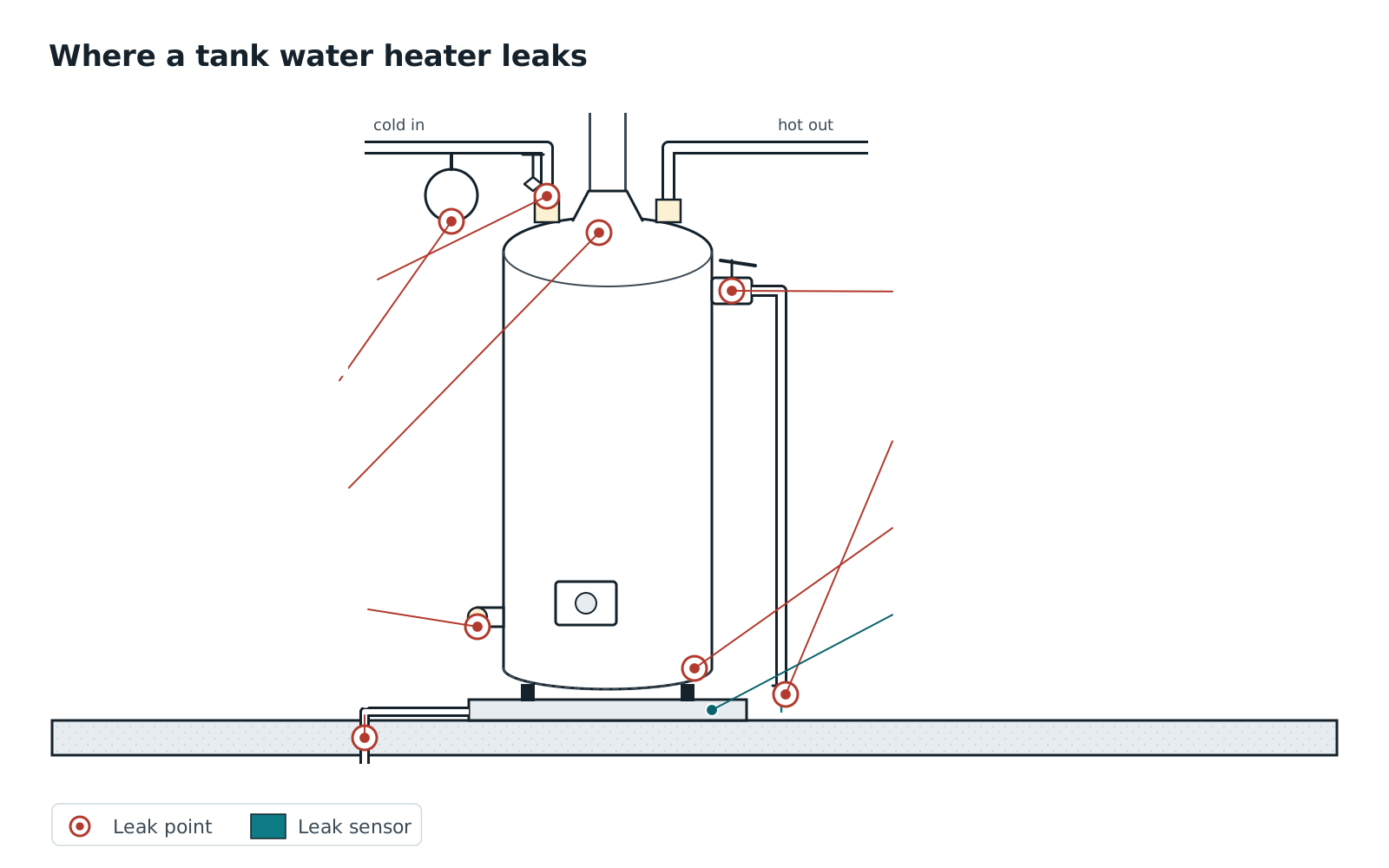
What each leak point means
Cold inlet and hot outlet fittings (top). The most common fixable leak. Flex connectors crack, compression nuts loosen, and the dielectric nipples that join copper to the steel tank corrode. Usually a new flex connector or a re-made joint; a plumber's half hour. Water from the top runs down the outside of the tank and pools at the bottom, which is why people misdiagnose a top leak as a failed tank. Dry the tank and look again.
Anode port and top seam. The anode rod threads into the top of the tank under a plastic cap; a leak there is a repair if the threads are good. Water weeping from the top seam of the tank itself is a replacement.
Temperature-and-pressure (T&P) relief valve. The lever valve on the side or top with a pipe running down to within about 6 in. of the floor. Dripping from the end of that pipe means the valve is opening: either because it has failed (sediment, age) or because it is doing its job against high pressure, which usually means a closed system with no expansion tank, a failed expansion tank, or a pressure regulator problem. Replace the valve (a plumber job, since the tank must be partly drained and the new valve rated for the tank) and find out why it opened; a new valve on a tank at 150 psi opens again. Never cap or plug a T&P valve. Ever.
Drain valve. The spigot at the bottom. Plastic ones crack and the washer on brass ones fails; it drips from the spout or around the stem. A hose cap screwed onto the spout stops the drip tonight; replacing the valve means draining the tank, so plumbers often do it at the same time as a flush.
Expansion tank. The small tank on the cold line above the heater. When its bladder fails it fills with water and weeps at the threaded connection, or it waterlogs and the T&P starts dripping. Replacement is a plumber's half hour.
Bottom seam and tank body. Rust streaks from the seam, water seeping from under the tank with everything above it dry, or a puddle that reappears after you dry the pan with the cold inlet closed. The glass lining has failed and the steel has rusted through. There is no repair. Tanks last roughly 8 to 12 years; check the manufacture date on the rating plate, and if the tank is past ten, the question was when, not whether.
Pan drain line. Not a leak point, but the pan is only useful if its drain goes somewhere. Pour a cup of water in it. If it comes out the other end into a drain or outside, good. If it sits there, the pan is a bathtub that will overflow the day the tank goes.
Tools and materials to have before this happens
You do not need much, but you need it on the shelf, not at the store:
- A flashlight or headlamp that lives near the heater
- A garden hose long enough to reach from the drain valve to a drain, with a hose cap
- Channel-lock pliers and an adjustable wrench (for stuck valve handles and flex connectors)
- A wet-dry vacuum, towels, a mop
- A drain pan under the tank, with a drain line that goes somewhere, on any heater not sitting on a bare slab next to a floor drain
- A water leak sensor in the pan with phone alerts; see where to put leak sensors
- The manufacture date of your tank, written on a piece of tape on the front
Repair or replace
Replace the tank if it is leaking from the body, if it is past ten years and leaking from anything, or if the repair quote is a large fraction of a new unit installed. Repair if it is a fitting, the T&P valve, the drain valve or the expansion tank and the tank is under about eight years old. A plumber can do a like-for-like tank swap in two to four hours; ask for a pan with a drain to daylight or a floor drain, an expansion tank if the house has a pressure regulator or check valve at the meter (most do now), a new shutoff on the cold inlet if the old one was stiff, and a leak sensor in the pan. If the heater is in a finished space or on an upper floor, ask about an automatic shutoff valve for the heater, or a whole-house smart valve that a pan sensor can close.
Preventing the next one
- Pan, drained. The single cheapest fix for a heater over finished space.
- A sensor in the pan with phone alerts, and one under the T&P discharge if it ends over the floor. Moen's detector and the Govee kit below both do this; the Moen can also tell a Moen Flo to close the main.
- A valve that closes on its own. A whole-house smart shutoff on the main (Moen Flo, Phyn Plus) closes the water on abnormal flow or on a sensor trigger; YoLink's controller bolts onto the existing main valve and runs on batteries. Our shutoff valve roundup covers them.
- Replace the anode rod at year five or six on a tank you want to keep; it is what rusts instead of the tank.
- Flush the tank yearly through the drain valve to clear sediment, which is what cooks the bottom and clogs the drain valve.
- Replace flex connectors when they discolor or at ten years, and the T&P valve when it drips or at ten years.
- Replace the tank at ten to twelve years on your schedule, in daylight, rather than on its schedule at 2 a.m.
Moen Smart Water Detector (920-004)
The no-hub sensor that can tell a Flo to close the main.
Score breakdown
| Battery life | 24 | 3.3 |
| Phone alerts | true | 10.0 |
| Radio reliability | wifi | 7.0 |
| Freeze warning | true | 10.0 |
| Probe cable | true | 10.0 |
| Local siren | n/a | — |
| Temperature and humidity logging | true | 10.0 |
| Warranty | 1 | 0.0 |
| No hub needed | false | 10.0 |
- No hub; joins 2.4 GHz Wi-Fi directly
- 48-in remote sensing disc included; 6-ft cables chain up to three
- Temperature and humidity alerts double as freeze and damp-basement warnings
- Triggers a Flo Smart Water Shutoff to close the main
- Works standalone; battery level reported in the app
- Two-year battery life is the shortest of the connected sensors here
- Only as reliable as your Wi-Fi at the sensor location
- No published siren rating
- One-year warranty
Moen's detector connects straight to 2.4 GHz Wi-Fi, so there is no gateway to buy and nothing extra on the shelf. It senses water on its base and on a 48-in remote sensing disc that comes in the box, which lets the body sit dry on the shelf of a water heater closet while the disc sits in the pan. Moen's optional 6-ft Leak Sensing Cable (920-006) extends that, and up to three cables link together.
It also reports room temperature and humidity with user-set alert ranges, temperature from 0 to 140°F and humidity across the full 0-100% RH scale, so a low alert at 38°F works as a freeze warning for a garage or crawl space, and a humidity alert catches a damp basement before it smells. The operating range is -20 to 140°F.
Power is a single CR123A lithium cell that Moen rates for up to two years, with battery level reported in the app. Warranty is one year. Moen does not publish a decibel rating for the audible alarm.
The feature that sets it apart: paired with a Flo Smart Water Shutoff on the main line, a wet disc triggers the valve to close. That turns a sensor under the dishwasher into whole-house protection. It works standalone too.
Buy it if you want hub-free Wi-Fi sensors with temperature and humidity, especially if a Flo is already installed or planned. Skip it for crawl spaces and pits beyond Wi-Fi reach; that is YoLink territory. The 3-pack is 920-005.
GoveeLife Smart Water Leak Detector 1s (Gateway + 3 sensors)
Five-year batteries, a 105 dB siren and 1,800 ft of reach for the price of dinner.
Score breakdown
| Battery life | 60 | 10.0 |
| Phone alerts | true | 10.0 |
| Radio reliability | proprietary hub | 7.0 |
| Freeze warning | n/a | — |
| Probe cable | false | 0.0 |
| Local siren | 105 | 8.8 |
| Temperature and humidity logging | n/a | — |
| Warranty | n/a | — |
| No hub needed | true | 6.0 |
- Up to five-year battery life on two AAA cells
- 105 dB adjustable siren plus app and email alerts
- 915 MHz link to the gateway rated to 1,804 ft
- IP67 sensors survive sitting in a puddle
- Gateway included in the 3-sensor kit
- Requires the Govee gateway on 2.4 GHz Wi-Fi
- No temperature or humidity sensing, so no freeze warning
- No extension cable in the base kit
- Warranty term not published on the product page
Govee's 1s kit is three IP67 sensors and a small 2.4 GHz Wi-Fi gateway. The sensors do not use Wi-Fi themselves; they talk to the gateway on 915 MHz, which Govee rates at up to 550 m (1,804 ft) of monitoring range. In a house that means a sensor in the crawl space or a detached garage still reports, where a Wi-Fi puck would have dropped off the network months ago.
Each sensor runs on two AAA alkalines (six come in the box) and Govee states a battery life of up to five years. The onboard siren is adjustable in four steps to 105 dB, loud enough to hear from upstairs with the furnace running, and the app pushes notifications and email when the dual probes bridge. Govee claims detection of drips and floods within two seconds, which matches what we see when we test sensors with a wet rag.
What the base kit lacks is an extension cable (Govee sells a cabled variant separately) and any temperature or humidity reporting, so it will not warn you about a pipe about to freeze. Govee did not publish a warranty term on the product page.
At roughly $50-$70 for gateway plus three sensors, it is the cheapest way to cover a water heater, a washer and a kitchen sink with loud local alarms and phone alerts. Buy it if you want the most coverage per dollar and do not need freeze warnings. Buy YoLink if you need a quarter-mile radio or want sensors that can close a valve.
We don't copy Amazon reviews. Read customer reviews on Amazon (paid link).
When to call a pro
Call a plumber today for any leak you cannot stop with the cold inlet valve, any T&P valve that drips after the tank cools, any leak from the tank body, a gas control that is wet or will not turn, or a tank in a closet or attic where a replacement needs two people and a drain path. Call an electrician before touching an electric heater standing in water if you cannot get the breaker off. Call a restoration contractor the same day if the water reached carpet, finished walls or a ceiling below, if more than one room is wet, or if the leak ran for more than a day before you found it; what gets dried in the first 48 hours gets saved. The form below reaches vetted local plumbers and restoration contractors through HelpMeNow.com.
Frequently asked questions
How do I shut off a leaking water heater?
Kill the heat first: turn the gas control dial to OFF, or flip the water heater breaker for an electric unit. Then close the cold-water valve on top of the tank (quarter-turn lever perpendicular to the pipe, or a round handle clockwise). If that valve is stuck or missing, close the house main. Open a hot tap somewhere in the house to relieve pressure. Do not touch an electric heater standing in water until the breaker is off.
Is a water heater leaking from the bottom dangerous?
It is urgent rather than dangerous in itself: a tank rusted through at the bottom seam cannot be repaired and will keep leaking, and the cold inlet keeps refilling it until you close the valve. The dangers are electrical (an electric heater in standing water) and gas (a wet gas control). Kill the heat, close the cold inlet, drain the tank through the drain valve once it has cooled, and call a plumber for a replacement.
Why is water coming out of the pressure relief valve pipe?
The temperature-and-pressure relief valve opens when the tank exceeds its pressure or temperature limit, or when the valve itself has failed from age or sediment. Occasional drips after heavy use often mean a closed plumbing system with no working expansion tank, so pressure spikes as the water heats; a steady drip or stream means a failed valve or a real pressure problem. Have a plumber replace the valve and check house pressure and the expansion tank. Never cap the pipe.
Can a leaking water heater be repaired?
If the leak is at the inlet or outlet fittings, the T&P relief valve, the drain valve, the anode port or the expansion tank, yes; those are parts a plumber replaces in an hour. If water is seeping from the bottom of the tank or the tank seams, no; the steel has rusted through behind the glass lining and the tank is replaced. Tanks last about 8 to 12 years; check the manufacture date on the rating plate.
How long does it take a water heater to drain?
Twenty to forty minutes for a 40- to 50-gallon tank through a garden hose, with a hot tap open in the house to let air in. Sediment clogs plastic drain valves; if the flow slows to a trickle, close the drain, open the cold inlet for a couple of seconds to stir the bottom, and reopen. Let the tank cool before draining into a plastic pan or PVC line, and do not drain through a drain valve that is itself the leak.
Does homeowners insurance cover a leaking water heater?
Most policies cover the sudden, accidental water damage a failed heater causes to floors, walls and contents, and do not cover the heater itself, which is treated as a worn-out appliance. Gradual leaks that were visibly ignored can be denied. Photograph the heater, the leak point, the rating plate and the spread of water before you clean up, call the insurer the same day, keep receipts for the plumber and any drying equipment, and keep a daily log of moisture readings if finished materials got wet.
DryHomeLab is written and reviewed by the team behind HelpMeNow.com, a marketplace that connects homeowners with vetted local contractors for water-damage restoration, plumbing and waterproofing. Before HelpMeNow the same team ran a 24/7 water-damage restoration company in the Seattle area; the equipment on this site is what we specified, bought and ran on real water losses. We publish the rubric behind every score.
- Ran a 24/7 water-damage restoration company, Seattle area
- Operate HelpMeNow.com, a contractor marketplace
- Publishes its scoring rubric