
The short version
Moen Flo Smart Water Monitor and Shutoff (3/4 in, 900-001)
The whole-house shutoff insurers name by name.
You want insurer recognition, a 3/4, 1 or 1-1/4-in valve body, freeze alerts and Moen's point sensors that close the main.
Phyn Plus Smart Water Assistant + Shutoff (2nd Gen)
Pressure-wave leak detection with no subscription attached.
You want pressure-wave detection, a Plumbing Check for pinholes, a two-year warranty and no subscription of any kind.
Quick verdict
These are the two inline shutoffs we see most on the mains of homes that avoided a major loss, and they are closer than the marketing suggests. Both go in line after the meter and pressure regulator, both learn your usage and then close the valve on abnormal flow, both run a closed-valve pressure test for micro-leaks, both need a licensed plumber and an outlet and 2.4 GHz Wi-Fi at the main, and neither has a battery backup.
Buy Flo if your insurer has a Flo program (Farmers names it outright), your main is 3/4, 1 or 1-1/4-in and you want a valve body made for it, you want freeze-condition alerts, and you plan to add Moen Smart Water Detectors that trigger the shutoff. Accept the one-year warranty or pay for FloProtect.
Buy Phyn if you want the more sophisticated detection method, a flow sensor with no moving parts, a two-year warranty out of the box, and a company with no subscription to sell you. Accept buying pipe adapters and a higher upfront price.
If you own a house with original copper or galvanized supply lines, the pressure-testing quality tips us toward Phyn. If your insurer is paying part of the bill, take the device they name.
Side by side
Scroll sideways on small screens. Scores are DryHomeLab scores out of 10; specs are from manufacturer documentation.
| Product | Score | Type | Flow monitoring | Pressure / micro-leak test | Automatic shutoff | Battery backup | Subscription needed for shutoff | Warranty (years) | |
|---|---|---|---|---|---|---|---|---|---|
| Moen Flo Smart Water Monitor and Shutoff (3/4 in, 900-001) Buy Flo if... | 7.5 | inline motorized shutoff with flow, pressure and temperature sensors | Yes | Yes | Yes | No | No | 1 | See it at Moen |
| Phyn Plus Smart Water Assistant + Shutoff (2nd Gen) Buy Phyn if... | 7.9 | inline motorized shutoff with ultrasonic flow sensor and pressure-wave analysis | Yes | Yes | Yes | No | No | 2 | See it at Phyn |
Paid links.
Detection method
Flo uses a turbine-style flow meter plus pressure and temperature sensors inside the valve body, and Moen's FloSense software learns the household's patterns. Moen states it continuously monitors pressure, flow rate and area temperature, runs daily microleak tests and can identify leaks as small as a single drop per minute. It also tracks use by fixture type in the app.
Phyn Plus measures flow with an ultrasonic sensor built by Badger Meter, which has no moving parts to foul with sediment, and layers on what Phyn calls high-definition pressure wave analysis. Every fixture in a house puts a distinct pressure signature on the line when it opens and closes; Phyn reads those signatures to identify which fixture is running and to flag a flow that matches none of them. Its Plumbing Check closes the valve and watches for pressure decay to catch poor seals and pinhole leaks.
In practice both catch the two leaks that matter most: a continuous draw that never stops (burst line, stuck fill valve) and a slow pressure loss with everything off (pinhole, weeping fitting). Phyn's approach gives it an edge on identifying what is leaking; Flo's gives you a simpler usage breakdown by fixture category. Neither depends on a point sensor getting wet, which is the whole reason to buy an inline unit over a sensor-triggered valve.
Install and pipe fit
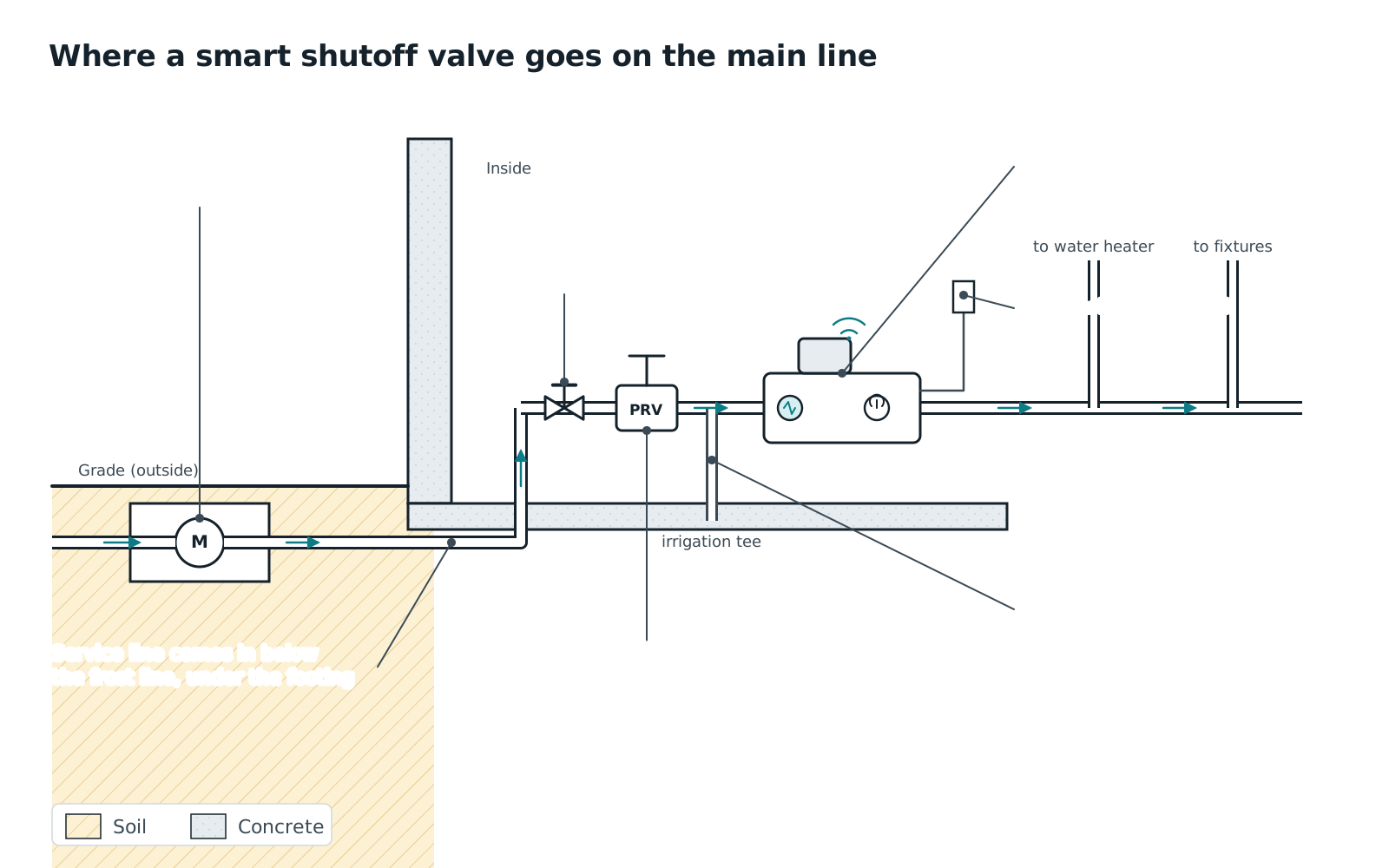
Both are plumber installs. Moen recommends a licensed plumber; Phyn does too and quotes one to two hours. The main gets cut after the meter, the house shutoff and the pressure-reducing valve, and the device goes in with unions.
Pipe fit is where they differ. Moen sells Flo in three valve bodies: 900-001 for 3/4-in, 900-006 for 1-in and 900-002 for 1-1/4-in, each with NPT or sweat connection kits. You buy the one that matches your main and the plumber threads or solders it in. Phyn ships one body with 1-in NPSM threaded ends and tells you adapters are not included; it recommends mains no larger than 1-1/4-in. Your plumber adds the reducers or increasers for a 3/4-in or 1-1/4-in main.
Power: Flo ships a wall-mount supply with a 10-ft cord; Phyn a 12-ft cord and a recommendation for a GFCI outlet. If the nearest outlet is farther than that, budget for an electrician. Both need 2.4 GHz Wi-Fi at the main, and Phyn's FAQ says to add a repeater if the signal is weak. We test signal at the meter with a phone before anyone picks up a torch.
App and alerts
Moen's Smart Water app is free and Moen says no fees or subscriptions are required. Alerts go out by push, phone call and email, it reports flow rate and pressure, flags freezing conditions, breaks usage down by fixture type, manages multiple properties, and works with Alexa, Google Home, Ring, Alarm.com and NICE.
Phyn's app shows real-time flow and pressure, usage by fixture from its signature detection, and the Plumbing Check results, with remote open and close of the valve. Phyn's product page does not list voice-assistant or alarm-panel integrations, so if you want the valve tied into a security system, Flo's list is longer.
Both let you adjust how aggressively the system shuts off and set modes for travel. The practical difference for most households: Flo's alert routing is broader (a phone call will wake you; a push notification may not), while Phyn's fixture identification is more specific when you are trying to figure out what tripped it.
Shutoff behavior and overrides
Both learn before they act. Moen says Flo learns household usage patterns and then automatically turns off water to prevent damage. Phyn says a learning period unlocks the ability to turn off water automatically on abnormally high flow. In both apps you can delay or cancel a pending shutoff from the alert, reopen the valve remotely, and set the system to a mode that tolerates a hose running for an hour.
Manual override matters on the day the Wi-Fi dies. Flo's valve has a manual position, and Phyn supplies a manual shutoff tool on the mounting bracket. Both are motorized ball valves, so a plumber or homeowner can still close the house with the main shutoff upstream of the device.
For point sensors, Moen's Smart Water Detector pairs with Flo to trigger the shutoff when a pan gets wet, and Phyn's help center documents configuring its Smart Water Sensor to have Phyn Plus shut off the water. Call that a tie, with Moen's sensor adding temperature and humidity reporting.
Subscription: FloProtect vs none
This is the clearest difference. Flo's core protection is free, but Moen sells FloProtect at around $5 a month, which adds a five-year extended warranty and a water-damage deductible guarantee under which Moen covers up to $5,000 of your home insurance deductible if you have a loss with the device installed. Over five years that is roughly $300 for the warranty extension and the guarantee.
Phyn sells no plan. Everything the device does is included, and the warranty is two years from delivery. If you dislike recurring charges on principle, Phyn is the answer; if you want the deductible guarantee, only Moen offers one.
Power and backup
Neither has a battery. Flo requires a nearby AC outlet and Moen lists no battery backup. Phyn states the valve remains in whatever state it was in when power was lost. In an outage neither will close on its own; both keep protecting the moment power returns. If outages are common where you live, put the device on a small UPS, which also keeps the Wi-Fi up for alerts. If you need a shutoff that works with the grid down, look at the battery-powered YoLink controller as a companion or alternative.
Warranty and support
Moen: one-year limited warranty on the device, five years total with FloProtect. Phyn: two-year limited warranty from the date of delivery, no plan required. Both companies run help centers and both route installs through plumber networks; Phyn's Nationwide page points to a find-a-plumber map, and Moen's pro program does the same. For a device that lives in your supply line for a decade, we weight warranty at 15% of the score, and Phyn's two years is why it scores higher on that line.
Insurance
Farmers names the Moen Flo Smart Water Monitor and Shutoff on its leak-detection page. Phyn runs bundle pages for Nationwide (15% off Phyn Plus 2nd Gen) and Chubb (15% off), and has announced an Amica partnership. Moen puts an insurance verification letter in the Flo app. Neither manufacturer publishes a premium percentage, because the insurer sets it by state. Our insurer discount database tracks the programs we can cite.
Recommendation
For most homes we send to a plumber this year, the deciding factor is the insurer. If the carrier names a device or bundles one, take it. Absent that, Phyn's detection method and two-year warranty make it our pick for older plumbing, and Flo's sized valve bodies, freeze alerts, broader integrations and sensor ecosystem make it our pick for a newer home that wants one app for everything. Either one, installed, beats any number of sensors alone. See the full field in our best smart water shutoff valve roundup.
How we score
Every product gets a DryHomeLab score out of 10 from a published rubric for its category: the specs that matter (capacity, coverage, flow at head height, sensor response, warranty) are verified against manufacturer documentation and weighted by how much they affect real-world drying and protection. Where our restoration crews have run the gear, field notes can move a score by at most 1.5 points, and the note is published. We never use Amazon star ratings. Read the full methodology.
Frequently asked questions
Is Phyn Plus more accurate than Moen Flo?
They detect differently. Phyn combines an ultrasonic flow sensor with pressure-wave analysis that identifies individual fixtures, and its Plumbing Check targets pinhole leaks and poor seals. Moen states Flo's daily microleak test identifies leaks as small as a drop per minute. Both catch continuous flow and slow pressure loss, which are the two failure modes that cause the losses we dry out. Phyn is better at telling you which fixture is leaking; Flo is simpler to read.
Does Moen Flo need a subscription to shut off the water?
No. Moen says the app is free with no fees or subscriptions required, and automatic shutoff is a device feature. FloProtect, at around $5 a month, is optional and adds a five-year extended warranty and a deductible guarantee of up to $5,000. Phyn has no subscription at all.
Which one fits my pipe size?
Flo comes in 3/4-in (900-001), 1-in (900-006) and 1-1/4-in (900-002) valve bodies. Phyn ships a single body with 1-in NPSM threads, adapters not included, and recommends mains up to 1-1/4-in. Have your plumber confirm the main's size and material before ordering either one.
What happens to Flo or Phyn in a power outage?
Neither has a battery. Flo requires an AC outlet and lists no battery backup; Phyn states the valve stays in the position it was in when power dropped and includes a manual shutoff tool. Both resume monitoring when power returns. A small UPS at the main keeps both the device and the Wi-Fi alive through short outages.
Can I install Flo or Phyn myself?
Both manufacturers recommend a licensed plumber, and we agree. The main is cut after the meter and pressure regulator, unions are added, and Phyn quotes one to two hours. A plumber in most markets charges a few hundred dollars for the install on accessible copper or PEX. Get the quote first; a buried main or galvanized pipe changes the number.
DryHomeLab is written and reviewed by the team behind HelpMeNow.com, a marketplace that connects homeowners with vetted local contractors for water-damage restoration, plumbing and waterproofing. Before HelpMeNow the same team ran a 24/7 water-damage restoration company in the Seattle area; the equipment on this site is what we specified, bought and ran on real water losses. We publish the rubric behind every score.
- Ran a 24/7 water-damage restoration company, Seattle area
- Operate HelpMeNow.com, a contractor marketplace
- Publishes its scoring rubric