
Where the main shutoff is
The main shutoff is always on the cold line between the water meter and the first branch to a fixture, and where the meter sits tells you where to look.
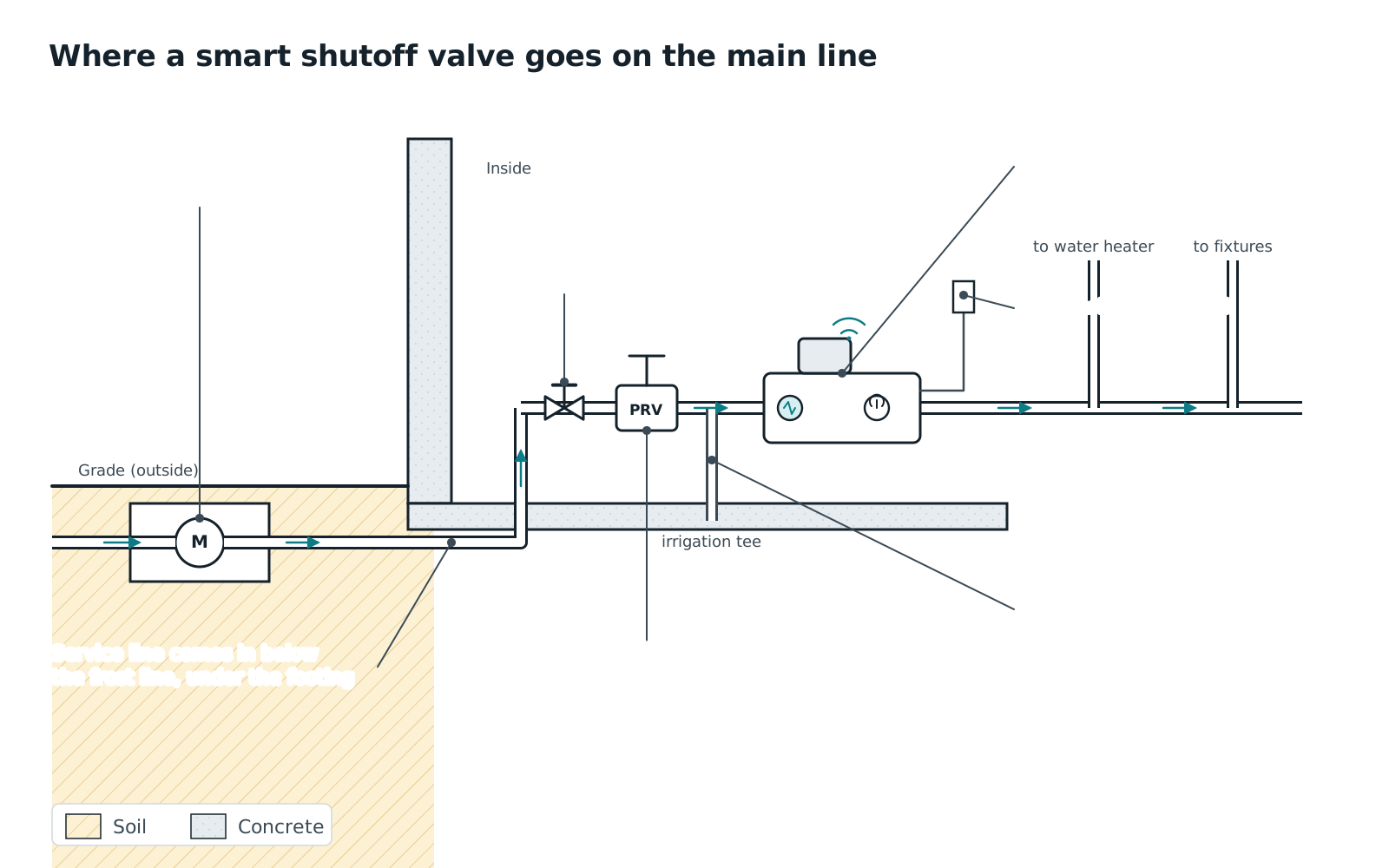
Basement, cold climates. The service line comes through the foundation wall below the frost line, on the side of the house that faces the street, usually within a few feet of a front corner. The meter is inside, a short way along the pipe, and the shutoff is on the house side of the meter; many homes have a second valve on the street side of the meter too. In older houses it is low on the wall at knee height. In newer ones it is often up near the joists, followed by a bell-shaped pressure reducing valve.
Crawl space. Same path. The line enters on the street side and the valve is usually within reach of the access hatch or where the pipe turns up into the floor. If not, check outside at the hose bib closest to the street; some builders put the main stop in the wall behind it or in a small access panel.
Slab foundation. The line comes up through the slab into the garage, a utility or water heater closet, or the laundry room, on the exterior wall nearest the street. A common Sunbelt pattern is a vertical pipe rising out of the ground outside, next to the hose bib nearest the meter, with a valve and sometimes a pressure regulator in the same stack.
Meter at the curb. In warm climates the meter sits in a box at the sidewalk under a lid that a flat screwdriver lifts. Inside: the meter, the utility's valve on the street side, and usually a customer valve on the house side with a lever or wheel handle. The customer valve is yours to operate; the utility's, in most jurisdictions, is not.
Private well. No meter. The shutoff is at the pressure tank, where the line from the well enters the house, usually with a valve on each side of the tank. Closing the house-side valve stops water to the house; to stop the well itself, switch off the pump's breaker.
Condos and townhouses. Each unit normally has its own shutoff: a utility closet, under the kitchen sink, behind an access panel in a bathroom wall, or beside the water heater. If there is none, the building has a riser valve that maintenance controls. Find out which, and who has the key, before you need it.
If none of that turns it up, follow the pipe. Start at the water heater, trace the cold line backward against the flow until it leaves the house. The last valve before the wall or the floor is the main.
The valves you will meet
| Valve | What it looks like | How to close it | What goes wrong |
|---|---|---|---|
| Ball valve | Lever handle, usually red or yellow, on a short brass body | Quarter turn. Handle perpendicular to the pipe is closed; parallel is open. Stop when it stops. | Rarely fails. One left untouched for years is stiff; work it back and forth gently rather than forcing it. |
| Gate valve | Round wheel handle on a tall stem; usually the oldest valve in the house | Clockwise, several full turns, until it seats firmly. No pliers on the wheel. | The gate corrodes, the stem snaps, or the gate drops off so the wheel spins without closing. Old ones often leak past even when shut. |
| Stop-and-waste valve | A ball or gate valve with a small capped port on the side | Close like the valve it resembles. The side cap drains the downstream pipe for winterizing. | The waste cap weeps if it is bumped loose. |
| Curb stop | Under a small round iron lid at the property line or inside the meter box; a slotted head 2 to 4 ft down, no handle | A curb key (long T-handle wrench) turns it a quarter turn. Most utilities want to operate it themselves; call their emergency line. | Buried under landscaping, frozen, or seized. Breaking it is a street-side repair bill. |
| Pressure reducing valve (PRV) | Bell-shaped brass body with an adjusting screw and lock nut, just after the main shutoff | It is not a shutoff. Leave the screw alone. | Fails toward high pressure, which starts drips at the water heater relief valve and fixtures. Life is roughly 10 to 15 years. |
| Fixture stops | Small oval or lever handles on the supply lines under sinks and behind toilets | Multi-turn stops close clockwise; quarter-turn stops close with the lever perpendicular. | Multi-turn stops seize or weep at the stem the first time they move in years. Keep a towel handy. |
| Appliance valves | Levers in the washer box; a stop under the sink feeding the dishwasher; a saddle valve on the fridge line; the valve on top of the water heater | Lever perpendicular to close; the water heater inlet wheel clockwise. | Saddle valves clog and leak and should be replaced with a proper stop. Washer valves left open for a decade stick. |
Ball valves are the ones you want. Every other type on this list is a candidate for replacement the next time a plumber is in the house.
Shutting the water off, in order
- 1
Close the main
Lever: a quarter turn so the handle sits across the pipe. Wheel: clockwise until it stops, firmly but by hand. You will hear the pipe downstream go quiet; a hose bib or the nearest faucet runs for a few seconds and dies. If the valve is a gate type and the wheel keeps turning with no resistance, or it stops but water keeps coming, skip to the stuck-valve section below.
- 2
Relieve the pressure
Open the lowest faucet in the house (a basement laundry sink or an outside hose bib) and the highest one, cold and hot sides. The lines drain down and the pressure at the leak drops to nothing, which is what actually stops the water coming out of a split pipe or a failed supply hose. Leave one faucet cracked open as a tell-tale: if water starts running from it again, the valve is not holding.
- 3
Confirm it held
Go back to the leak. A supply leak should slow to a drip and stop within a minute as the pipe empties. If it keeps flowing at full strength, either the valve is not sealing or the water is coming from something the main does not control: a drain line, a roof, ground water, or a neighbor's supply in an attached building. If you can see the meter, look at the small low-flow indicator (a triangle, star or small dial). With the main closed it should be dead still; if it is creeping, water is getting past the valve.
- 4
Protect the water heater if the water will be off more than an hour
A heater that keeps heating while the house drains down can expose an electric element to air and burn it out, or heat an emptying gas tank harder than it should. For an electric heater, flip its breaker. For gas, turn the control dial to VACATION or OFF. If a hot tap has been draining with the lines open, the tank is still full and will be fine, but turning the heat off costs nothing. Our water heater leak guide covers the heater itself.
- 5
If only one fixture is the problem, isolate that instead
A running toilet, a dripping faucet supply, or a washer hose is a job for the stop that feeds it, so the rest of the house keeps working. Toilet and sink stops: clockwise or lever perpendicular. Washer: both levers in the box behind the machine. Dishwasher: the stop under the kitchen sink that feeds it. Refrigerator: the valve on the 1/4 in line, under the sink or in the basement below. Irrigation: the valve just before the backflow preventer outside. Water heater: the valve on the cold inlet on top of the tank. If a stop will not close or weeps when you turn it, close the main and have the stop replaced.
- 6
Turning it back on
Close the faucets you opened except one, then open the main slowly, a quarter of its travel at first, so air leaves through the open faucet instead of slamming into the fixtures. Once the open faucet runs steadily, open the main the rest of the way and walk the house: every faucet runs sputtering for a few seconds, then clear. Check every valve you touched for a weep at the stem. Toilets should refill and shut off. Restore the water heater last, and only after you have confirmed the tank is full by running a hot tap.
When the valve is stuck, spins, or will not close
The failure happens in three ways and each has a different answer.
The handle will not move. Do not put a pipe wrench or a cheater bar on a wheel handle; the stem snaps and now the valve is open forever. Spray penetrating oil where the stem enters the packing nut, wait a few minutes, and work the wheel back and forth in small movements, open a hair then closed, gaining a little each time. A ball valve that is stiff responds to the same patience with an adjustable wrench on the flats of the stem if the handle is missing. Never heat a valve with a torch; the packing burns and the valve leaks.
The handle turns but the water does not stop. On a gate valve this means the gate has corroded off the stem or the seat is too fouled to seal. There is no fix from the handle. Go upstream: a second valve on the street side of the meter, the customer valve in the meter box, or the curb stop through the utility. Then have the valve replaced.
It closed, and now it drips from the stem. The packing around the stem has dried out. Snug the packing nut (the hex nut the stem passes through) a quarter turn clockwise with a wrench. If it still weeps, leave a bucket under it and add the valve to the plumber's list; it will seal again once it is reopened, usually.
A main valve that fails any of these tests gets replaced with a full-port ball valve, which is an hour's work for a plumber once the utility has closed the curb stop, or with a pipe-freeze kit if the utility is slow. It is the single best plumbing upgrade in an older house, because every other emergency in this guide depends on it.
Automating it: where a smart shutoff valve fits
A valve you have to be home to turn does nothing for the leak that starts on day two of a vacation. There are two ways to make the main close itself, and the choice depends on the valve you already have.
An inline smart valve (Moen Flo, Phyn Plus) is a motorized ball valve with flow and pressure sensors in one body, cut into the main line just after the existing shutoff and the pressure reducing valve, before the first branch. It watches flow around the clock, learns the household's pattern, runs a nightly pressure test for micro-leaks, and closes on anything abnormal. It needs a plumber, an outlet within cord reach and Wi-Fi at the main. Your manual valve stays where it is, upstream, so you can still shut the house off by hand.
A bolt-on actuator (the YoLink kit) clamps over the handle of the ball valve you already have and cranks it shut when a leak sensor touches water. It is a homeowner install, runs on batteries, and keeps working with the power out. The catch is in the name: it needs a quarter-turn ball valve with a free-swinging handle. If your main is a gate valve, replace it with a ball valve first, and then the actuator is an afternoon.
Moen Flo Smart Water Monitor and Shutoff (3/4 in, 900-001)
The whole-house shutoff insurers name by name.
Score breakdown
| Detects leaks from flow | true | 10.0 |
| Shuts the main automatically | true | 10.0 |
| Micro-leak pressure testing | true | 10.0 |
| Warranty | 1 | 0.0 |
| No subscription for core protection | false | 10.0 |
| Works in a power outage | false | 0.0 |
| Insurance discounts | true | 10.0 |
| No extra hub | false | 10.0 |
| Expands with point sensors | true | 10.0 |
- Monitors flow, pressure and temperature on the main and runs daily microleak tests
- Automatic shutoff and the app are free; no subscription required for core protection
- Named on Farmers' leak-detection page; in-app insurance verification letter
- Pairs with Moen Smart Water Detectors to trigger shutoff from a puddle
- 3/4, 1 and 1-1/4 in versions cover almost every residential main
- One-year warranty unless you pay for FloProtect
- No battery backup; needs an outlet and Wi-Fi at the main line
- Licensed-plumber install recommended, which adds a few hundred dollars
- Learning period before fully automatic shutoff is active
The Flo is a motorized ball valve with flow, pressure and temperature sensors built into one body. Moen installs it on the main line right after the meter, shutoff and pressure regulator, and the device learns your household's water habits before it starts closing the valve on its own. Moen states it runs a daily microleak test and can identify leaks as small as a drop per minute; in practice that is the feature that matters most, because a slow drip inside a wall never trips a floor sensor.
It needs Wi-Fi at the main and an AC outlet within reach of the 10-ft power cord. There is no battery backup, so when the power is out the valve stays where it was. Moen recommends a licensed plumber for the install, and on 3/4-in copper or PEX that is a one-to-two-hour job.
The app is free and automatic shutoff does not need a subscription. FloProtect, Moen's optional plan at around $5 a month, adds a five-year extended warranty and a water-damage deductible guarantee of up to $5,000. Without it the warranty is one year, which is short for a device that sits in your supply line for a decade.
Flo is the device we see most on claims where the loss was stopped early, and it is the only one in this group that an insurer (Farmers) names on its own leak-detection page. Moen also puts an insurance verification letter in the app. Pair it with Moen's Smart Water Detectors so a puddle under the water heater closes the main too.
Buy it if you want the widest insurer recognition and the most complete sensor set. Skip it if you have a 1-1/4-in main (get the 900-002) or cannot get power and Wi-Fi to the main line.
YoLink Smart Water Valve Controller Kit (YS4909 + Hub)
Sensor-triggered shutoff that keeps working with the power out.
Score breakdown
| Detects leaks from flow | false | 0.0 |
| Shuts the main automatically | true | 10.0 |
| Micro-leak pressure testing | false | 0.0 |
| Warranty | 1 | 0.0 |
| No subscription for core protection | false | 10.0 |
| Works in a power outage | true | 10.0 |
| Insurance discounts | false | 0.0 |
| No extra hub | true | 6.0 |
| Expands with point sensors | true | 10.0 |
- Bolts onto the existing ball valve; no pipe cutting
- Battery-powered controller plus local device-to-device pairing works in an outage
- LoRa sensors reach basements, crawl spaces and outbuildings
- No subscription; automations run in the free app
- Roughly a quarter of the price of an inline flow monitor
- No flow or pressure monitoring; it only reacts to sensors that get wet
- YoLink Hub required
- Manipulator needs a clean quarter-turn ball valve with room around it
- One-year limited warranty and no named insurer programs
The YoLink kit solves a different problem from Flo and Phyn. It does not watch flow or pressure. It clamps a battery-powered manipulator over the handle of the ball valve you already have, and when a YoLink leak sensor touches water the hub tells the manipulator to crank the valve shut. YoLink's instructions are explicit: the valve closes immediately and stays closed until you open it from the app or the SET button.
The install is a homeowner job. The manipulator fits 1/2, 3/4 and 1-in quarter-turn ball valves; if your main has a gate valve you need YoLink's motorized valve, which is a plumber install and adds a 1-1/4-in size. The controller runs on four AA batteries rather than a wall adapter, and the device-to-device pairing (Control-D2D) runs locally, so YoLink states the water still shuts off with the power out and the internet down. That is a real advantage over the mains-powered inline units.
The radio is LoRa, which is why these sensors reach crawl spaces and detached garages that Wi-Fi never will. The trade-off is that the YoLink Hub is required, the valve only knows about leaks a sensor can touch, and the one-year electrical warranty is short. YoLink does not name any insurer program; it says only that your insurer may offer discounts.
Buy this if you want automatic shutoff for roughly a quarter of the cost of an inline monitor and you are willing to place sensors at every risk point. Buy Flo or Phyn if you want flow-based detection of leaks you cannot see.
Label it and test it twice a year
- Tag the valve. A luggage tag or a label that says MAIN WATER SHUTOFF with an arrow for closed. Take a photo of it and its surroundings and keep it on your phone. Show every adult in the house, and the house sitter.
- Exercise it. When the clocks change, close the main fully, open a faucet to confirm the water stops, then reopen it. A valve that moves twice a year keeps moving. Do the same for the water heater inlet and the washer valves.
- Check the pressure. A hose-bib gauge, available at any hardware store, screwed onto an outside spigot or the washer valve should read between about 40 and 80 psi. Plumbing codes call for a pressure reducing valve when street pressure exceeds 80 psi, and a reading above that means the PRV has failed or was never installed; high pressure is what starts drips at the water heater relief valve and splits supply hoses.
- Walk the stops. Under every sink and behind every toilet, look for green crust or a wet spot at the stop, and replace plastic-nut supply lines with braided stainless ones with metal nuts.
- Before a long trip. Close the main, or at minimum the washer valves and the water heater inlet, and set the heater to vacation mode. A closed house cannot flood from a supply line. If the house has a fire sprinkler system or a boiler with an auto-fill, ask the installer what may be closed.
When to call a pro
Call a plumber if the main is a gate valve of any age that you have not successfully closed, if the valve spins or weeps after you operate it, if there is no shutoff at all between the meter and the house, if the pressure gauge reads over 80 psi, or if the service line is galvanized steel or lead, which a licensed plumber should be the one to touch. Call the water utility, not a plumber, to operate the curb stop; in most places that is free and usually quick for an active leak. If the water has already reached finished floors or walls, the first 24 to 48 hours decide whether it is a cleanup or a mold job; our 72-hour guide covers that part, and the form below reaches vetted local plumbers and restoration contractors through HelpMeNow.com.
Frequently asked questions
Where is the main water shutoff valve in a house?
On the cold water line where it enters the house, between the meter and the first branch. In a basement it is on the street-facing wall near a front corner, next to the meter. In a crawl space it is near the access hatch or where the line turns up into the floor. On a slab it is in the garage, a utility closet or the laundry room on the wall nearest the street, or on a vertical pipe outside next to the hose bib. In warm climates it may be in the meter box at the curb; on a well system it is at the pressure tank.
Which way do you turn a water valve to shut it off?
A lever handle turns a quarter turn so it sits perpendicular to the pipe; parallel is open. A round wheel handle turns clockwise, several full turns, until it seats. Turn by hand, never with pliers on a wheel; a snapped stem leaves the valve open for good. Then open a low faucet and a high one to drain the pressure out of the pipes, which is what stops the flow at the leak.
What if the main water valve is stuck or will not turn?
Spray penetrating oil where the stem enters the packing nut, wait a few minutes and work the handle back and forth in small movements, gaining a little each time. Do not force it with a cheater bar or heat it. If the handle turns freely but water keeps flowing, the gate has broken off inside and the valve cannot be closed from the handle; go upstream to the valve on the street side of the meter, the customer valve in the meter box, or ask the utility to close the curb stop. Then replace it with a full-port ball valve.
Should I turn off the water heater when I shut off the water?
If the water will be off for more than an hour, yes. Flip the breaker on an electric heater or turn a gas control to VACATION or OFF. An electric element that ends up above the water line burns out in minutes, and a gas tank should not be heated while it drains. Turn the heater back on only after the lines are refilled and a hot tap runs steadily.
Can I turn off the water at the meter myself?
If the meter box has a customer valve on the house side of the meter, with a lever or wheel handle, that one is yours to use. The curb stop and the utility's valve on the street side are usually the utility's property, and many utilities prohibit customers from operating them or bill for damage. Call the utility's emergency line; for an active leak most send someone quickly at no charge. Some utilities do allow homeowners to use a curb key, so ask yours before you need the answer.
Should I shut off the water when I go on vacation?
Yes, if you can. A house with the main closed cannot flood from a supply line, a washer hose, an icemaker line or a failed toilet fill valve, the common losses while owners are away. Close the main, open a faucet to relieve pressure, and set the water heater to vacation mode. If something must stay fed (a boiler auto-fill, a fire sprinkler system), close the washer valves and the water heater inlet instead and let a smart shutoff valve watch the rest.
The seasonal checklist, by email
One email when the season changes — freeze week, spring thaw, hurricane season — with the checklist for that month. No weekly newsletter, no selling your address.
We send one confirmation link first. Every email has a one-click unsubscribe. Privacy.
Check your inbox for the confirmation link; the checklist follows as soon as you click it.
You are on the list. The next email arrives when the season changes.
That did not go through. Check the address and try again.
DryHomeLab is written and reviewed by the team behind HelpMeNow.com, a marketplace that connects homeowners with vetted local contractors for water-damage restoration, plumbing and waterproofing. Before HelpMeNow the same team ran a 24/7 water-damage restoration company in the Seattle area; the equipment on this site is what we specified, bought and ran on real water losses. We publish the rubric behind every score.
- Ran a 24/7 water-damage restoration company, Seattle area
- Operate HelpMeNow.com, a contractor marketplace
- Publishes its scoring rubric