
Our picks
YoLink Water Leak Starter Kit (Hub + 3 Water Leak Sensor 1)
Quarter-mile LoRa sensors that can also close your main.
LoRa radio rated to a quarter mile, five-plus-year batteries, IP68 pucks, and the same sensors can close a YoLink valve with the power out.
GoveeLife Smart Water Leak Detector 1s (Gateway + 3 sensors)
Five-year batteries, a 105 dB siren and 1,800 ft of reach for the price of dinner.
Gateway plus three IP67 sensors with five-year batteries, a 105 dB siren and 1,804 ft of rated range for the price of a tank of gas.
Moen Smart Water Detector (920-004)
The no-hub sensor that can tell a Flo to close the main.
Joins 2.4 GHz Wi-Fi directly, ships a 48-in sensing disc, reports temperature and humidity, and can tell a Moen Flo to close the main.
Eve Water Guard
A 6.5-ft sensing cable you can stretch to 490 ft, for Apple Home houses.
A mains-powered unit with a 6.5-ft cable you can extend to 490 ft and a 100 dB siren, for houses that already run HomeKit.
Who this is for
Point sensors are the cheapest insurance in the house, and the most misunderstood. A sensor does one thing: it tells you water has reached the spot where it sits. It will not see a pinhole inside a wall, a slab leak or a running toilet; for those you need a flow monitor on the main, covered in our smart water shutoff valve guide. What sensors do brilliantly is catch the appliance failures that cause most of the water losses we dry out: a water heater that let go at the bottom seam, a washer hose, a dishwasher pump seal, an icemaker line, an HVAC condensate pan, a sump pump that quit.
This guide is for anyone who wants phone alerts from those spots, and for anyone who wants sensors that can also close the main. We weight battery life and radio reliability heavily because a sensor with a dead battery in year two protects nothing, and because the places that flood are the places Wi-Fi does not reach.
Compared at a glance
Compared at a glance
Scroll sideways on small screens. Scores are DryHomeLab scores out of 10; specs are from manufacturer documentation.
| Product | Score | Connectivity | Hub required | Battery life (months) | Extension probe / cable | Freeze alerts | |
|---|---|---|---|---|---|---|---|
| YoLink Water Leak Starter Kit (Hub + 3 Water Leak Sensor 1) Best overall | 7.8 | lora | Yes | 60 | No | — | Check price |
| GoveeLife Smart Water Leak Detector 1s (Gateway + 3 sensors) Best value multipack | 7.7 | proprietary hub | Yes | 60 | No | — | Check price |
| Moen Smart Water Detector (920-004) Best no-hub Wi-Fi | 7.1 | wifi | No | 24 | Yes | Yes | See it at Moen |
| Eve Water Guard Best long sensing cable (Apple Home) | 8.7 | thread | Yes | — | Yes | — | See it at Eve |
| Ring Alarm Flood & Freeze Sensor | 5.2 | z-wave | Yes | 36 | No | Yes | Check price |
| Zircon Leak Alert Electronic Water Detector | 2.0 | local alarm only | No | — | No | No | See it at Zircon |
Paid links.
YoLink Water Leak Starter Kit (Hub + 3 Water Leak Sensor 1)
Quarter-mile LoRa sensors that can also close your main.
Score breakdown
| Battery life | 60 | 10.0 |
| Phone alerts | true | 10.0 |
| Radio reliability | lora | 9.0 |
| Freeze warning | n/a | — |
| Probe cable | false | 0.0 |
| Local siren | n/a | — |
| Temperature and humidity logging | n/a | — |
| Warranty | n/a | — |
| No hub needed | true | 6.0 |
- LoRa radio rated to a quarter mile open air; reaches pits and crawl spaces
- Five-plus-year battery life on two AAA cells
- IP68 housing
- Same sensors trigger YoLink's valve controller, even offline
- Hub works on Ethernet or 2.4 GHz Wi-Fi
- Hub required, and it needs internet for app alerts
- No siren rating published and no extension probe on Sensor 1
- No temperature or humidity data
- Warranty not published on the datasheet
YoLink built its system on LoRa, the same long-range, low-power radio utilities use for meter reading, and it shows in the places these sensors work: sump pits under a slab, crawl spaces behind a block foundation, pump houses a hundred feet from the router. YoLink rates the Water Leak Sensor 1 at a quarter mile of open-air range to the hub. Nothing on Wi-Fi comes close.
The sensor itself is a small IP68 puck with two sets of electrodes on the bottom, powered by two AAA batteries that YoLink rates for five-plus years. The kit's hub connects by Ethernet or 2.4 GHz Wi-Fi and pushes alerts to the app. YoLink lists an indoor operating range of 32°F to 122°F, so in an unheated pit it is the batteries and the pipe you worry about, not the sensor.
The real reason we steer homeowners here is the upgrade path. Add YoLink's valve controller later and the same sensors close the main through local device-to-device pairing, with the power out and the internet down. No other sensor at this price can do that.
Weak points: the datasheet does not list a siren rating, there is no extension cable on this model (YoLink's Sensor 2 adds a probe), no temperature reporting, and YoLink did not publish a warranty for the sensor where we could verify it. The hub is required and needs internet for full function.
Buy this kit if your risk points are far from the router or you plan to add automatic shutoff. Buy Govee if you want a louder local alarm in a compact house.
We don't copy Amazon reviews. Read customer reviews on Amazon (paid link).
GoveeLife Smart Water Leak Detector 1s (Gateway + 3 sensors)
Five-year batteries, a 105 dB siren and 1,800 ft of reach for the price of dinner.
Score breakdown
| Battery life | 60 | 10.0 |
| Phone alerts | true | 10.0 |
| Radio reliability | proprietary hub | 7.0 |
| Freeze warning | n/a | — |
| Probe cable | false | 0.0 |
| Local siren | 105 | 8.8 |
| Temperature and humidity logging | n/a | — |
| Warranty | n/a | — |
| No hub needed | true | 6.0 |
- Up to five-year battery life on two AAA cells
- 105 dB adjustable siren plus app and email alerts
- 915 MHz link to the gateway rated to 1,804 ft
- IP67 sensors survive sitting in a puddle
- Gateway included in the 3-sensor kit
- Requires the Govee gateway on 2.4 GHz Wi-Fi
- No temperature or humidity sensing, so no freeze warning
- No extension cable in the base kit
- Warranty term not published on the product page
Govee's 1s kit is three IP67 sensors and a small 2.4 GHz Wi-Fi gateway. The sensors do not use Wi-Fi themselves; they talk to the gateway on 915 MHz, which Govee rates at up to 550 m (1,804 ft) of monitoring range. In a house that means a sensor in the crawl space or a detached garage still reports, where a Wi-Fi puck would have dropped off the network months ago.
Each sensor runs on two AAA alkalines (six come in the box) and Govee states a battery life of up to five years. The onboard siren is adjustable in four steps to 105 dB, loud enough to hear from upstairs with the furnace running, and the app pushes notifications and email when the dual probes bridge. Govee claims detection of drips and floods within two seconds, which matches what we see when we test sensors with a wet rag.
What the base kit lacks is an extension cable (Govee sells a cabled variant separately) and any temperature or humidity reporting, so it will not warn you about a pipe about to freeze. Govee did not publish a warranty term on the product page.
At roughly $50-$70 for gateway plus three sensors, it is the cheapest way to cover a water heater, a washer and a kitchen sink with loud local alarms and phone alerts. Buy it if you want the most coverage per dollar and do not need freeze warnings. Buy YoLink if you need a quarter-mile radio or want sensors that can close a valve.
We don't copy Amazon reviews. Read customer reviews on Amazon (paid link).
Moen Smart Water Detector (920-004)
The no-hub sensor that can tell a Flo to close the main.
Score breakdown
| Battery life | 24 | 3.3 |
| Phone alerts | true | 10.0 |
| Radio reliability | wifi | 7.0 |
| Freeze warning | true | 10.0 |
| Probe cable | true | 10.0 |
| Local siren | n/a | — |
| Temperature and humidity logging | true | 10.0 |
| Warranty | 1 | 0.0 |
| No hub needed | false | 10.0 |
- No hub; joins 2.4 GHz Wi-Fi directly
- 48-in remote sensing disc included; 6-ft cables chain up to three
- Temperature and humidity alerts double as freeze and damp-basement warnings
- Triggers a Flo Smart Water Shutoff to close the main
- Works standalone; battery level reported in the app
- Two-year battery life is the shortest of the connected sensors here
- Only as reliable as your Wi-Fi at the sensor location
- No published siren rating
- One-year warranty
Moen's detector connects straight to 2.4 GHz Wi-Fi, so there is no gateway to buy and nothing extra on the shelf. It senses water on its base and on a 48-in remote sensing disc that comes in the box, which lets the body sit dry on the shelf of a water heater closet while the disc sits in the pan. Moen's optional 6-ft Leak Sensing Cable (920-006) extends that, and up to three cables link together.
It also reports room temperature and humidity with user-set alert ranges, temperature from 0 to 140°F and humidity across the full 0-100% RH scale, so a low alert at 38°F works as a freeze warning for a garage or crawl space, and a humidity alert catches a damp basement before it smells. The operating range is -20 to 140°F.
Power is a single CR123A lithium cell that Moen rates for up to two years, with battery level reported in the app. Warranty is one year. Moen does not publish a decibel rating for the audible alarm.
The feature that sets it apart: paired with a Flo Smart Water Shutoff on the main line, a wet disc triggers the valve to close. That turns a sensor under the dishwasher into whole-house protection. It works standalone too.
Buy it if you want hub-free Wi-Fi sensors with temperature and humidity, especially if a Flo is already installed or planned. Skip it for crawl spaces and pits beyond Wi-Fi reach; that is YoLink territory. The 3-pack is 920-005.
Eve Water Guard
A 6.5-ft sensing cable you can stretch to 490 ft, for Apple Home houses.
Score breakdown
| Battery life | n/a | — |
| Phone alerts | true | 10.0 |
| Radio reliability | thread | 8.0 |
| Freeze warning | n/a | — |
| Probe cable | true | 10.0 |
| Local siren | 100 | 7.5 |
| Temperature and humidity logging | n/a | — |
| Warranty | n/a | — |
| No hub needed | true | 6.0 |
- 6.5-ft sensing cable detects along its full length, extendable to 490 ft
- 100 dB siren plus visual alert
- Mains powered; no batteries to replace
- Thread radio and Apple Home integration
- Away-from-home alerts need a HomePod or Apple TV; Apple-only
- Needs an outlet where you want the sensor
- No temperature or freeze reporting stated
- Warranty not stated on the product page
Eve Water Guard is built around the cable rather than the puck. The unit plugs into a wall outlet (100-240 V, so no batteries to track) and trails a 6.5-ft sensing cable that detects water along its whole length. Eve sells extensions and states you can run it out to 490 ft, which is how you line the perimeter of a finished basement or trace every supply line in a mechanical room with one device. When the cable gets wet, a 100 dB siren and a red flashing light go off and your iPhone, iPad and Apple Watch get the alert.
It talks Bluetooth and Thread and works in Apple Home. Eve says no hub is needed to control it from an iPhone on the same network, but notifications away from home need a home hub: a HomePod, HomePod mini or Apple TV 4K. We score that as hub required, because an alert you only get while standing in the house is not what you are paying for. Android households should look elsewhere.
Eve did not state a warranty term, temperature sensing or a radio range on the product page, and because it is mains powered there is no battery life to rate. The outlet requirement also decides placement: no cord, no sensor.
Buy it if you run Apple Home and want a long cable along a basement wall or under a run of fixtures. Buy Govee or YoLink if you need battery-powered pucks in places without an outlet or an Android phone in the family.
Where to place sensors
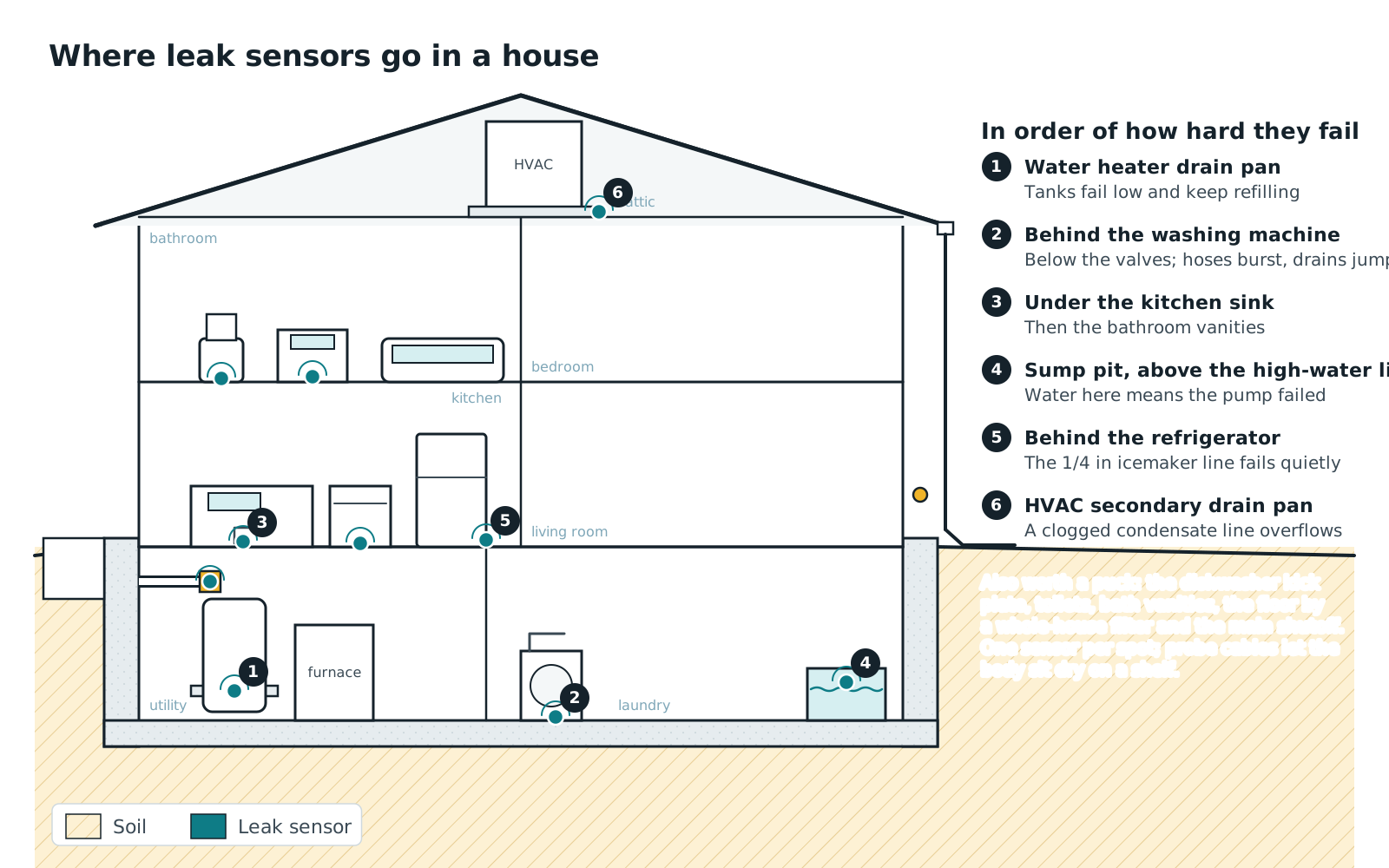
Work from the appliances that fail hardest to the ones you would notice anyway. One sensor per spot; the first six cover most houses.
- Water heater pan. A tank fails at the bottom and keeps refilling itself, so a 50-gallon heater can put hundreds of gallons on the floor overnight. Put the sensor or probe disc in the drain pan, not beside it. If the pan has a drain line, confirm it actually goes somewhere.
- Washing machine. Behind or under the washer, below the supply valves. Braided hoses still burst; the drain hose jumps out of the standpipe. A probe cable lets the sensor body sit on the shelf while the probe lies on the floor behind the machine.
- Under sinks. Kitchen first (dishwasher supply and disposal share the cabinet), then bathrooms. Set the sensor at the back of the cabinet under the trap, where a weeping compression nut drips.
- Sump pit high-water line. Mount the sensor on the pit wall or hang a probe just below the rim, above the float's normal high point. If water reaches it, the pump has failed or cannot keep up. This is where long-range radios earn their keep; a pit under a slab is a Wi-Fi dead zone.
- Behind the refrigerator. Icemaker and water dispenser lines are 1/4-in plastic or copper, and they fail quietly behind an appliance nobody moves for years.
- HVAC drain pan. A clogged condensate line overflows the secondary pan in the attic or the closet; by the time the ceiling stains, the drywall is done. A probe disc in the pan beats a float switch that nobody tests.
Also worth a sensor: the dishwasher kick plate, a basement toilet, the boiler room, and the floor under a whole-house filter housing. In crawl spaces, put one at the lowest point and one near the main shutoff.
How to choose
Battery life and the year-three problem
We score battery life at 20% of the rubric because most sensors are dead when the leak comes. YoLink rates its Water Leak Sensor 1 at five-plus years on two AAA cells and Govee rates the 1s at up to five years on two AAA; both report battery level to the app. Ring quotes a maximum of three years on a 3 V lithium cell. Moen's detector runs about two years on a CR123A. Eve Water Guard plugs into the wall, so there is no battery to track, but it also cannot go anywhere without an outlet. Zircon's 9 V box does not publish a life figure and beeps when it is low.
Whatever you buy, put the battery date on the sensor with a marker and put a yearly reminder in your phone to press the test button.
Radios: why range matters more than Wi-Fi
The places that flood are basements, crawl spaces and pits, which is also where Wi-Fi fades. YoLink's LoRa sensors are rated at a quarter mile open air to the hub; we have seen them report from detached pump houses and from pits under slabs. Govee's 1s talks 915 MHz to its gateway, rated at 1,804 ft, which is plenty for a large house and most outbuildings. Ring's Z-Wave sensors reach 250 ft to the base station and ride a mesh of other Ring devices. Eve uses Thread. Moen's detector is pure 2.4 GHz Wi-Fi, which is fine for an upstairs laundry and risky for a crawl space.
The trade-off for long range is a hub. YoLink, Govee, Ring and Eve (for alerts away from home) all need one plugged in somewhere. The rubric gives a small bonus to no-hub designs because a hub is one more thing to lose power, but we would rather have a hub and a sensor that reports than no hub and a sensor that quietly dropped off the network.
Freeze alerts
Burst pipes from freezing are the single most expensive residential water loss we see, and they happen in garages, crawl spaces and cabins where nobody is standing. Ring's Flood and Freeze Sensor is built for it. Moen's detector reports temperature and lets you set an alert anywhere in its 0 to 140°F range, so a 38°F alert is a practical freeze warning, and it adds humidity alerts that catch a damp basement. Govee's 1s, YoLink's Sensor 1, Eve Water Guard and Zircon do not publish temperature reporting, so if freeze is your worry, buy accordingly or add a dedicated temperature sensor from the same ecosystem.
Probe cables and sensing discs
A probe or cable lets the electronics stay dry and high while the sensing element reaches the low spot: the bottom of a water heater pan, the back corner behind a washer, the inside of a sump pit. Moen includes a 48-in remote sensing disc and sells a 6-ft cable that chains up to three deep. Eve Water Guard is nothing but cable: 6.5 ft in the box, extendable to 490 ft, and it senses along the whole length, which is how you line a basement perimeter with one device. Govee sells a cabled variant of the 1s separately. YoLink's Sensor 1 and Ring's sensor have electrodes on the puck itself, so the puck sits in the water; YoLink's Sensor 2 adds a probe if you need one.
Local sirens
A loud sensor still matters when you are home. Govee's 1s is adjustable to 105 dB, Eve's siren is 100 dB, and Zircon's is 90 dB with no app at all. YoLink and Ring do not publish a siren rating for the sensor; Ring's base station does the shouting and YoLink sells a separate siren. For an occupied laundry room, loud wins. For a vacation home, nobody hears anything, so phone alerts and a shutoff valve are the only things that count.
How sensors pair with a shutoff valve
A sensor that can close the main is a different product from one that can only text you. Three of our picks can:
- YoLink: add the YoLink valve controller, which bolts onto your existing ball valve, and the sensors close it through local device-to-device pairing, with the power and internet down.
- Moen: the Smart Water Detector pairs with a Moen Flo on the main; a wet disc triggers the shutoff.
- Phyn: Phyn's Smart Water Sensor can be configured to have Phyn Plus shut off the water.
Govee, Ring, Eve and Zircon alert only. If you are starting from scratch and think you will ever want automatic shutoff, buy into one of the three ecosystems above. We compare the valves in our smart water shutoff roundup and the two big inline units in Moen Flo vs Phyn Plus.
What we skipped and why
Ring Alarm Flood and Freeze Sensor. Good if you already own a Ring base station, and the only pick with a dedicated freeze function, but it needs the base station and Ring notes a compatible subscription is required for alerts. It stays in the table for Ring households.
Zircon Leak Alert. A 90 dB local alarm with no connectivity. We keep a few in occupied rooms and rentals, and it is in the table, but it cannot win a category that is about alerts while you are away.
Aqara Water Leak Sensor. A solid Zigbee puck for Aqara hub owners; Eve took the slot because Eve publishes cable length, extension limit and siren rating on its own site and the long cable solves a problem pucks cannot.
Generic Wi-Fi pucks with no published battery life or range. If the manufacturer will not state battery life, we will not recommend it.
How we test and score
We do not run a sensor lab and we do not claim to. We place these on real water losses and in our own mechanical rooms, we read the manufacturer datasheets, and we score each product against the published rubric for this class: battery life (20%), phone alerts (15%), radio reliability (10%), freeze warning (10%), probe cable (10%), local siren (10%), temperature and humidity logging (10%), warranty (10%) and no hub needed (5%). Every spec comes from the manufacturer; where a value was not published we left it blank, and the coverage figure next to each score tells you how much of the rubric had data. We do not score on price.
How we score
Every product gets a DryHomeLab score out of 10 from a published rubric for its category: the specs that matter (capacity, coverage, flow at head height, sensor response, warranty) are verified against manufacturer documentation and weighted by how much they affect real-world drying and protection. Where our restoration crews have run the gear, field notes can move a score by at most 1.5 points, and the note is published. We never use Amazon star ratings. Read the full methodology.
Frequently asked questions
How many water leak sensors do I need?
Six covers most single-family homes: water heater pan, washing machine, kitchen sink, sump pit, behind the refrigerator and the HVAC drain pan. Add one per bathroom vanity and one at the lowest point of a basement or crawl space if you have them. Multipacks from YoLink and Govee make the first three or four cheap; buy the kit, then add singles where you find a risk you missed.
Do water leak sensors need Wi-Fi?
Only some. Moen's Smart Water Detector joins 2.4 GHz Wi-Fi directly with no hub. YoLink (LoRa), Govee (915 MHz) and Ring (Z-Wave) use low-power radios to a hub or gateway that sits near your router, which is why they work in crawl spaces and pits where Wi-Fi does not. Eve uses Thread and Bluetooth with an Apple home hub for alerts away from home. Zircon's Leak Alert uses nothing; it just sounds a 90 dB alarm.
How long do leak sensor batteries last?
Manufacturer ratings: YoLink five-plus years on two AAA, Govee up to five years on two AAA, Ring up to three years on a 3 V lithium cell, Moen up to two years on a CR123A. Eve Water Guard is mains powered. Real life is shorter in cold spaces because alkaline cells lose capacity below freezing; lithium AAA cells help in a garage or crawl space where the manufacturer allows them.
Can a leak sensor shut off the water?
By itself, no. Paired with a valve, yes: YoLink sensors close a YoLink valve controller on your existing ball valve, Moen's detector triggers a Moen Flo on the main, and Phyn's sensor can be configured to have Phyn Plus shut off the water. If automatic shutoff is the goal, buy into one of those three ecosystems; Govee, Ring, Eve and Zircon alert only.
Where should I put a sensor at the water heater?
In the drain pan, at the lowest point, using a probe disc or cable if the sensor has one so the electronics stay dry. If there is no pan, put the sensor on the floor at the base of the tank on the side away from the burner or elements. Tanks fail at the bottom seam and keep refilling, so this is the one spot where a sensor paired to a shutoff pays for itself in a single event.
Do leak sensors detect frozen pipes?
Only the ones that report temperature. Ring's Flood and Freeze Sensor alerts on dropping temperature, and Moen's Smart Water Detector lets you set a low-temperature alert anywhere from 0 to 140°F plus a humidity alert. Govee's 1s, YoLink's Sensor 1, Eve Water Guard and Zircon do not publish temperature reporting. A flow-monitoring shutoff on the main will not prevent the freeze but will close the water once the burst pipe starts flowing.
DryHomeLab is written and reviewed by the team behind HelpMeNow.com, a marketplace that connects homeowners with vetted local contractors for water-damage restoration, plumbing and waterproofing. Before HelpMeNow the same team ran a 24/7 water-damage restoration company in the Seattle area; the equipment on this site is what we specified, bought and ran on real water losses. We publish the rubric behind every score.
- Ran a 24/7 water-damage restoration company, Seattle area
- Operate HelpMeNow.com, a contractor marketplace
- Publishes its scoring rubric