
First decide: save it or pull it
Three questions, answered before you plug in a fan.
What kind of water? The IICRC S500 standard that restoration crews and insurers work from sorts water into three categories. Category 1 is clean: a supply line, a water heater, a tub overflow with nothing in it. Category 2 is significantly contaminated: a washing machine or dishwasher discharge, a toilet overflow with urine only, an aquarium, or clean water that has sat for a day or two in a warm room. Category 3 is grossly contaminated: sewage, a toilet overflow with feces, rising ground water or storm water, anything that came up through a floor drain. Carpet and pad touched by Category 3 water are removed and discarded, period. Category 2 carpet can sometimes be cleaned and saved by a professional with hot-water extraction and an antimicrobial; the pad goes. Category 1 is what this guide is about.
How long has it been wet? The EPA's mold guidance puts the start of growth on wet materials at 24 to 48 hours, and in restoration practice a carpet that has been wet for more than 72 hours is treated as Category 2 or worse regardless of where the water came from. If you found it today and it happened yesterday, go. If the water has been under the carpet for the better part of a week, the pad is growing mold, the backing is delaminating, and the carpet is a loss.
How much? One room, a few hundred square feet, with the water contained to the carpet and the bottom of the walls, is a homeowner job with rented or owned equipment. Water that has run under walls into other rooms, wet hardwood or laminate under the carpet, or a finished basement with wet drywall on three sides is a crew job; our 72-hour basement guide covers the bigger picture, and the form at the end reaches one.
If the answers are Category 1, under 48 hours, one room: here is the method.
Tools and materials
- A wet-dry vacuum, 12 gallons or larger, with the floor squeegee tool. For a room over about 200 sq ft, rent a carpet extractor with a wand instead; it pulls water out of the pad that a shop vac leaves behind.
- One or two air movers. A centrifugal (snail) air mover is the right tool for floating carpet because its snout tucks under the carpet edge; the Dri-Eaz Sahara Pro X3 is the classic, the XPOWER P-230AT is the small one a homeowner can own. Rent if this is a one-time loss.
- A dehumidifier with a drain hose. A large consumer unit (50 pints DOE) handles a small room; a rented LGR or the AlorAir Storm LGR Extreme for anything bigger. Fans without a dehumidifier just move water from the carpet into the air and back onto the cold walls.
- A moisture meter. A pin meter such as the General Tools MMD4E tells you whether the subfloor and the bottom of the drywall are dry; your hand cannot.
- Utility knife with fresh blades, pliers, a flat pry bar, knee pads, nitrile gloves
- Contractor bags for the pad; painter's tape and a marker for the reading grid
- A sandbag, a sand-filled tube or a few bricks in a towel to seal the carpet over the air mover snout
- Aluminum foil or plastic to put under furniture legs
- A knee kicker and tack strip (if you are relaying yourself) or a carpet installer's number
- A hygrometer for the room
The method, step by step
- 1
Stop the water and move the furniture
Close the valve, shut off the appliance, or shut the main. Then get everything off the wet carpet: furniture to a dry room, or at minimum foil or plastic under every leg. Wood stain and rust from furniture legs wick into wet carpet within hours and do not come out. Photograph the room before you move anything if there is any chance of an insurance claim: each corner, the water line, the source. Note the time.
- 2
Extract until the vacuum stops pulling water
Work the wet-dry vac or extractor slowly across the carpet in overlapping passes, pushing down hard on the squeegee; weight on the wand is what pulls water out of the pad. Empty it often. Go over the wettest area twice more after the rest of the room is done. Every gallon you extract now is a gallon the dehumidifier does not have to pull out of the air over three days. Expect to be surprised by how much comes out; a saturated pad holds several times the water of the carpet above it.
- 3
Release the carpet from the tack strip
Pick a corner of the wet area and, with pliers, grab the carpet an inch from the wall and lift; it pops off the tack strip pins. Work along the wall until the whole wet edge is free, plus a foot or two past where the carpet feels wet; water in the pad spreads farther than the carpet shows. Fold the carpet back onto itself without creasing it hard; the backing cracks if you fold it sharply while wet. Mind the tack strip; it is sharp, and a wet one with rust is a tetanus conversation.
- 4
Pull the pad and bag it
Wet pad does not dry in place and it is cheap; it comes out. Cut it into strips with the utility knife, peel it off the subfloor (it is stapled on wood, glued at the seams on concrete), roll it into contractor bags and get it out of the house, not into the garage next to the furnace return. Photograph a piece with the water line on it for the adjuster. Scrape the staples flat or pull them. If the subfloor is plywood or OSB, look at the seams; if it is concrete, note any efflorescence or standing water, and vacuum it.
- 5
Float the carpet on an air mover
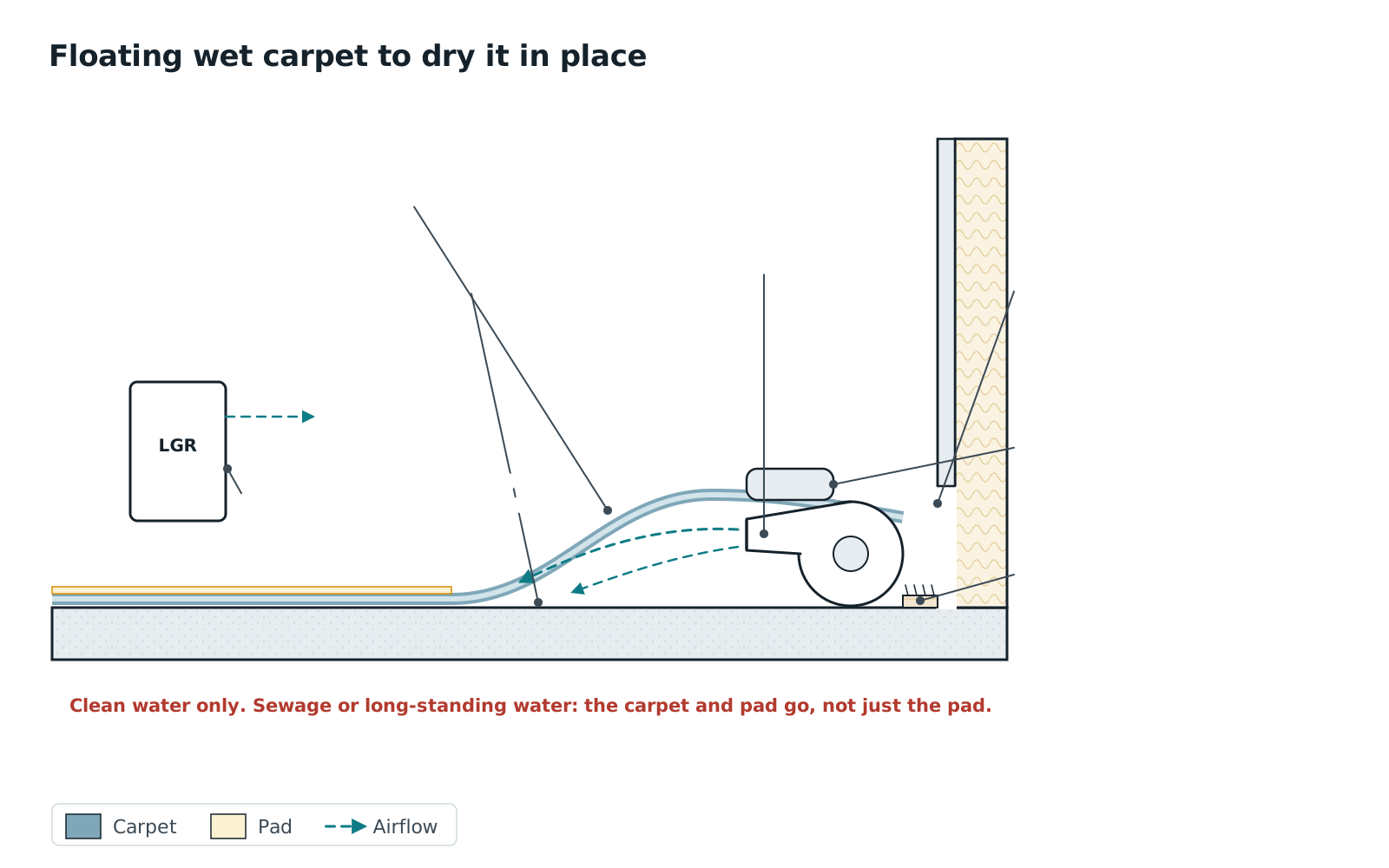
Set the air mover at the released edge with its snout pointed under the carpet, tuck the carpet edge over the snout, and lay the sandbag across the carpet behind the snout to seal the gap. Turn it on: the carpet lifts into a low arch on the air, which dries the backing and the subfloor at the same time. Weight the far edges of the carpet lightly so the air flows through rather than lifting the whole thing. A second air mover along the wall at 15 to 45 degrees keeps air moving across the exposed subfloor and the base of the walls. Do not stand a fan on the carpet pointing down; it does nothing for the back.
- 6
Close the room and start the dehumidifier
Shut the doors, close the HVAC register in the room (tape a piece of cardboard over it) so you are not pulling the wet air through the furnace, and put the dehumidifier in the room with its hose to a drain or a bucket you will empty. A 50-pint consumer unit covers a bedroom; a 300 sq ft family room wants an LGR. Set it to its lowest setpoint or continuous. The room should feel warm and dry within a few hours; if it feels cold and clammy, the dehumidifier is undersized or the room is open. The drying planner sizes it from the room dimensions.
- 7
Open the bottom of the walls if they are wet
Water under carpet runs under the drywall. Meter the wall 2 in. above the floor along the wet edge. If it reads wet, pull the baseboard (score the caulk, pry gently, number the pieces) and drill 3/8 in. holes through the drywall every 16 in. just above the sole plate so the air mover's flow gets into the cavity. If the drywall is wet more than a few inches up, or the insulation behind it is wet, it needs a flood cut; see the drywall section of the basement guide.
- 8
Meter it daily and decide on day three
Mark a grid of reading points with tape: the subfloor at the wettest spot and two others, the back of the carpet at the arch, the bottom of the drywall every 2 ft. Take a dry standard from an unaffected closet first. Read the same points at the same time each day with the same meter and photograph the display. Plywood and OSB read about 8 to 14 percent when dry and are wet above 16; the carpet's back should feel room-temperature and read like the dry standard. Readings should fall every day. When they match the dry standard and hold overnight, usually day two or three for carpet and day three to five for a wood subfloor, you are done. Run the dehumidifier one more day.
- 9
New pad, relay, stretch
Buy pad of the same thickness and density as the old (the installer can match it from a scrap); lay it, staple or seam-tape it, and relay the carpet, hooking it back onto the tack strip with a knee kicker from the dry side toward the wet side so it is tight. A carpet that was floated for three days usually relays fine; one that was wet for a week has shrunk or delaminated and will not. Replace any rusted tack strip. Re-caulk and reinstall the baseboard once the wall is dry. Then run the vacuum; floated carpet picks up grit from the subfloor.
How long it takes
With the pad out, the carpet floated, a dehumidifier running and the room closed: the carpet itself is typically dry in 24 to 48 hours, a plywood or OSB subfloor in three to five days, concrete longer but concrete does not rot. Hardwood or laminate under the carpet changes everything; laminate that got wet is done, and hardwood needs a specialty drying mat system and a crew. Without equipment, in a closed room in summer, wet carpet over wet pad does not dry; it just stops looking wet while the pad grows mold.
Smell, stains and cleaning afterward
A musty smell after relaying means something is still wet or the pad was left in somewhere. Meter again. Brown rings on the carpet are wicking stains from the pad or the subfloor; a hot-water extraction cleaning once everything is dry usually takes them out of synthetic carpet. Furniture stains and rust do not come out. Category 1 carpet does not need an antimicrobial; if someone is selling you one for clean water, ask why.
When it is a loss
Pull and discard the carpet and pad if any of these are true: the water is Category 2 or 3; it has been wet more than 72 hours; the backing separates from the face when you fold it (delamination); the carpet is jute-backed or wool and has been saturated; or the seams have opened. In those cases the job becomes cleaning and drying the subfloor and the bottom of the walls, and the carpet is a line on the insurance claim, which is cheaper than a mold job next spring.
Equipment we would rent or own
For a one-time Category 1 loss in one room, rent a centrifugal air mover and an LGR for three days. If your basement has done this before, own the small set: one air mover that stores on a shelf, a consumer dehumidifier with a hose, and a pin meter. The three below are the ones we point homeowners to.
Dri-Eaz Sahara Pro X3 TurboDryer
The classic snail-shell carpet dryer, now 27 lb and 4 amps.
Score breakdown
| Airflow | 2700 | 8.6 |
| Amps per fan | 4 | 2.9 |
| Warranty | n/a | — |
| Positioning options | 3 | 6.7 |
| Daisy-chain outlets | n/a | — |
| Portability | 27 | 3.2 |
| Durability | roto-molded polyethylene | 10.0 |
| Stackable | true | 10.0 |
| Quietness | n/a | — |
- 2,700 CFM with the static pressure to float a carpet and dry the pad underneath
- Rotomolded polyethylene housing is the most durable construction in the category
- Three positions including a 90° setting for ceilings
- Stackable for transport and storage
- 4.0 A per fan means only three on a 15 A circuit
- Loud compared with low-profile axial units
- Dri-Eaz does not list noise, cord length or warranty in the spec comparison we could verify
The Sahara Pro X3 is the centrifugal air mover most people picture when they think of a restoration fan: a roto-molded polyethylene snail shell that throws a fast, concentrated sheet of air along the floor. Dri-Eaz rates the current F351 version at 2,700 CFM on high with three speeds, drawing 4.0 A. The three positions (0°, 45° and 90°) let you float a carpet, aim up a wall, or point at a ceiling.
This is the fan for wet carpet and pad. A centrifugal unit develops more static pressure than an axial fan, so it will lift the edge of a carpet and drive air underneath it, which an axial fan does poorly. On a hardwood or tile floor the advantage shrinks and the extra noise is harder to justify.
The trade-offs are power and sound. At 4.0 A you get three of these on a 15 A circuit, so a larger loss means spreading fans across several breakers or running cords from another room. It is louder than a low-profile fan; expect to close the door on the room. At 27 lb it is lighter than the previous generation but still twice the weight of a compact unit, and the rotomolded housing is the reason it survives being thrown in a truck for a decade.
Buy it if carpet is what gets wet in your house. If your losses are on hard floors and walls, a low-profile fan dries the same area with less noise and electricity.
XPOWER P-230AT Mini Mighty Air Mover
A 10 lb centrifugal with a timer and daisy-chain outlets, for the price of a good box fan.
Score breakdown
| Airflow | 925 | 0.6 |
| Amps per fan | 2.3 | 7.7 |
| Warranty | n/a | — |
| Positioning options | 4 | 10.0 |
| Daisy-chain outlets | true | 10.0 |
| Portability | 10.2 | 9.9 |
| Durability | plastic | 5.0 |
| Stackable | true | 10.0 |
| Quietness | n/a | — |
- 925 CFM at only 2.3 A, so six fit on a 15 A circuit
- Daisy-chain outlets for up to four units and a 3-hour timer
- 10.2 lb and stackable; easy to store between leaks
- Four positions including a 20° kickstand for wall bases
- 10 ft cord is short for basements
- Airflow suits one room, not a whole floor
- Polypropylene housing is lighter duty than rotomolded professional units
- Warranty term is not on the spec sheet; confirm with XPOWER before buying
The P-230AT is the compact air mover we recommend most often to homeowners who want something better than a box fan without paying contractor prices. XPOWER's spec sheet lists a 1/5 HP motor rated at 925 CFM, 2.3 A, three speeds, and four drying positions (0°, a 20° kickstand, 45° and 90°). It weighs 10.2 lb, so it goes up a stairway in one hand.
Two features punch above the price. The daisy-chain outlets let you link up to four units on one cord, which is how you dry a whole room from a single outlet, and the 3-hour timer means you can set it under a sink cabinet and let it shut itself off. It stacks for storage.
The limits are the ones you would expect from a small housing. At 925 CFM it dries a bathroom, a closet or a 10 x 12 ft room; a flooded basement needs several of these or a bigger fan. The 10 ft cord is short for basement work, so plan on a heavy-gauge extension cord. The housing is polypropylene, fine for a garage shelf but not the rotomolded shell a crew throws in a van every day. XPOWER lists an older rating of 800 CFM for this model on some retailer pages; the current manufacturer sheet says 925 CFM. Treat the airflow as modest either way and buy two if the wet area is bigger than a bathroom.
Buy it if you want a real air mover for a one-room leak, a rental unit, or a crawl space hatch, and you want to spend about what a decent dehumidifier filter costs per year.
General Tools MMD4E Digital Pin Moisture Meter
The cheap pin meter that is accurate enough to tell you whether to open a wall.
Score breakdown
| Accuracy | 2 | 7.5 |
| Versatility | pin | 7.0 |
| Professional grade | false | 0.0 |
| Warranty | 1 | 0.0 |
| Calibration check | true | 10.0 |
| Scan depth | n/a | — |
| Reading hold | true | 10.0 |
| Backlight | true | 10.0 |
| Temperature / RH | false | 0.0 |
- Manufacturer-rated ±2% accuracy, unusual at this price
- Calibration check holes in the pin cap (18.3% reference)
- Backlight, hold, audible alarm and auto power-off
- Two scales: wood 5–50% and building materials 1.5–33%
- Pin holes in every surface you test
- No species or temperature correction
- One-year warranty
- Reads only the surface unless the pins penetrate
The MMD4E is the pin meter most homeowners end up with, and for once the popular choice is a sound one. General Tools rates it at ±2% across a 5 to 50% range for wood and 1.5 to 33% for building materials, with a backlit LCD, a hold button, an audible alarm that trips at 16% in wood and 20% in building materials, and auto power-off after three minutes. It runs on a 9 V battery and the pins are replaceable.
The feature that earns it a place on a professional's list is the calibration check built into the pin cap: press the pins into the two holes and the meter should read 18.3% ±1% in wood mode. That is a real check against a fixed resistor, not a self-test light, and it is why we trust this meter more than pinless meters at the same price that cannot be verified at all.
What it will not do: it reads only where the pins touch, so you leave two small holes per reading and you only learn about the surface layer unless you drive the pins through paint into the paper and gypsum. It has no species or temperature correction, so treat wood readings as approximate and always compare with a dry reference area in the same house. The one-year warranty is short.
Buy it if you want to know, today, whether the drywall behind the washing machine is wet. Pair it with a pinless meter if you need to scan a whole room without leaving marks.
We don't copy Amazon reviews. Read customer reviews on Amazon (paid link).
When to call a pro
Call if the water is from a drain, a toilet or outside; if it has been wet more than two days; if more than one room is wet or the water reached finished walls on more than one side; if there is hardwood, laminate or an engineered floor under or next to the carpet; if the subfloor is swelling or feels soft; if a moisture meter shows readings that stop falling for two days; or if the loss is going through insurance and the adjuster wants drying logs and a moisture map. A restoration crew brings a truck-mounted extractor that pulls more water in an hour than a shop vac does in a day, meters everything, and documents it for the claim. The form below reaches vetted local restoration contractors through HelpMeNow.com.
Frequently asked questions
How long does it take for wet carpet to dry?
With the pad removed, the carpet floated on an air mover and a dehumidifier running in a closed room, the carpet itself is usually dry in 24 to 48 hours and a wood subfloor in three to five days; confirm with a moisture meter against a dry standard rather than by touch. Left in place over wet pad with a fan on top, carpet does not reliably dry at all; the surface feels dry in a day while the pad underneath grows mold.
Can wet carpet be saved?
Clean-water (Category 1) carpet found within about 48 hours almost always can, if the pad is removed, the carpet is floated and dried, and the subfloor is metered dry. Carpet wet from a drain, toilet or outside water (Category 3) is discarded; Category 2 carpet from a washer or dishwasher can sometimes be professionally cleaned and saved. Carpet wet more than 72 hours, or whose backing separates when folded, is a loss regardless of source.
Do I have to replace the carpet pad?
Yes, if it got wet. Pad is a sponge that holds several times the water of the carpet above it, does not dry in place, and is cheap. Cut it into strips, bag it, photograph a piece for the insurance claim, and replace it with pad of the same thickness and density when the subfloor meters dry. Leaving wet pad under a dried carpet is the most common cause of the musty smell and the mold we find when we pull carpet months later.
Will wet carpet mold?
The EPA puts the start of mold growth on wet materials at 24 to 48 hours, and restoration practice treats carpet wet more than 72 hours as contaminated. The pad and the backing grow mold before the face does, so a carpet can look fine on top and be growing underneath. Extract, pull the pad and get air and dehumidification on it within the first day, and meter it dry; if you are already past three days, plan on removing it.
Can I just use a fan to dry wet carpet?
A fan alone dries the top of the carpet and leaves the pad and subfloor wet, and in a closed room it raises the humidity until evaporation stalls. You need air moving across the back of the carpet (floated on a centrifugal air mover with the pad out) and a dehumidifier taking the water out of the air. A box fan is better than nothing for a small damp spot; it is not a drying setup for a soaked room.
Does insurance cover wet carpet?
Usually for sudden, accidental water from inside the house (a burst supply line, a failed water heater, an overflowed tub) and usually not for ground water, surface flooding or sewer backup without an endorsement. Photograph everything before you move it, call the insurer the same day, keep receipts for rental equipment and new pad, and keep a daily log of moisture readings; policies require you to take reasonable steps to prevent further damage, and renting an air mover and dehumidifier is that step.
DryHomeLab is written and reviewed by the team behind HelpMeNow.com, a marketplace that connects homeowners with vetted local contractors for water-damage restoration, plumbing and waterproofing. Before HelpMeNow the same team ran a 24/7 water-damage restoration company in the Seattle area; the equipment on this site is what we specified, bought and ran on real water losses. We publish the rubric behind every score.
- Ran a 24/7 water-damage restoration company, Seattle area
- Operate HelpMeNow.com, a contractor marketplace
- Publishes its scoring rubric