
The target: 30 to 50 percent, never over 60
The EPA's guide to mold and moisture in homes puts it in one sentence: keep indoor humidity below 60 percent, ideally between 30 and 50 percent relative humidity. For a basement we aim at 50 in summer and let it fall toward 35 in winter. Below 30 the air is dry enough to crack wood and raise static; above 60 for days at a time is where mold grows on cardboard, the back of drywall and the dust on everything, and where the musty smell comes from. Dust mites need humidity above about 50 percent, which is the reason the band stops where it does.
Two more numbers matter alongside the percentage. Temperature, because relative humidity is relative to it; a basement at 62°F and a living room at 74°F holding the same air give very different readings. And dew point, the temperature at which the air in the room will start to condense on a surface. If the slab, a cold water pipe or a duct is below the dew point of the basement air, that surface is wet no matter what the hygrometer says. Most digital hygrometers show the first two; the table below does the third for you.
Why a basement is humid when the house is not
A basement is the coldest space in the house in summer, and humidity follows temperature downhill. Take the air from upstairs on a July afternoon, 75°F at a comfortable 50 percent. Its dew point is about 55°F. Carry that same air down the stairs into a basement sitting at 65°F and, with not one drop added, it now reads about 70 percent. Against a slab or a cold water line at 55°F it is at 100 percent, which is why pipes sweat and the floor feels clammy. Outdoor air on a muggy day is worse: 85°F at 60 percent has a dew point near 70°F, so letting it into a 65°F basement through an open window condenses water onto every surface in the room. Opening basement windows in summer makes a basement wetter, not drier.
The same air at three temperatures
| Where the air is | Temperature | Relative humidity | What you notice |
|---|---|---|---|
| Living room, July afternoon | 75°F | 50% | Comfortable. Dew point about 55°F. |
| Same air in the basement | 65°F | about 70% | Musty smell within days; mold on cardboard and the back of drywall over a season. |
| Same air at a cold pipe or the slab | 55°F | 100% | Condensation. Sweating pipes, damp floor, rust on tool boxes. |
| Outdoor air through an open window | 85°F at 60% outside | above 100% at 65°F | Dew point near 70°F; it rains inside the basement onto anything cooler than that. |
Nothing was added to the air in the first three rows. Cooling it is enough. A dehumidifier works by removing water so the basement's dew point drops below the temperature of its coldest surface.
How to measure it so the number means something
- 1
Buy two hygrometers and check them against each other
Inexpensive digital hygrometers are accurate to within a few percent at best, and some are off by ten. Set two side by side overnight; if they disagree by more than three points, run the salt test on both: put a bottle cap of table salt wetted to a slush inside a sealed zip-top bag with the hygrometer, wait eight hours at room temperature, and it should read close to 75 percent. Note each unit's error on a piece of tape on its back and subtract it from every reading. Units with a min/max memory are worth the extra cost; the overnight peak tells you more than any single reading.
- 2
Place the first in the middle of the room
Chest height, 3 to 5 ft off the floor, on a shelf or hung from a joist in the open part of the basement, at least 6 ft from a dehumidifier, the furnace, the dryer, a window or an exterior wall. This is the reading that describes the room. A hygrometer sitting on the slab, in a window well, or in the dehumidifier's exhaust describes only that spot.
- 3
Place the second where the trouble is
The far corner the air never reaches, inside a closed storage room, under the stairs, or behind the furnace. Same height. The difference between the two readings is what tells you whether the basement needs more air movement rather than a bigger dehumidifier; a room that reads 48 in the middle and 68 in the back corner has a circulation problem, and the fix is a fan and an open door before it is another machine.
- 4
Log morning and evening for a week
Write down both readings, the temperature, and the weather, twice a day for seven days. A basement that rises after every rain and falls two days later is taking on water through the walls or floor. One that climbs on hot humid afternoons and falls at night is breathing outdoor air through gaps, the dryer vent, or open windows. One that sits at 65 percent day and night regardless of weather needs a dehumidifier, or has one that is undersized.
- 5
Check the surfaces, not just the air
Tape the square of plastic sheeting to the slab in the dampest-feeling area, and another to a below-grade wall, all four edges sealed, for 48 hours. Water droplets on the underside mean moisture is coming up through the concrete, a water problem the dehumidifier will fight forever. Droplets on top mean room air is condensing on a cold slab, a humidity problem the dehumidifier solves. If you own a moisture meter, read the bottom plate of any framed wall and a joist near the rim; framing that reads above 16 percent moisture content is wet enough to support growth and tells you the humidity has been high for a long time. Our moisture meter roundup covers the readings.
- 6
Decide with the numbers in front of you
Center reading under 50 all week: nothing to do but keep logging each season. Center reading between 50 and 60: a dehumidifier set to 50, placed and drained as described below. Over 60 with no rain pattern: a dehumidifier sized for the space, and a check that windows and the dryer vent are closed. Over 60 that tracks the rain, or water under the plastic: the section on water problems below comes first, and the dehumidifier is what you run while you fix it.
When a dehumidifier is the answer, and how to run it
If the plastic stayed dry underneath and the humidity does not follow the rain, the basement's problem is air, and a dehumidifier is the whole fix. Three things make it work:
Size it for the space. Capacity on the box is pints per day at the DOE 2019 test condition, which is 65°F and 60 percent, close to a real basement. A 50-pint unit covers most basements up to about 1,500 sq ft of real floor area; a very damp or very large basement wants two units or a commercial one. The calculator below does the arithmetic from your floor area, ceiling height and how damp the space reads.
Set it to 50 and leave it. Lower setpoints cost more electricity for no benefit; 45 is as low as a basement needs in summer. Most units stop at their setpoint and restart a few points above it, so a 50 setting holds the room between 50 and 55.
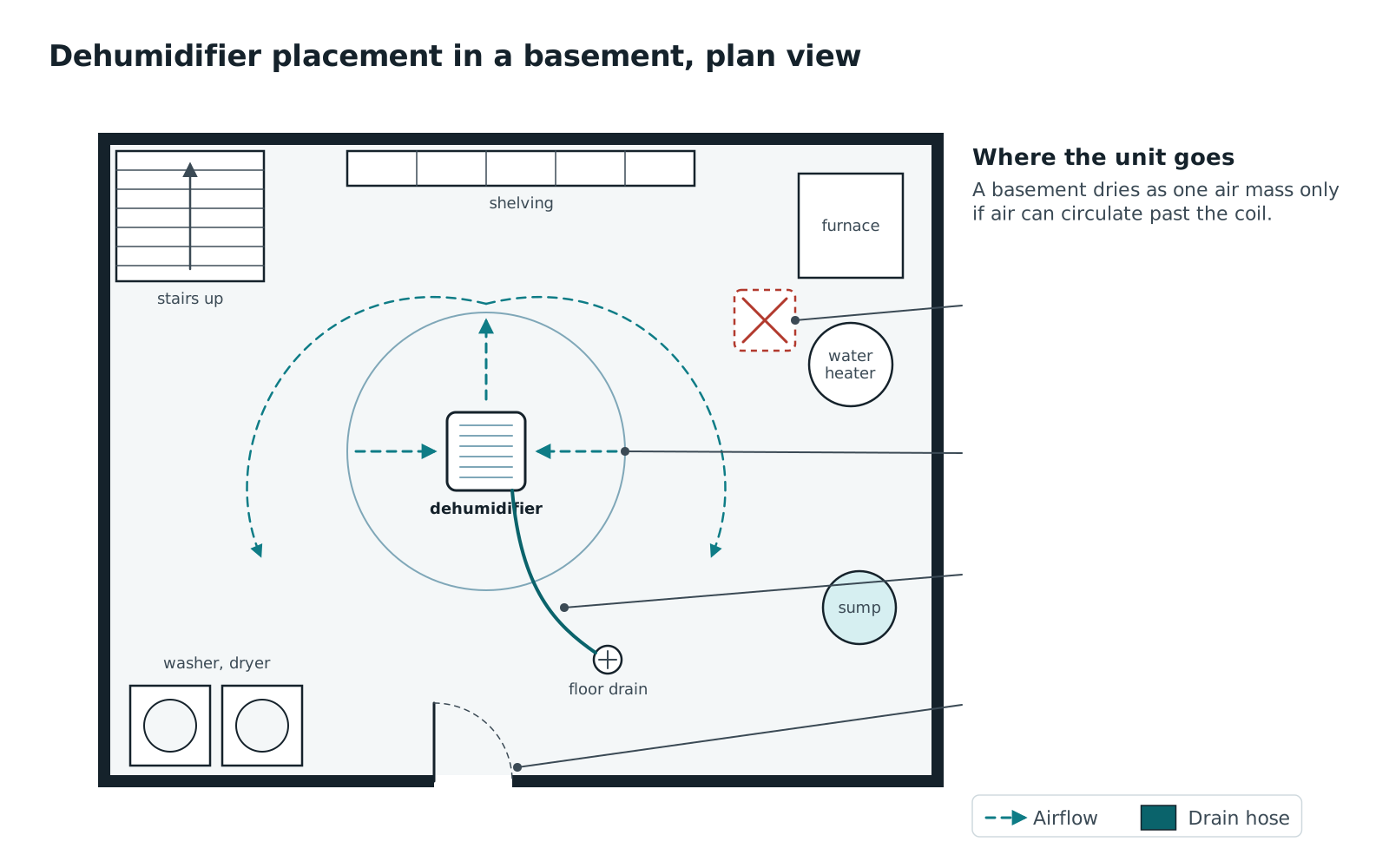
Put it where the air can reach it and the water can leave. Open floor, roughly central, a foot of clearance all round, not in a corner or a closet, with the continuous drain hose falling to a floor drain or the sump so the bucket never stops it at 2 a.m. The drawing shows where and our drain setup guide covers the hose, the air gap and the pump option for a drain that is uphill.
What size dehumidifier do you need?
Enter the space. We size by the current DOE pint rating (the number on the box since 2019), with the headroom restoration crews build in.
- Minimum removal needed: about 12 pints/day; with 25% headroom, 15 pints/day.
- Estimated running cost: roughly $15/month in season at ~300 W. ENERGY STAR units cut this 10–15%.
- Route the drain hose to a floor drain or condensate pump so it never stops to empty a bucket.
- Midea Cube 50-Pint (MAD50S1QWT)Score 7.2 · 50 pt/day · 4500 sq ftCheck price
- Frigidaire FHDD5033Y1 50-Pint with Wi-FiScore 6.6 · 50 pt/day · ? sq ft
- Paid links.
The full dehumidifier size calculator explains the math and the 2012-versus-2019 pint ratings. For the units themselves, our basement dehumidifier picks are the ones below and their siblings; a crawl space is a different problem with a colder target range, covered in the crawl space roundup.
When it is a water problem, not a humidity problem
A dehumidifier removes water from air. It cannot remove the water that a wall or floor delivers every day, and a basement with a water source will hold a 50-pint unit at full output all summer and still read 65. These are the signs that the humidity is a symptom:
- The reading tracks the weather. Up a day after rain, down a few days later. Ground water is coming through the walls or the slab, or in at the footing.
- Water under the plastic sheet. Vapor is moving through the concrete from wet soil behind it.
- White crust on the walls or floor. Efflorescence is the mineral that water left behind on its way through the concrete.
- The bucket tells on the house. A 50-pint unit in a closed basement should taper off to a few pints a day once the space is dry. One that still fills its bucket daily in week three, in dry weather, is being fed.
- Damp to the touch at the base of the wall, a tide line, rust at the bottom of metal shelving, a sump that runs in dry weather.
The order of fixes is outside-in and mostly cheap: downspouts extended 6 ft or more from the foundation, soil graded to fall away from the house, window wells covered and drained, cracks sealed, and a sump pump with a battery backup if there is a pit. Interior drain systems and exterior membranes come after those, not before. The dehumidifier stays running through all of it; it just stops being the plan.
What the seasons do to a basement
| Season | Typical basement reading | What drives it | What to do |
|---|---|---|---|
| Summer | 60 to 75% without a dehumidifier | Warm humid air cooling in the coldest room of the house; open windows and the dryer vent make it worse | Dehumidifier set to 50, windows closed, cold pipes insulated |
| Fall | Falling through the 50s | Outdoor dew points drop; the slab is at its warmest | The unit cycles less; clean the filter and check the drain hose |
| Winter | 30 to 45% | Heating season dries the house; the slab and walls are cold, so any humidity shows up as condensation on windows and the rim joist | Most basements need no dehumidifier; watch for frost or sweat at the rim joist and on cold-side walls |
| Spring | Rises with the thaw and the rain | Ground water, a high water table, and the first humid days arriving while the basement is still cold | Dehumidifier back on; this is when a water problem shows itself |
Log one week in each season. The pattern over a year tells you more than any single reading, and it is what a contractor will ask for.
Midea Cube 50-Pint (MAD50S1QWT)
The basement portable with a bucket you can actually live with.
Score breakdown
| Moisture removal | 50 | 10.0 |
| Efficiency | 2.01 | 7.6 |
| Coverage | 4500 | 10.0 |
| Built-in pump | false | 0.0 |
| Quietness | n/a | — |
| ENERGY STAR certified | true | 10.0 |
| Warranty | 1 | 0.0 |
| Tank size | 4.25 | 10.0 |
| Continuous drain | true | 10.0 |
| Cold-room operation | 41 | 7.5 |
- Extended bucket holds about 4.25 gal per the manual's fill table; roughly double a standard 50-pint tank
- ENERGY STAR certified; 2.01 L/kWh integrated energy factor on the current R-32 revision
- Continuous-drain hose included; cabinet nests to half height for storage
- App and voice control with humidity readout; 41.5 lb, lighter than most 50-pint boxes
- No pump on this SKU (the MAD50PS1QWT has one)
- 1-year warranty
- 41°F minimum operating temperature, like every compressor portable
- Midea does not publish a sound level for this model
The Cube is the portable we recommend first for basements, and the reason is not the compressor; every 50-pint unit on this page pulls about the same water. It is the bucket. Midea's lift-and-twist cabinet nests for storage and extends for use, and the owner's manual's fill table puts the extended bucket at roughly 4.25 gallons at its top mark, about double a conventional 50-pint's 1.9-gallon tank. If you have to run on the bucket, that is one trip a day in a damp basement instead of two or three. For everyone else, the continuous-drain hose is in the box: run it to a floor drain or sump and forget the bucket entirely.
Midea rates it at 50 pints per day (the DOE 2019 rating, the number on the box since 2019) for spaces up to 4,500 sq ft, with app and voice control, a 1-year warranty, and 41.5 lb. ENERGY STAR lists the current revision, MAD50S1QWT-A with R-32 refrigerant, at 49.67 pints per day and an integrated energy factor of 2.01 L/kWh, 515 kWh a year on the federal test; that is the same efficiency as the Frigidaire 50-pints and the common figure for the class. The manual gives the operating range as 41°F to 95°F, which is standard for a compressor portable and the reason a basement that sits below 50°F needs a different class of machine. There is no pump on this SKU; the MAD50PS1QWT adds one with up to 14 ft of lift per the manual.
What we have not verified: Midea does not publish a sound level for the 50-pint Cube on its US or Canadian pages, so that cell stays empty. Buy the Cube for a basement up to about 1,500 sq ft of real, damp floor area (manufacturer coverage numbers assume a sealed room; size with our calculator) where you can drain by gravity or do not mind the bucket. Skip it if you need to pump uphill, or if the space runs cold.
We don't copy Amazon reviews. Read customer reviews on Amazon (paid link).
Frigidaire FHDD5033Y1 50-Pint with Wi-Fi
The current Frigidaire 50-pint: a conventional box with a published spec sheet and a Wi-Fi app.
Score breakdown
| Moisture removal | 50 | 10.0 |
| Efficiency | 2.01 | 7.6 |
| Coverage | n/a | — |
| Built-in pump | false | 0.0 |
| Quietness | 51.5 | 5.7 |
| ENERGY STAR certified | true | 10.0 |
| Warranty | 1 | 0.0 |
| Tank size | 1.9 | 7.5 |
| Continuous drain | true | 10.0 |
| Cold-room operation | 41 | 7.5 |
- Full manufacturer spec table: 50 pints/day, 49–51.5 dBA, 8.8 A, 41.45 lb
- ENERGY STAR certified; 2.01 L/kWh integrated energy factor
- Wi-Fi app with schedules and setpoint; Alexa and Google Home
- Conventional front bucket and rear continuous-drain port; washable filter
- 1.9-gallon bucket fills twice a day in a wet basement; run it on a hose
- 1-year warranty
- No pump on this SKU (buy the FHDP5033Y1)
- Frigidaire does not publish a coverage figure
The FHDD5033Y1 is Frigidaire's current 50-pint, the direct replacement for the FFAD5033W1 that spent a decade as the default basement dehumidifier, and it is the conventional box we recommend when the Midea Cube's nesting bucket does not appeal. Frigidaire publishes a real specification table for it: 50 pints per day (DOE), a 1.9-gallon bucket, 197 CFM on low and 218 on high, 49 dBA on low fan and 51.5 on high, 8.8 A and 470 W, a 72-in. cord, 41.45 lb, and a 19.1 by 18.9 by 9.9 in. cabinet. ENERGY STAR lists it at 49.95 pints per day and an integrated energy factor of 2.01 L/kWh, 520 kWh a year on the federal test, with R-32 refrigerant. Frigidaire rates it to run down to 41°F, which is the floor for every compressor portable.
It is a front-bucket, rear-drain design: the continuous-drain port takes a standard hose, the washable filter pulls out of the back, and the controls are on top. The Frigidaire app adds remote on/off, setpoint, schedules and fan speed, and it works with Alexa and Google Home. There is no pump; the FHDP5033Y1 is the same machine with one.
The weaknesses are the ones the whole class shares. The 1.9-gallon bucket fills twice a day in a wet basement, so run it on the hose. The warranty is 1 year of labor coverage. Frigidaire does not publish a coverage figure, which we count as honesty rather than a gap; size it with our calculator. Buy it for any damp basement up to about 1,500 sq ft of real floor area with a floor drain or sump within hose reach. Buy the Cube instead if you will run on the bucket, and the FHDP5033Y1 if the drain is uphill.
When to call a pro
Call a basement waterproofing contractor if the humidity tracks the rain and the outside-in fixes have not changed it, if there is water under the plastic sheet on more than one wall, if a crack weeps, or if the sump runs in dry weather. Call a restoration or remediation contractor if you find growth covering more than about 10 square feet, which is the EPA's threshold for professional mold remediation, or any growth inside ductwork or on insulation. A home inspector or a crawl space contractor with a moisture meter can read the framing if you do not own one. The form below reaches vetted local waterproofing, encapsulation and restoration contractors through HelpMeNow.com.
Frequently asked questions
What is the ideal humidity for a basement?
Between 30 and 50 percent relative humidity, measured at chest height in the middle of the room, with 60 percent as the ceiling you should never sit above for days at a time. That is the EPA's guidance for indoor spaces generally, and basements are the room in the house most likely to break it because they are the coolest. Aim for 50 in summer with a dehumidifier and let it drift down toward 35 in winter.
Is 60 percent humidity too high for a basement?
Yes, if it stays there. Sixty percent in the middle of the room means 70 or more in the cool corners and 100 on the slab and cold pipes, which is where condensation, rust and mold start. A reading of 60 for an afternoon after a storm is not an emergency; a reading of 60 every evening for a month is the point at which cardboard, fabric and the paper on drywall begin to grow things. Set the dehumidifier to 50.
Where should I put a hygrometer in my basement?
In the open part of the basement, 3 to 5 ft off the floor, at least 6 ft from the dehumidifier, the furnace, the dryer, a window or an exterior wall. Then put a second one in the worst spot: the far corner, a closed storage room, or behind the furnace. The first tells you about the room, the second tells you whether the air is reaching every part of it. A hygrometer on top of the dehumidifier reads the machine's exhaust and will tell you the basement is dry when it is not.
Why is my basement humidity still high with a dehumidifier running?
In order of likelihood: the hygrometer is next to the unit and the far end of the basement is not getting any airflow; the unit is in a corner or closet and starving its own intake; a window, the dryer vent or a door to the garage is feeding it humid air; the unit is undersized for the floor area; the room is below the unit's operating temperature and the coil is icing; or the basement has a water source, in which case the reading rises after rain and there is moisture under a taped square of plastic on the slab. Fix the measurement and the placement first, then size, then look for water.
What should I set my basement dehumidifier to?
Fifty percent. Most units stop at the setpoint and restart a few points above it, so a 50 setting holds the room between about 50 and 55, which is under the mold threshold with a margin. Forty-five is as low as a basement needs; lower settings cost electricity and change nothing you can see. Run it continuously with the drain hose to a floor drain rather than on a timer, and check the far-corner hygrometer, not the one on the machine.
Does opening basement windows reduce humidity?
In summer it does the opposite. Outdoor air at 85°F and 60 percent has a dew point near 70°F; when it enters a 65°F basement it is over saturation and condenses on the slab, pipes and walls. Open windows only when the outdoor dew point is below the basement temperature, which in most of the country means cool dry days in spring and fall, and close them when it is muggy. A dehumidifier in a closed basement does what the window cannot.
The seasonal checklist, by email
One email when the season changes — freeze week, spring thaw, hurricane season — with the checklist for that month. No weekly newsletter, no selling your address.
We send one confirmation link first. Every email has a one-click unsubscribe. Privacy.
Check your inbox for the confirmation link; the checklist follows as soon as you click it.
You are on the list. The next email arrives when the season changes.
That did not go through. Check the address and try again.
DryHomeLab is written and reviewed by the team behind HelpMeNow.com, a marketplace that connects homeowners with vetted local contractors for water-damage restoration, plumbing and waterproofing. Before HelpMeNow the same team ran a 24/7 water-damage restoration company in the Seattle area; the equipment on this site is what we specified, bought and ran on real water losses. We publish the rubric behind every score.
- Ran a 24/7 water-damage restoration company, Seattle area
- Operate HelpMeNow.com, a contractor marketplace
- Publishes its scoring rubric