
Our picks
Protimeter SurveyMaster BLD5365 Dual-Function Moisture Meter
The meter insurers expect to see in the photos.
Pin and search modes, a calibration check device included, and the WME scale that works across every material in a house.
General Tools MMD4E Digital Pin Moisture Meter
The cheap pin meter that is accurate enough to tell you whether to open a wall.
±2% stated accuracy and a calibration reference in the pin cap for the price of a pizza.
Delmhorst BD-2100 Pin Moisture Meter
The pin meter with a real gypsum scale, built in the US for restoration work.
A true gypsum scale for drywall, built-in calibration check, and hammer-probe electrodes for framing.
Tramex ME5 Moisture Encounter 5
The pinless meter restoration crews sweep across drywall, with a shallow mode for thin materials.
Reads 1 1/4 in deep across drywall, plaster, tile and masonry without a mark.
Who this is for
A moisture meter answers the question every water problem comes down to: is it still wet in there? We use them to decide which walls to open, when the fans can go home, and whether the house a client is about to buy has a leak nobody disclosed. A good one costs less than an hour of a plumber's time; a bad one gives you confident wrong answers.
There are three kinds of buyers. The homeowner with a leak this week needs a pin meter that is accurate and can be checked, and the General Tools MMD4E is that. The buyer who wants one meter for leaks, firewood and a home inspection should get a dual pin/pinless meter; the Extech MO55 is the affordable one and the Protimeter SurveyMaster is the professional one. The landlord, inspector or restoration tech whose readings will be questioned by an adjuster should carry the SurveyMaster or a Delmhorst and a Tramex, which is roughly what our crews carry.
How to read a moisture meter
Start with a dry standard
No meter tells you a material is wet by itself. It tells you a number, and that number means something only against the same material in an unaffected part of the same house. The IICRC S500 standard calls that reference the dry standard. Before you take a single reading in the wet room, go to a closet or a wall on the opposite side of the house, take three readings on the same kind of material, and write down the average. Everything in the wet area is then compared with that.
This matters because dry readings vary. Framing in a Seattle basement in February reads higher than framing in a Phoenix attic in July. Drywall with a vinyl wallcovering reads differently from painted drywall. A pinless meter over a metal corner bead reads wet when nothing is. The dry standard removes all of that.
Pin versus pinless
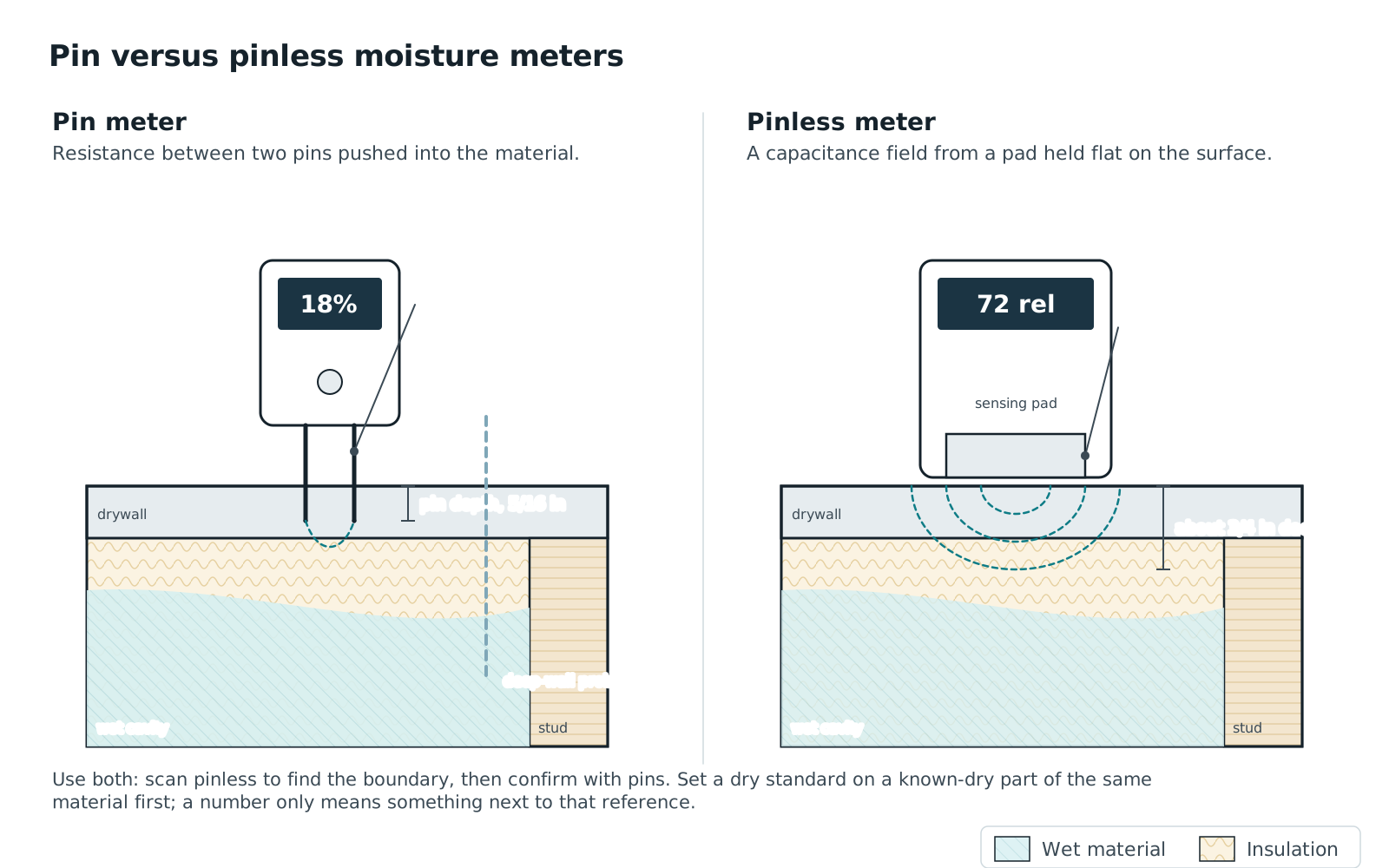
A pin meter drives two steel pins into the material and measures electrical resistance between them. Water conducts; dry wood and gypsum do not. Pins read exactly where they are, at the depth they reach, which makes them the tool for confirming a specific spot and for reading at depth with longer probes. They leave two small holes.
A pinless meter sends a radio-frequency field about 3/4 to 1 1/4 in into the material and measures how much it is dampened. It reads a patch a few square inches across, through paint and vinyl, without marks, which makes it the tool for scanning a whole wall in a minute and finding the boundary of a wet area. It also reads anything else in that field: pipes, wire, nail plates, foil-faced insulation, and the mastic under tile. Pinless readings on anything but wood are relative numbers, not percentages.
The professional workflow is scan, then confirm. Sweep the pinless meter along the base of the wall and mark where the number climbs. Push the pins into the highest spot and record the percentage. A dual meter does both; otherwise buy a cheap pin meter to go with a pinless one.
Material modes
A pin meter's number is calibrated for one material, usually Douglas fir at about 70°F. A reading on drywall, plaster or concrete on that scale is not a true percentage. Meters handle this three ways. The Delmhorst BD-2100 has a separate gypsum scale that reads drywall from 0.2 to 50%, which is the honest approach. The Protimeter SurveyMaster reports wood moisture equivalent (WME): the moisture content a piece of wood would have if it were sitting in equilibrium with whatever you are touching, so one scale and one set of color bands work across the house. Cheaper meters offer a wood scale and a building-materials scale and ask you to pick.
Whatever your meter does, use the same mode for the dry standard and the wet reading.
What wet means
These are typical ranges we work with; your dry standard overrides them.
Framing lumber and wood subfloor. Dry wood in a conditioned house usually sits between about 8 and 14%, higher in a humid basement. Above about 16% we treat framing as wet. Mold can grow on wood that stays above roughly 19 to 20%, and around 28 to 30% the wood fibers are saturated and the meter is telling you there is free water. A floor that reads 14% in the kitchen and 22% under the dishwasher has a leak under the dishwasher.
Drywall. On a true gypsum scale, dry drywall reads under about 1%. Readings climbing past 1% mean the paper and core have taken on water, and drywall that has been saturated will not read dry again even after it dries. On a WME scale, Protimeter's own color bands put dry below 17, borderline at 17 to 20, and wet above 20. Drywall that has been wet for more than a day or two is usually removed rather than dried; see the flood-cut section of our 72-hour basement guide.
Plywood and OSB subfloor. Treat like framing: under about 14% is normal, over 16 to 17% is wet, and OSB that reads high and has swollen at the edges will not flatten again.
Concrete and masonry. Pin and pinless meters give relative readings on concrete, useful for comparing a slab's wet corner with its dry middle and nothing more. If the question is whether a slab is dry enough for new flooring, that is a different test: in-situ relative humidity probes (ASTM F2170) or calcium chloride tests (ASTM F1869), which flooring installers run.
A reading is done when it matches the dry standard within the margin your meter allows, which for most of these meters is a couple of points, and stays there on a second visit a day later. Surfaces that feel dry are not evidence.
Using a meter after a leak
The day water shows up, map the problem before you dry it. Take dry-standard readings. Then read the wet room on a grid: every 2 ft along the base of each wall at 6 in above the floor, and again at 18 and 30 in to find how high the water wicked. Read the subfloor through the carpet pad at the wettest corner by pulling the carpet back. Mark readings on painter's tape stuck to the wall; photograph everything with the meter in frame showing the number. That photo set is what an adjuster wants to see, and it is how you prove the drying worked.
Re-read the same spots every 24 hours while fans and the dehumidifier run. Drywall and carpet in a clean-water loss usually reach dry standard in three to five days; framing, subfloor and hardwood take longer. If a spot stops dropping for two days while others keep falling, something behind it is still wet or still leaking.
Using a meter when buying a house
A pinless meter is the home buyer's tool, because a seller will not let you leave pin holes. Scan the drywall below every window, around the tub and shower surround, behind the toilet, under every sink, the ceiling below each bathroom, the wall shared with the water heater and washer, and the bottom 2 ft of any basement wall. Scan the subfloor at the edges of a finished basement floor. Compare each reading with the same material on an interior wall. A localized high reading at a window or a shower is a leak, whatever the seller's disclosure says, and it is grounds for a plumber or a roofer to take a look before you sign. Readings on a freshly painted or recently dried wall can look normal; stains, swollen baseboard and new paint in one spot are the companion evidence.
Calibration checks
A meter you cannot check is a meter you cannot defend. Four of our seven products ship with a way to verify them: the General Tools MMD4E has a calibration resistor in its pin cap that should read 18.3%, the Delmhorst BD-2100 has a built-in check, the Protimeter SurveyMaster includes a check device, and the Wagner Orion 910 comes with a paired calibrator block you set the meter on. The Tramex ME5 sells its check box separately; the Klein ET140 has none; the Extech MO55 has a functional verification test rather than a reference standard. Check before every job that matters and once a season otherwise. Professional meters should go back to the manufacturer for calibration about once a year, which Tramex states outright.
Compared at a glance
Scroll sideways on small screens. Scores are DryHomeLab scores out of 10; specs are from manufacturer documentation.
| Product | Score | Type | Accuracy (± %) | Pinless scan depth (in) | Material modes | Calibration check | Warranty (years) | |
|---|---|---|---|---|---|---|---|---|
| Protimeter SurveyMaster BLD5365 Dual-Function Moisture Meter Best overall | 6.4 | dual | — | 0.75 | Wood, drywall, plaster, masonry and other building materials on the WME scale; search mode behind tile and vinyl | Yes | 2 | See it at Sylvane |
| General Tools MMD4E Digital Pin Moisture Meter Best value | 5.1 | pin | 2 | — | Wood; building materials (drywall, plaster, concrete, brick) | Yes | 1 | Check price |
| Delmhorst BD-2100 Pin Moisture Meter Best pro-grade pin meter | 5.9 | pin | — | — | Wood, gypsum drywall, and a reference scale for other building materials | Yes | 1 | See it at Delmhorst |
| Tramex ME5 Moisture Encounter 5 Best pinless | 5.3 | pinless | — | 1.25 | Wood and wood flooring; shallow-depth mode; drywall and roofing; plaster and tile; masonry | No | 1 |
Paid links.
Protimeter SurveyMaster BLD5365 Dual-Function Moisture Meter
The meter insurers expect to see in the photos.
Score breakdown
| Accuracy | n/a | — |
| Versatility | dual | 10.0 |
| Professional grade | true | 10.0 |
| Warranty | 2 | 1.7 |
| Calibration check | true | 10.0 |
| Scan depth | 0.75 | 2.5 |
| Reading hold | n/a | — |
| Backlight | n/a | — |
| Temperature / RH | false | 0.0 |
- Pin and search modes in one meter; the industry's reference tool
- WME scale works across wood, drywall, plaster and masonry
- Calibration check device included
- Accepts deep-wall and hammer probe accessories; two-year warranty
- Priced for professionals
- No numeric accuracy specification in the brochure
- No temperature or humidity measurement
- Search mode is relative and reads metal behind the surface
The SurveyMaster is the dual-function meter that restoration crews, home inspectors and insurance adjusters have standardized on, and if you only ever buy one professional meter this is the one. Protimeter's brochure lists built-in pins reading 6 to 98% wood moisture equivalent (WME), and a non-invasive search mode that reads up to 3/4 in (19 mm) below the surface on a 70 to 999 relative scale. A calibration check device is included so you can prove the meter before every job.
The WME scale is the key idea. Instead of separate wood, drywall and masonry scales, the pins report the moisture content a piece of wood would have if it were in equilibrium with the material you are touching, which makes one color band work across the whole house: green is dry, yellow is borderline, red is wet. You find the wet area in search mode without marking anything, then switch to the pins to put a number on it. The pin head accepts Protimeter's deep-wall and hammer probes for subfloor and framing behind finished surfaces.
The costs: the brochure publishes no numeric accuracy figure, it measures neither temperature nor humidity, and it is priced in the several-hundred-dollar range, which is a lot for a one-time leak. The two-year warranty is the standard across Protimeter's line.
Buy it if you are documenting a claim, inspecting houses, or own property you expect to get wet again. For a single leak, rent one from an equipment yard or buy the Extech and a pin meter.
General Tools MMD4E Digital Pin Moisture Meter
The cheap pin meter that is accurate enough to tell you whether to open a wall.
Score breakdown
| Accuracy | 2 | 7.5 |
| Versatility | pin | 7.0 |
| Professional grade | false | 0.0 |
| Warranty | 1 | 0.0 |
| Calibration check | true | 10.0 |
| Scan depth | n/a | — |
| Reading hold | true | 10.0 |
| Backlight | true | 10.0 |
| Temperature / RH | false | 0.0 |
- Manufacturer-rated ±2% accuracy, unusual at this price
- Calibration check holes in the pin cap (18.3% reference)
- Backlight, hold, audible alarm and auto power-off
- Two scales: wood 5–50% and building materials 1.5–33%
- Pin holes in every surface you test
- No species or temperature correction
- One-year warranty
- Reads only the surface unless the pins penetrate
The MMD4E is the pin meter most homeowners end up with, and for once the popular choice is a sound one. General Tools rates it at ±2% across a 5 to 50% range for wood and 1.5 to 33% for building materials, with a backlit LCD, a hold button, an audible alarm that trips at 16% in wood and 20% in building materials, and auto power-off after three minutes. It runs on a 9 V battery and the pins are replaceable.
The feature that earns it a place on a professional's list is the calibration check built into the pin cap: press the pins into the two holes and the meter should read 18.3% ±1% in wood mode. That is a real check against a fixed resistor, not a self-test light, and it is why we trust this meter more than pinless meters at the same price that cannot be verified at all.
What it will not do: it reads only where the pins touch, so you leave two small holes per reading and you only learn about the surface layer unless you drive the pins through paint into the paper and gypsum. It has no species or temperature correction, so treat wood readings as approximate and always compare with a dry reference area in the same house. The one-year warranty is short.
Buy it if you want to know, today, whether the drywall behind the washing machine is wet. Pair it with a pinless meter if you need to scan a whole room without leaving marks.
We don't copy Amazon reviews. Read customer reviews on Amazon (paid link).
Delmhorst BD-2100 Pin Moisture Meter
The pin meter with a real gypsum scale, built in the US for restoration work.
Score breakdown
| Accuracy | n/a | — |
| Versatility | pin | 7.0 |
| Professional grade | true | 10.0 |
| Warranty | 1 | 0.0 |
| Calibration check | true | 10.0 |
| Scan depth | n/a | — |
| Reading hold | n/a | — |
| Backlight | n/a | — |
| Temperature / RH | false | 0.0 |
- Dedicated gypsum scale (0.2–50%) for drywall
- Built-in calibration check
- Accepts hammer and insulated-pin electrodes for framing and subfloor
- Serviceable, US-made professional instrument
- Pin-only; holes in every test spot
- No numeric accuracy specification published
- One-year warranty
- Professional price, higher with the package
Delmhorst's BD-2100 is the pin meter many restoration technicians are issued on their first day, and the reason is one word on its scale selector: gypsum. Where most meters read drywall on a borrowed wood scale, the BD-2100 has a dedicated gypsum scale from 0.2 to 50% that resolves the difference between dry drywall and drywall that has been wet, which happens below 1% and is invisible to a meter that starts at 5%. It also reads wood from 6 to 40% and has a 0 to 100 reference scale for everything else.
The integral pins penetrate 5/16 in, and the meter accepts Delmhorst's external electrodes: the 21-E for flat surfaces and insulated-pin electrodes and hammer probes for reading framing and subfloor through finished surfaces. The built-in calibration check means you can verify it on the truck. It is a plain instrument, 8 x 3 x 1 5/8 in, running on a 9 V battery, and it is made by a company that has serviced its meters for decades.
The limits: Delmhorst does not publish a numeric accuracy figure on the product page, there is no pinless mode, so you leave pin holes everywhere you test, and the standard warranty is one year. It is priced for professionals, and the full package with case and electrode costs more still.
Buy it if drywall is what gets wet in your properties and you want the most defensible drywall readings short of a lab. Pair it with a pinless scanner to find the area first.
Tramex ME5 Moisture Encounter 5
The pinless meter restoration crews sweep across drywall, with a shallow mode for thin materials.
Score breakdown
| Accuracy | n/a | — |
| Versatility | pinless | 8.0 |
| Professional grade | true | 10.0 |
| Warranty | 1 | 0.0 |
| Calibration check | false | 0.0 |
| Scan depth | 1.25 | 7.5 |
| Reading hold | true | 10.0 |
| Backlight | n/a | — |
| Temperature / RH | false | 0.0 |
- Reads about 1 1/4 in deep, plus a 0.4 in shallow mode
- Five material scales including drywall, plaster/tile and masonry
- Wide electrode base scans walls fast; hold function
- Industry-standard pinless meter on restoration trucks
- Calibration check box sold separately
- No numeric accuracy specification
- One-year warranty
- Comparative readings only on drywall, plaster and masonry
The Moisture Encounter has been the non-destructive building meter on restoration trucks for decades, and the ME5 is the current version. Three rubber electrodes on the base read about 1 1/4 in (30 mm) deep in normal mode and 0.4 in (10 mm) in a shallow-depth mode designed for thin materials and for readings Tramex says are comparable to pin readings. Five scales cover wood (5 to 30% MC), shallow depth, drywall and roofing, plaster and tile, and masonry, the last three on a comparative 0 to 100 scale.
The reason crews like it is speed and reach. The wide electrode base glides across a wall, the scale LEDs and tone let you track changes without staring at the screen, and the 30 mm depth finds moisture behind tile and under vinyl that a shallow pinless meter misses. The hold button freezes a reading in a tight spot. It shuts off after five minutes of inactivity.
The compromises are documentation and verification. Tramex publishes no numeric accuracy figure, and the calibration check box (CALBOXME5) is a separate accessory rather than something in the case, so budget for it if your readings will be questioned. Concrete readings are comparative only. The warranty is one year, short for the price. There is no backlight mentioned in the user guide.
Buy it if you scope water losses or inspect buildings and want the deepest non-destructive read in this group. Add the calibration box.
How to choose
Accuracy you can verify
Only three of our seven products publish a numeric accuracy figure: the General Tools MMD4E at ±2%, the Extech MO55 at ±3% of reading in pin mode, and the Klein ET140 at ±4% for wood. The professional meters publish calibration procedures instead and expect you to verify against a reference. Either is acceptable; a meter with neither a stated accuracy nor a calibration check is a guess with a display.
Depth
Pinless meters read about 3/4 in (Klein ET140, Protimeter search mode, Wagner Orion 910), 1 in (Extech MO55) or 1 1/4 in (Tramex ME5). Deeper reaches behind tile and through thick plaster but also picks up more of what is behind the wall. Pin depth is the length of the pins, 5/16 to 3/8 in on integral pins, which is why the professional pin meters accept hammer probes and insulated long pins for reading framing through drywall.
Pro grade means defensible
We mark a meter as professional grade when inspectors and restoration crews carry it and adjusters recognize it in photos. That is the Protimeter, the Delmhorst, the Tramex and the Wagner. The consumer meters are accurate enough for your own decisions; they are just not what the industry documents with.
Warranty
Wagner's seven years is the outlier. Protimeter and Extech give two, the rest one.
What we skipped and why
Extech MO55 / MO55A. Not skipped so much as not a pick: it is the right budget dual-mode meter and we list it, but Extech is mid-transition to the MO55A and the pinless mode has no published accuracy. Buy it if you want pin and pinless under a hundred dollars.
Wagner Orion 910. The best wood-floor meter here, with the longest warranty and a calibrator in the case, but it is a wood meter first and a building meter second. It is our pick for hardwood and subfloor questions, not for scoping drywall.
Klein ET140. Inexpensive, scans without holes and separates hardwood from softwood, but with no calibration check and relative-only drywall readings it is a scanner, not a documenting tool.
Meters with no manufacturer spec sheet. A large share of the pinless meters sold online publish no depth, no accuracy and no warranty, and the brand has no address. We do not list them.
How we score
Every product gets a DryHomeLab score out of 10 from a published rubric for its category: the specs that matter (capacity, coverage, flow at head height, sensor response, warranty) are verified against manufacturer documentation and weighted by how much they affect real-world drying and protection. Where our restoration crews have run the gear, field notes can move a score by at most 1.5 points, and the note is published. We never use Amazon star ratings. Read the full methodology.
Frequently asked questions
What moisture reading is considered wet for drywall?
On a meter with a true gypsum scale, dry drywall reads under about 1%, and anything climbing past that has taken on water. On Protimeter's wood-moisture-equivalent scale, readings under 17 are dry, 17 to 20 borderline, and above 20 wet. On a plain wood scale or a relative pinless scale the number alone means little; compare it with the same wall type in an unaffected room. Drywall that has been soaked usually comes out rather than dries.
What is a normal moisture reading for wood framing and subfloor?
In a conditioned house, framing and plywood subfloor typically read between about 8 and 14%, a little higher in a damp basement. We treat readings above about 16% as wet, and wood that stays above 19 to 20% can support mold. Near 28 to 30% the fibers are saturated. Always set your own dry standard from an unaffected area of the same house; climate and species shift the numbers.
Pin or pinless moisture meter: which should I buy?
If you can only buy one, a dual meter: the Extech MO55 on a budget or the Protimeter SurveyMaster if your readings have to stand up to an adjuster. If you are buying one of each, a cheap accurate pin meter like the General Tools MMD4E plus a pinless scanner covers everything. Pins confirm a spot and a depth; pinless finds the edge of the wet area fast and without holes.
Can a moisture meter detect mold?
No. It detects moisture, which is the condition mold needs. A wall that reads wet and has been wet for more than 48 to 72 hours is a wall you should assume has mold growth behind it, which is the EPA's guidance on how quickly growth starts, but the meter cannot see the growth itself. Opening the wall or an inspection by a professional does that. The meter's job is to tell you where to look.
How do I know if my moisture meter is accurate?
Use its calibration check. The General Tools MMD4E should read 18.3% in the holes in its pin cap; the Delmhorst, Protimeter and Wagner meters ship with a built-in check or a reference block; Tramex sells a check box. If the meter has no check, test it against known-dry kiln-dried lumber from a lumber yard, which usually reads under 12%, and against a wet rag. A meter that fails its check goes back to the manufacturer, not back in the bag.
Can I use a moisture meter on concrete?
Only for comparison. Pin and pinless meters give relative readings on concrete that tell you one part of a slab is wetter than another, which is useful for finding where water is coming in. They do not tell you whether a slab is dry enough for flooring; that requires in-situ relative humidity probes (ASTM F2170) or calcium chloride tests (ASTM F1869).
How long after a leak should readings return to normal?
With air movers and a dehumidifier running continuously, drywall and carpet in a clean-water loss usually reach dry standard in three to five days. Framing, plywood subfloor and hardwood take a week or more. Re-read the same marked spots every 24 hours; a reading that stops falling while the others keep dropping means something behind it is still wet or still leaking. Our 72-hour basement guide walks through the sequence.
DryHomeLab is written and reviewed by the team behind HelpMeNow.com, a marketplace that connects homeowners with vetted local contractors for water-damage restoration, plumbing and waterproofing. Before HelpMeNow the same team ran a 24/7 water-damage restoration company in the Seattle area; the equipment on this site is what we specified, bought and ran on real water losses. We publish the rubric behind every score.
- Ran a 24/7 water-damage restoration company, Seattle area
- Operate HelpMeNow.com, a contractor marketplace
- Publishes its scoring rubric