
Which setup you need
Walk to where the dehumidifier will sit and look for the nearest place water can go: a floor drain, the sump pit, a utility sink, a laundry standpipe, a window well, a condensate drain already serving the furnace or AC. Then answer one question: is that drain lower than the dehumidifier's drain port, with a path the hose can fall along the whole way?
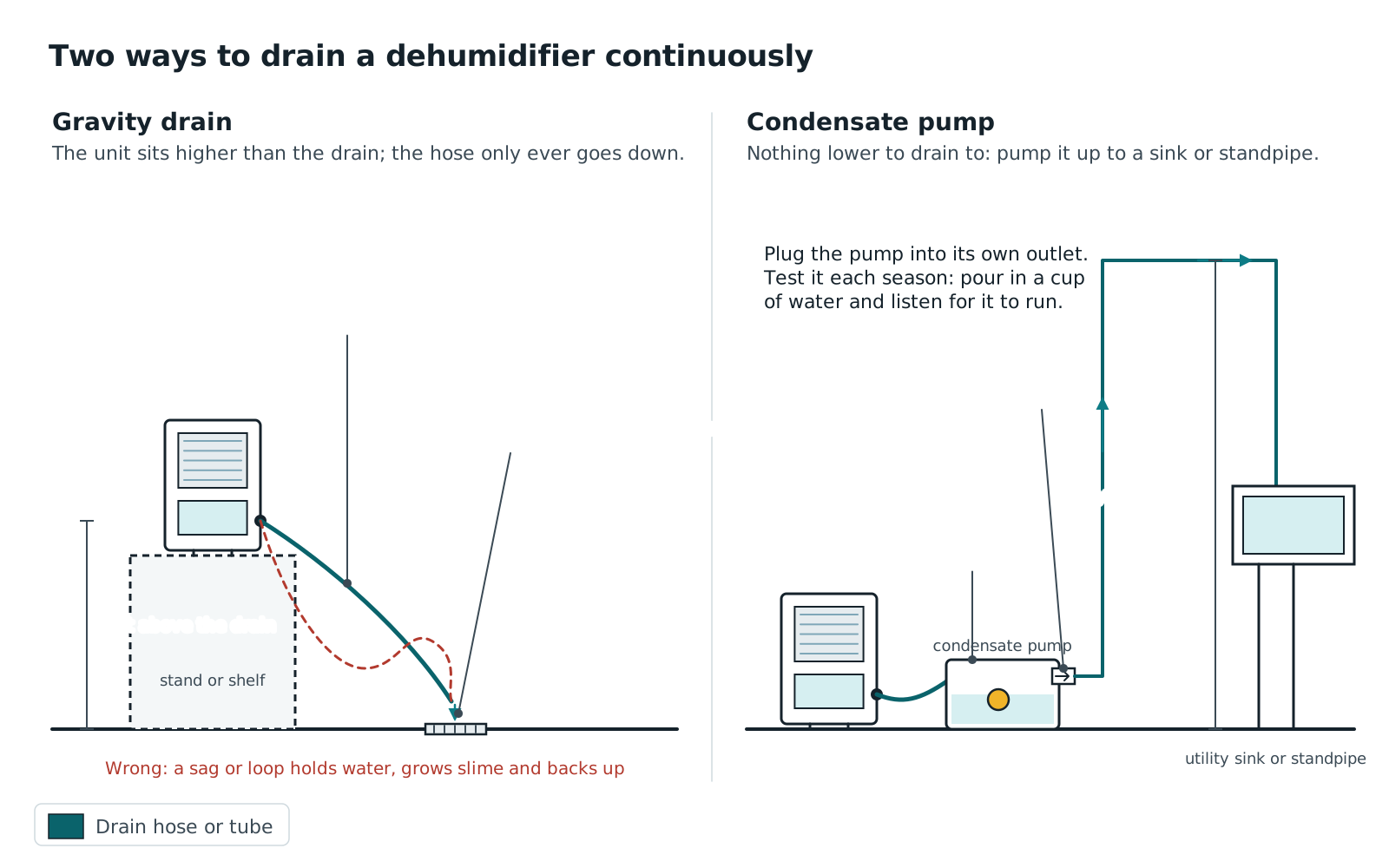
- Yes: gravity drain. A hose from the unit's drain port, falling continuously to the drain, no pump, nothing to fail. Raise the unit on a stand if you need more fall. This is the right answer whenever it is available.
- No, the drain is higher: a pump. Either a dehumidifier with a built-in pump (the Frigidaire FHDP5033Y1 or Midea's pump Cube in our basement roundup), or an external condensate pump that any dehumidifier can gravity-drain into and that lifts the water to the sink.
- No drain at all within 25 ft: the bucket, a long gravity run across the floor along a wall, or a condensate pump with a long tube to the nearest sink. We have run 40 ft of 3/8 in. tube from a basement corner to a laundry standpipe; it works if the pump is rated for the lift and the tube is secured.
Two numbers to keep in mind. Gravity needs about 1/4 in. of fall per foot of run with no sags; a 20-ft hose needs the port 5 in. higher than the drain, plus a few inches of margin. Condensate pumps are rated by lift: the small ones used under furnaces are typically rated around 15 to 20 ft, and every elbow and every foot of horizontal tube eats into that. Check the pump's rating against your worst-case height before you buy.
Tools and materials
For a gravity drain
- Drain hose. Most portables have a standard 3/4 in. garden-hose thread on the drain port; a short garden hose or a purpose-made 5/8 in. dehumidifier drain hose both work. Midea ships one with both Cubes; Frigidaire's pages list the drain option but not a hose, so buy one. Shorter is better; cut a long hose rather than coiling the extra.
- A stand or shelf for the unit: a sturdy plastic step stool, a milk crate, two concrete blocks and a board. Anything level that lifts the port 6 to 12 in. and lets air reach the intake.
- Hose clamps or zip ties and a few screw-in hooks to hold the hose off the floor along the wall
- A hose washer (the one in the hose end is usually enough)
- Optional: a short piece of 1/2 in. PVC or a hose guide to hold the end of the hose above the floor drain grate
For a condensate pump
- A condensate pump with a reservoir, float switch, check valve and a safety (overflow) switch, rated for at least your lift plus 5 ft. The 1/50 to 1/30 HP units sold for furnaces and air conditioners are the right class.
- 3/8 in. ID clear vinyl tubing in the length you need, plus the barbed fitting the pump comes with
- A short gravity hose from the dehumidifier to the pump's inlet
- Tube clips or zip ties to secure the tube every 2 to 3 ft; a tube-to-standpipe clip or a hole in the sink's drain stub for the end
- A grounded outlet for the pump; most have a 6-ft cord
- Optional but recommended: a drain pan under the unit and a leak sensor in it
For either
- A hygrometer for the far end of the room
- A cup of water for testing
Gravity drain: the five-minute version
- 1
Raise the unit
Set the dehumidifier on a level stand so its drain port is at least 6 in. higher than the drain it will feed, more if the run is long. Keep 12 in. of clear space at the intake and make sure the stand does not block the exhaust; the unit still has to move air. Do not stack it on anything that will go soft when wet.
- 2
Pull the bucket and find the port
On most units the continuous-drain port is behind a cap on the back or side, often inside the bucket cavity. Unscrew the cap, keep it with the manual, and check the manual for any internal plug or a switch that tells the unit it is in drain mode; on some models the bucket must stay in place with the float released for the unit to run.
- 3
Thread the hose on by hand
Confirm the washer is in the hose end and thread it onto the port hand-tight. No wrench, no tape; the plastic threads strip easily. Give it a gentle tug. If the hose will not seat, the thread is a different size than you assumed; check the manual before forcing an adapter.
- 4
Run the hose downhill the whole way
Lay the hose from the port to the drain so that every inch is lower than the inch before it: 1/4 in. per foot or more, no loops, no bellies, no climbing over a threshold. Hang it on hooks along the wall rather than letting it lie where feet and boxes will kink it. A sag holds water, grows slime, and air-locks; a hose that goes up even 2 in. will back up into the unit and trip the bucket-full switch, which is the most common 'my drain quit' call we get.
- 5
End it above the drain with an air gap
Terminate the hose 1 to 2 in. above the floor drain grate, sink rim or sump water line, not pushed down into the drain or the sump. The air gap keeps sewer gas and sump water out of the hose, lets you see it flowing, and stops a sump that rises in a storm from siphoning into the dehumidifier. Secure the end so it cannot flip out of the drain.
- 6
Test with a cup of water, then run it
Pour a cup of water into the unit's drain pan or, if you cannot reach it, lift the hose end briefly to confirm it drains freely from the port. Start the unit at 50 percent RH and high fan, come back in an hour, and look for water dripping at the drain and a dry floor under every foot of hose. Check again the next day.
Condensate pump: when the drain is uphill
- 1
Place the pump below the dehumidifier's port
The dehumidifier gravity-drains into the pump's reservoir, so the pump sits on the floor next to or below the unit, and the short hose from the port falls into the reservoir inlet. Most reservoirs have two or three inlet holes on top; use the one that gives the hose a straight fall and leave the others capped. Keep the pump out of the path of the unit's exhaust and off carpet.
- 2
Connect the discharge tube with the check valve
Push the 3/8 in. tube onto the pump's barbed outlet; the check valve is usually built into that fitting. It keeps the column of water in the tube from running back into the reservoir and short-cycling the pump. Route the tube straight up first, as close to the pump as possible, then across; a tube that wanders horizontally before it climbs loses lift to friction. Secure it every 2 to 3 ft.
- 3
Terminate at the sink or standpipe with an air gap
End the tube above the rim of the utility sink, clipped so it cannot slide out, or through the top of a laundry standpipe with 1 to 2 in. of air above the water. Never seal the tube into a drain; a blocked drain would then back up into the pump. If the tube goes out a window well or wall, give it a downward turn at the end so it cannot freeze full of water.
- 4
Wire the safety switch to the dehumidifier
Every decent condensate pump has a second float switch that opens when the reservoir overfills because the pump has failed. Most dehumidifiers cannot use it directly, so the simple approach is a plug-through relay or a smart plug that cuts power to the dehumidifier when the safety switch opens; the pump's manual shows the terminals. If you skip this step, a failed pump means the dehumidifier keeps producing 6 gallons a day onto the floor until someone notices. At minimum, put a leak sensor in a pan under the pump.
- 5
Test the lift with the reservoir full
Pour water into the reservoir until the pump starts, and watch the tube: water should climb steadily and arrive at the sink within a few seconds, with no gurgling back when the pump stops. If it stalls partway up, the lift is beyond the pump's rating or there is a kink; fix that before relying on it. Then start the dehumidifier and check the setup after an hour and after a day.
- 6
Put it on a maintenance calendar
Once a month in season, pour a cup of water into the reservoir to confirm the pump runs. Twice a season, pull the reservoir and rinse the slime out, and run a cup of diluted white vinegar through the dehumidifier's drain pan and the tube. In the fall, run the pump dry of standing water if the space can freeze.
Draining into the sump pit
The sump is often the nearest drain, and it is fine to use with two rules. End the hose above the highest water level the pit reaches in a storm, never below the lid and never under water; a rising pit will push water back up a submerged hose into the dehumidifier. And remember that every pint the dehumidifier makes is a pint the sump pump has to lift out of the house; on a 50-pint unit running hard that is 6 gallons a day, which no pump will notice, but it does mean the dehumidifier should be on a different circuit than the pump. If the pit has a sealed radon lid, drill and grommet a port for the hose rather than leaving the lid cracked.
Draining into a floor drain
Make sure the drain actually works before you trust it with 6 gallons a day: pour a bucket down it and watch it clear. Floor drains with a trap dry out in winter and let sewer gas up; a dehumidifier dripping into one all summer keeps the trap full, which is a side benefit. Keep the hose end above the grate and off to one side so the grate can still be lifted.
Units with a built-in pump
A pump-equipped dehumidifier replaces the external condensate pump with one inside the cabinet and a thin pump hose out the back; the gravity drain port is usually still there for when the drain is downhill. Midea rates the pump in its MAD50PS1QWT Cube for up to 14 ft of lift; Frigidaire says the FHDP5033Y1 pumps to a sink or window but does not publish a lift figure, so keep its run modest. Route the pump hose the same way: up first, then across, secured, air gap at the end. Run the pump once a month in the off-season so the impeller does not seize, and keep the hose short; the small pumps in these units move water slowly and a long hose means the pump runs for minutes at a time.
Troubleshooting a continuous drain that stopped
- Bucket-full light on with the hose connected. Water is backing up: a sag, a kink, a hose end under water, or a drain port cap left in place inside the unit. Walk the hose from the unit to the drain.
- Water on the floor under the unit. A hose washer missing or the hose cross-threaded; or the internal drain pan overflowing because the port is blocked with slime. Pull the hose and flush the port.
- Pump runs but nothing reaches the sink. Lift beyond the rating, a kinked tube, a check valve stuck shut, or a split in the tube near the pump. Test with the reservoir full and watch the tube.
- Pump cycles every few seconds. Check valve failed; the tube drains back and refills the reservoir. Replace the fitting.
- Slime and smell. Normal after a season. Vinegar flush, replace the vinyl tube every couple of years; it yellows and hardens.
- Nothing drains in winter. The room is below about 65°F and the unit is making little water, or below 41°F and not running at all. That is the unit, not the drain.
Midea Cube 50-Pint (MAD50S1QWT)
The basement portable with a bucket you can actually live with.
Score breakdown
| Moisture removal | 50 | 10.0 |
| Efficiency | 2.01 | 7.6 |
| Coverage | 4500 | 10.0 |
| Built-in pump | false | 0.0 |
| Quietness | n/a | — |
| ENERGY STAR certified | true | 10.0 |
| Warranty | 1 | 0.0 |
| Tank size | 4.25 | 10.0 |
| Continuous drain | true | 10.0 |
| Cold-room operation | 41 | 7.5 |
- Extended bucket holds about 4.25 gal per the manual's fill table; roughly double a standard 50-pint tank
- ENERGY STAR certified; 2.01 L/kWh integrated energy factor on the current R-32 revision
- Continuous-drain hose included; cabinet nests to half height for storage
- App and voice control with humidity readout; 41.5 lb, lighter than most 50-pint boxes
- No pump on this SKU (the MAD50PS1QWT has one)
- 1-year warranty
- 41°F minimum operating temperature, like every compressor portable
- Midea does not publish a sound level for this model
The Cube is the portable we recommend first for basements, and the reason is not the compressor; every 50-pint unit on this page pulls about the same water. It is the bucket. Midea's lift-and-twist cabinet nests for storage and extends for use, and the owner's manual's fill table puts the extended bucket at roughly 4.25 gallons at its top mark, about double a conventional 50-pint's 1.9-gallon tank. If you have to run on the bucket, that is one trip a day in a damp basement instead of two or three. For everyone else, the continuous-drain hose is in the box: run it to a floor drain or sump and forget the bucket entirely.
Midea rates it at 50 pints per day (the DOE 2019 rating, the number on the box since 2019) for spaces up to 4,500 sq ft, with app and voice control, a 1-year warranty, and 41.5 lb. ENERGY STAR lists the current revision, MAD50S1QWT-A with R-32 refrigerant, at 49.67 pints per day and an integrated energy factor of 2.01 L/kWh, 515 kWh a year on the federal test; that is the same efficiency as the Frigidaire 50-pints and the common figure for the class. The manual gives the operating range as 41°F to 95°F, which is standard for a compressor portable and the reason a basement that sits below 50°F needs a different class of machine. There is no pump on this SKU; the MAD50PS1QWT adds one with up to 14 ft of lift per the manual.
What we have not verified: Midea does not publish a sound level for the 50-pint Cube on its US or Canadian pages, so that cell stays empty. Buy the Cube for a basement up to about 1,500 sq ft of real, damp floor area (manufacturer coverage numbers assume a sealed room; size with our calculator) where you can drain by gravity or do not mind the bucket. Skip it if you need to pump uphill, or if the space runs cold.
We don't copy Amazon reviews. Read customer reviews on Amazon (paid link).
Frigidaire FHDP5033Y1 50-Pint with Pump and Wi-Fi
The pump version of the current Frigidaire 50-pint, for basements where the drain is uphill.
Score breakdown
| Moisture removal | 50 | 10.0 |
| Efficiency | 2.01 | 7.6 |
| Coverage | n/a | — |
| Built-in pump | true | 10.0 |
| Quietness | 51.5 | 5.7 |
| ENERGY STAR certified | true | 10.0 |
| Warranty | 1 | 0.0 |
| Tank size | 1.9 | 7.5 |
| Continuous drain | true | 10.0 |
| Cold-room operation | 41 | 7.5 |
- Built-in pump for a sink, standpipe or window above the unit
- Same published table as the FHDD5033Y1: 49–51.5 dBA, 8.8 A, 1.9-gal bucket
- ENERGY STAR certified; 2.01 L/kWh
- Wi-Fi app with Alexa and Google Home; conventional front bucket as the fallback
- Frigidaire does not state the pump lift height on its product pages
- Pump is one more motor and float to fail; keep the hose short and clear
- 1-year warranty; 1.9-gal bucket if you ever run without the pump
The FHDP5033Y1 is the FHDD5033Y1 with a built-in condensate pump, and the pump is the whole reason to buy it: a basement with no floor drain, a utility sink across the room, or a window well above the unit. A pump lets the dehumidifier push water up and out on its own, which turns a twice-a-day chore into a once-a-season hose check. On drying jobs we run pumped units whenever the drain is uphill, because a dehumidifier that stops when its bucket fills is a dehumidifier that stopped at 2 a.m. on day one.
Everything else matches its sibling's published table: 50 pints per day, a 1.9-gallon bucket for the days the pump is not connected, 197 to 218 CFM, 49 dBA on low fan and 51.5 on high, 8.8 A, a 72-in. cord, and 41.89 lb. ENERGY STAR lists it at 49.95 pints per day and 2.01 L/kWh with R-32 refrigerant. Frigidaire rates it to 41°F, adds the Frigidaire app with Alexa and Google Home support, and backs it with 1 year of labor coverage. Frigidaire's pages say the pump sends water 'into a sink or out a window' but do not state a lift height, so check the owner's guide before you plan a run that climbs more than one story; every elbow and foot of horizontal hose costs lift.
Buy it when the drain is above the unit and you want one box rather than a separate condensate pump. If the drain is downhill, buy the FHDD5033Y1 and let gravity do it. Against the Midea pump Cube, the Frigidaire publishes its sound level and has a conventional front bucket; the Midea has the bigger bucket and a stated 14-ft lift.
When to call a pro
A drain hose is not a trade. But if the only drain in the basement is a floor drain that does not clear, a sump that overflows, or a standpipe that backs up, the dehumidifier is the least of it: get a plumber to fix the drain. If the basement needs a dehumidifier year-round and there is no drain within 25 ft, a plumber can add a condensate line to the sewer with a proper trap in an hour or two, which is a better long-term answer than a 40-ft tube. And if the basement is wet rather than damp, no drain setup fixes that; our 72-hour dry-out guide and the crawl space roundup cover the bigger machines, and the form below reaches a local contractor.
Frequently asked questions
Can you leave a dehumidifier running continuously with a drain hose?
Yes; that is what the continuous-drain port is for. With the hose falling the whole way to a drain and the humidistat set at 50 percent, the unit cycles on its own setpoint and never stops for a full bucket. Check the hose and the drain monthly, clean the filter, and keep a hygrometer at the far end of the room so you notice if it stops working.
Why is my dehumidifier not draining through the hose?
Almost always because somewhere the hose goes up: a sag or loop holding water, a kink behind a box, the hose end pushed under water in a sump or sink, or a cap or plug still in the drain port inside the unit. The unit backs up and trips its bucket-full switch. Walk the hose from the port to the drain, make it fall continuously at about 1/4 in. per foot, and end it 1 to 2 in. above the drain.
Does a dehumidifier drain hose need to be below the unit?
The whole hose needs to be below the drain port and fall continuously to a drain that is lower still; a dehumidifier cannot push water uphill through its gravity port. Raise the unit on a stable stand to get the fall you need. If the drain is higher than any stand will fix, you need a condensate pump or a unit with a built-in pump.
Can I drain a dehumidifier into the sump pump pit?
Yes. End the hose above the highest level the pit reaches in a storm, never under water, so a rising pit cannot push water back into the dehumidifier, and put the dehumidifier on a different circuit than the sump pump. A 50-pint unit adds up to about 6 gallons a day, which the pump will not notice. If the pit has a sealed lid, add a grommeted port for the hose rather than leaving the lid ajar.
How high can a dehumidifier pump push water?
Built-in pumps vary and some makers do not publish a figure; Midea rates the pump in its MAD50PS1QWT Cube for up to 14 ft of lift, and Frigidaire does not state one for the FHDP5033Y1. External condensate pumps of the furnace class are typically rated around 15 to 20 ft. Horizontal runs and elbows reduce the usable lift, so route the tube straight up first, then across, and test with a full reservoir before relying on it.
What size hose does a dehumidifier drain use?
Most portables have a standard 3/4 in. garden-hose thread on the drain port, so a garden hose or a 5/8 in. dehumidifier drain hose threads straight on by hand. Condensate pumps discharge through 3/8 in. inside-diameter vinyl tubing. Check the manual before buying adapters; forcing a wrong thread strips the plastic port.
DryHomeLab is written and reviewed by the team behind HelpMeNow.com, a marketplace that connects homeowners with vetted local contractors for water-damage restoration, plumbing and waterproofing. Before HelpMeNow the same team ran a 24/7 water-damage restoration company in the Seattle area; the equipment on this site is what we specified, bought and ran on real water losses. We publish the rubric behind every score.
- Ran a 24/7 water-damage restoration company, Seattle area
- Operate HelpMeNow.com, a contractor marketplace
- Publishes its scoring rubric