
Our picks
Midea Cube 50-Pint (MAD50S1QWT)
The basement portable with a bucket you can actually live with.
50 DOE pints, ENERGY STAR at 2.01 L/kWh, an extended bucket of about 4.25 gallons, a drain hose in the box and app control; the easiest 50-pint to live with.
Frigidaire FHDP5033Y1 50-Pint with Pump and Wi-Fi
The pump version of the current Frigidaire 50-pint, for basements where the drain is uphill.
Frigidaire's current 50-pint with a built-in pump, 49 to 51.5 dBA and Wi-Fi, for basements where the only drain is a sink or window well above the unit.
Frigidaire FHDD5033Y1 50-Pint with Wi-Fi
The current Frigidaire 50-pint: a conventional box with a published spec sheet and a Wi-Fi app.
The same Frigidaire without the pump: a front bucket, a rear drain port, a full published spec table and ENERGY STAR at 2.01 L/kWh.
Midea Cube 20-Pint (MAD20S1QWT)
The budget Cube for a small, mildly damp basement or a bedroom over a crawl space.
20 DOE pints in the same lift-and-twist cabinet, 48 dB, ENERGY STAR, for a small sealed basement or a room over a crawl space.
Who this is for
This is for the basement that is not flooded, just damp: the musty smell when you come down the stairs, condensation on the cold-water lines in July, a hygrometer reading above 60 percent, efflorescence on the block, cardboard boxes going soft on the slab. It is also for anyone whose old dehumidifier died and who is confused about why the new ones say 50 pints where the old one said 70.
We are a water damage restoration crew. We run commercial dehumidifiers in basements for a living, and we see what the homeowner's portable was doing when we arrive: usually running on a full bucket, shut off on the float switch, in the wrong corner. The picks below are the portable units we would put in our own basements, chosen on the manufacturers' published specifications and the ENERGY STAR certified list, and on what makes a portable actually keep running unattended for a season: how it drains, how big the bucket is, how cold it can run, and how loud it is.
A note on our spec tables: we only publish numbers we can cite to the manufacturer's documentation or the ENERGY STAR database. Every pick on this page has at least 90 percent of its rubric verified. Two common units, the hOmeLabs 50-pint and GE's APER50LZ pump model, are not picks because we still cannot read their manufacturers' spec sheets; they are covered under what we skipped.
If you have standing water, this is the wrong page. Read how to dry out a flooded basement in 72 hours, and if it is more than an inch deep or it is sewage, call a pro.
The short answer
- Buy a 50-pint (DOE 2019) unit for any basement over about 800 sq ft, or any basement that is more than musty. The 50-pint class is what used to be sold as 70 pints before the 2019 test change; it is the right size for most basements, and it costs little more than a 35.
- Run it on a hose, not the bucket. Every unit here has a continuous-drain port. Put the unit near a floor drain, a sump or a utility sink and forget the bucket; our continuous-drain guide covers the hose and the pump.
- If the drain is uphill, buy a pump unit. Frigidaire's FHDP5033Y1 or Midea's pump Cube (MAD50PS1QWT) push water up to a sink or out a window well on their own.
- Efficiency is a wash in this class. Every 50-pint here is ENERGY STAR certified at the same 2.01 L/kWh integrated energy factor, about 515 to 520 kWh a year on the federal test. Choose on drainage, bucket and noise, not on the energy label.
- If the basement is below 50°F in winter, no portable will work well. Compressor portables stall around 41°F, and lose capacity well above that. Either accept it will not run in January (which is usually fine; cold basements are dry basements) or look at a crawl space class unit rated for the cold.
- Size it with the calculator, with 25 percent headroom, and ignore the square footage on the box.
Compared at a glance (manufacturer and ENERGY STAR specifications)
Scroll sideways on small screens. Scores are DryHomeLab scores out of 10; specs are from manufacturer documentation.
| Product | Score | Capacity (DOE 2019) (pints/day) | Coverage (sq ft) | Integrated energy factor (L/kWh) | ENERGY STAR | Built-in pump | Noise (high) (dB) | Warranty (years) | Where to buy |
|---|---|---|---|---|---|---|---|---|---|
| Midea Cube 50-Pint (MAD50S1QWT) Best overall | 7.2 | 50 | 4,500 | 2.01 | Yes | No | — | 1 | Check price |
| Frigidaire FHDP5033Y1 50-Pint with Pump and Wi-Fi Best with a pump | 7.7 | 50 | — | 2.01 | Yes | Yes | 51.5 | 1 | |
| Frigidaire FHDD5033Y1 50-Pint with Wi-Fi Best conventional box | 6.6 | 50 | — | 2.01 | Yes | No | 51.5 | 1 | |
| Midea Cube 20-Pint (MAD20S1QWT) Best for small basements | 3.7 | 20 | 1,500 | 1.7 | Yes | No | 48 | 1 | Check price |
| Midea Cube 50-Pint with Pump (MAD50PS1QWT) | 8.4 | 50 | 4,500 | 2.01 | Yes | Yes | — | 1 |
Paid links.
Midea Cube 50-Pint (MAD50S1QWT)
The basement portable with a bucket you can actually live with.
Score breakdown
| Moisture removal | 50 | 10.0 |
| Efficiency | 2.01 | 7.6 |
| Coverage | 4500 | 10.0 |
| Built-in pump | false | 0.0 |
| Quietness | n/a | — |
| ENERGY STAR certified | true | 10.0 |
| Warranty | 1 | 0.0 |
| Tank size | 4.25 | 10.0 |
| Continuous drain | true | 10.0 |
| Cold-room operation | 41 | 7.5 |
- Extended bucket holds about 4.25 gal per the manual's fill table; roughly double a standard 50-pint tank
- ENERGY STAR certified; 2.01 L/kWh integrated energy factor on the current R-32 revision
- Continuous-drain hose included; cabinet nests to half height for storage
- App and voice control with humidity readout; 41.5 lb, lighter than most 50-pint boxes
- No pump on this SKU (the MAD50PS1QWT has one)
- 1-year warranty
- 41°F minimum operating temperature, like every compressor portable
- Midea does not publish a sound level for this model
The Cube is the portable we recommend first for basements, and the reason is not the compressor; every 50-pint unit on this page pulls about the same water. It is the bucket. Midea's lift-and-twist cabinet nests for storage and extends for use, and the owner's manual's fill table puts the extended bucket at roughly 4.25 gallons at its top mark, about double a conventional 50-pint's 1.9-gallon tank. If you have to run on the bucket, that is one trip a day in a damp basement instead of two or three. For everyone else, the continuous-drain hose is in the box: run it to a floor drain or sump and forget the bucket entirely.
Midea rates it at 50 pints per day (the DOE 2019 rating, the number on the box since 2019) for spaces up to 4,500 sq ft, with app and voice control, a 1-year warranty, and 41.5 lb. ENERGY STAR lists the current revision, MAD50S1QWT-A with R-32 refrigerant, at 49.67 pints per day and an integrated energy factor of 2.01 L/kWh, 515 kWh a year on the federal test; that is the same efficiency as the Frigidaire 50-pints and the common figure for the class. The manual gives the operating range as 41°F to 95°F, which is standard for a compressor portable and the reason a basement that sits below 50°F needs a different class of machine. There is no pump on this SKU; the MAD50PS1QWT adds one with up to 14 ft of lift per the manual.
What we have not verified: Midea does not publish a sound level for the 50-pint Cube on its US or Canadian pages, so that cell stays empty. Buy the Cube for a basement up to about 1,500 sq ft of real, damp floor area (manufacturer coverage numbers assume a sealed room; size with our calculator) where you can drain by gravity or do not mind the bucket. Skip it if you need to pump uphill, or if the space runs cold.
We don't copy Amazon reviews. Read customer reviews on Amazon (paid link).
Frigidaire FHDP5033Y1 50-Pint with Pump and Wi-Fi
The pump version of the current Frigidaire 50-pint, for basements where the drain is uphill.
Score breakdown
| Moisture removal | 50 | 10.0 |
| Efficiency | 2.01 | 7.6 |
| Coverage | n/a | — |
| Built-in pump | true | 10.0 |
| Quietness | 51.5 | 5.7 |
| ENERGY STAR certified | true | 10.0 |
| Warranty | 1 | 0.0 |
| Tank size | 1.9 | 7.5 |
| Continuous drain | true | 10.0 |
| Cold-room operation | 41 | 7.5 |
- Built-in pump for a sink, standpipe or window above the unit
- Same published table as the FHDD5033Y1: 49–51.5 dBA, 8.8 A, 1.9-gal bucket
- ENERGY STAR certified; 2.01 L/kWh
- Wi-Fi app with Alexa and Google Home; conventional front bucket as the fallback
- Frigidaire does not state the pump lift height on its product pages
- Pump is one more motor and float to fail; keep the hose short and clear
- 1-year warranty; 1.9-gal bucket if you ever run without the pump
The FHDP5033Y1 is the FHDD5033Y1 with a built-in condensate pump, and the pump is the whole reason to buy it: a basement with no floor drain, a utility sink across the room, or a window well above the unit. A pump lets the dehumidifier push water up and out on its own, which turns a twice-a-day chore into a once-a-season hose check. On drying jobs we run pumped units whenever the drain is uphill, because a dehumidifier that stops when its bucket fills is a dehumidifier that stopped at 2 a.m. on day one.
Everything else matches its sibling's published table: 50 pints per day, a 1.9-gallon bucket for the days the pump is not connected, 197 to 218 CFM, 49 dBA on low fan and 51.5 on high, 8.8 A, a 72-in. cord, and 41.89 lb. ENERGY STAR lists it at 49.95 pints per day and 2.01 L/kWh with R-32 refrigerant. Frigidaire rates it to 41°F, adds the Frigidaire app with Alexa and Google Home support, and backs it with 1 year of labor coverage. Frigidaire's pages say the pump sends water 'into a sink or out a window' but do not state a lift height, so check the owner's guide before you plan a run that climbs more than one story; every elbow and foot of horizontal hose costs lift.
Buy it when the drain is above the unit and you want one box rather than a separate condensate pump. If the drain is downhill, buy the FHDD5033Y1 and let gravity do it. Against the Midea pump Cube, the Frigidaire publishes its sound level and has a conventional front bucket; the Midea has the bigger bucket and a stated 14-ft lift.
Frigidaire FHDD5033Y1 50-Pint with Wi-Fi
The current Frigidaire 50-pint: a conventional box with a published spec sheet and a Wi-Fi app.
Score breakdown
| Moisture removal | 50 | 10.0 |
| Efficiency | 2.01 | 7.6 |
| Coverage | n/a | — |
| Built-in pump | false | 0.0 |
| Quietness | 51.5 | 5.7 |
| ENERGY STAR certified | true | 10.0 |
| Warranty | 1 | 0.0 |
| Tank size | 1.9 | 7.5 |
| Continuous drain | true | 10.0 |
| Cold-room operation | 41 | 7.5 |
- Full manufacturer spec table: 50 pints/day, 49–51.5 dBA, 8.8 A, 41.45 lb
- ENERGY STAR certified; 2.01 L/kWh integrated energy factor
- Wi-Fi app with schedules and setpoint; Alexa and Google Home
- Conventional front bucket and rear continuous-drain port; washable filter
- 1.9-gallon bucket fills twice a day in a wet basement; run it on a hose
- 1-year warranty
- No pump on this SKU (buy the FHDP5033Y1)
- Frigidaire does not publish a coverage figure
The FHDD5033Y1 is Frigidaire's current 50-pint, the direct replacement for the FFAD5033W1 that spent a decade as the default basement dehumidifier, and it is the conventional box we recommend when the Midea Cube's nesting bucket does not appeal. Frigidaire publishes a real specification table for it: 50 pints per day (DOE), a 1.9-gallon bucket, 197 CFM on low and 218 on high, 49 dBA on low fan and 51.5 on high, 8.8 A and 470 W, a 72-in. cord, 41.45 lb, and a 19.1 by 18.9 by 9.9 in. cabinet. ENERGY STAR lists it at 49.95 pints per day and an integrated energy factor of 2.01 L/kWh, 520 kWh a year on the federal test, with R-32 refrigerant. Frigidaire rates it to run down to 41°F, which is the floor for every compressor portable.
It is a front-bucket, rear-drain design: the continuous-drain port takes a standard hose, the washable filter pulls out of the back, and the controls are on top. The Frigidaire app adds remote on/off, setpoint, schedules and fan speed, and it works with Alexa and Google Home. There is no pump; the FHDP5033Y1 is the same machine with one.
The weaknesses are the ones the whole class shares. The 1.9-gallon bucket fills twice a day in a wet basement, so run it on the hose. The warranty is 1 year of labor coverage. Frigidaire does not publish a coverage figure, which we count as honesty rather than a gap; size it with our calculator. Buy it for any damp basement up to about 1,500 sq ft of real floor area with a floor drain or sump within hose reach. Buy the Cube instead if you will run on the bucket, and the FHDP5033Y1 if the drain is uphill.
Midea Cube 20-Pint (MAD20S1QWT)
The budget Cube for a small, mildly damp basement or a bedroom over a crawl space.
Score breakdown
| Moisture removal | 20 | 0.0 |
| Efficiency | 1.7 | 3.7 |
| Coverage | 1500 | 0.0 |
| Built-in pump | false | 0.0 |
| Quietness | 48 | 8.0 |
| ENERGY STAR certified | true | 10.0 |
| Warranty | 1 | 0.0 |
| Tank size | 3.2 | 10.0 |
| Continuous drain | true | 10.0 |
| Cold-room operation | 41 | 7.5 |
- Same lift-and-twist cabinet and large bucket (12 L, about 3.2 gal) as the 50-pint
- ENERGY STAR certified; 48 dB at high fan is the quietest published figure in this group
- Continuous-drain hose included; Wi-Fi app control; 33.3 lb
- Right-sized for a small sealed basement or a room over a crawl space
- 20 pints/day will not keep up with a wet or large basement
- 1.7 L/kWh is less efficient per pint than the 50-pint class
- No pump; 1-year warranty
The 20-pint Cube is the budget pick for the smaller job: a 600-to-1,000 sq ft basement that reads 55 to 65 percent RH in summer, a finished room over a crawl space, a laundry or storage room. It shares the 50-pint Cube's lift-and-twist cabinet and the same owner's manual, and Midea's specification table puts the bucket at 12 liters (about 3.2 gallons), still larger than most 50-pint units' tanks, with the same 41°F to 95°F operating range and 1-year warranty. The continuous-drain hose is in the box, there is no pump, and Wi-Fi app control is built in. Midea rates it for rooms up to 1,500 sq ft and lists 48 dB at high fan and 33.3 lb.
It is ENERGY STAR certified: the certified list shows 20.16 pints per day and an integrated energy factor of 1.7 L/kWh (249 kWh a year on the federal test). That IEF is lower than the 2.01 of the 50-pint class, which is normal for small units and means a 20-pint running flat out all summer is not cheaper to run than a 50-pint cycling half the time.
A note on the number: under the DOE 2019 test, 20 pints per day is the class that was sold as a 30-pint before 2019, so do not read it as a toy. It is still a compressor machine that will hold a small sealed basement at 50 percent RH. What it will not do is dry a wet basement, keep up with 1,500 sq ft of slab in July (Midea's 1,500 sq ft assumes a sealed room at the test condition; plan on about half that for a damp basement), or handle a space below about 50°F. For those, buy the 50-pint Cube; the price difference is small against a season of the 20-pint running without a break.
We don't copy Amazon reviews. Read customer reviews on Amazon (paid link).
Midea Cube 50-Pint with Pump (MAD50PS1QWT)
The Cube with a pump: the big bucket and the app, plus 14 ft of lift to a sink or window.
Score breakdown
| Moisture removal | 50 | 10.0 |
| Efficiency | 2.01 | 7.6 |
| Coverage | 4500 | 10.0 |
| Built-in pump | true | 10.0 |
| Quietness | n/a | — |
| ENERGY STAR certified | true | 10.0 |
| Warranty | 1 | 0.0 |
| Tank size | 4.25 | 10.0 |
| Continuous drain | true | 10.0 |
| Cold-room operation | 41 | 7.5 |
- Built-in pump rated to 14 ft of lift per the manual; drains uphill to a sink or window
- Same 4.25-gallon extended bucket and nesting cabinet as the plain Cube
- ENERGY STAR certified; 2.01 L/kWh on the current revision
- App and voice control; drain hose included for gravity draining when the pump is not needed
- Midea does not publish a sound level for the 50-pint Cubes
- Pump adds a motor and float that need an off-season run and a short, loop-free hose
- 1-year warranty; 41°F minimum operating temperature
The MAD50PS1QWT is the 50-pint Cube with a condensate pump built in, and it exists for one basement: the one where the only drain is above the machine. Everything we like about the plain Cube carries over. Midea rates it at 50 pints per day (DOE 2019) for rooms up to 4,500 sq ft, the same lift-and-twist cabinet nests for storage and extends to a bucket the shared manual's fill table puts at about 4.25 gallons, app and voice control are built in, and ENERGY STAR lists the current MAD50PS1QWT-A revision at 49.67 pints per day and 2.01 L/kWh, identical to the non-pump unit. The manual rates the pump for up to 14 ft of vertical lift, enough to reach a utility sink, a laundry standpipe or a basement window well from floor level.
The trade-offs are the same as any pumped portable. The pump is a second small motor and a float switch that live in a damp cabinet; keep the pump hose short, avoid loops and sags, and run it once a month in the off-season so the impeller does not seize. Midea does not publish a sound level for the 50-pint Cubes, so the noise cell is empty, and the warranty is 1 year, the same as every unit in this class. At 41.5 lb it is still lighter than most 50-pint boxes.
Buy it over the plain Cube only if the drain is uphill. If you have a floor drain or sump within hose reach, gravity never fails and the plain MAD50S1QWT costs less. Against the Frigidaire FHDP5033Y1, the other pump unit we can fully document, the Cube wins on bucket size and the nesting cabinet; the Frigidaire publishes its sound level (49 to 51.5 dBA) and has a conventional front bucket you can empty without extending the cabinet.
What size dehumidifier do you need?
Enter the space. We size by the current DOE pint rating (the number on the box since 2019), with the headroom restoration crews build in.
- Minimum removal needed: about 12 pints/day; with 25% headroom, 15 pints/day.
- Estimated running cost: roughly $15/month in season at ~300 W. ENERGY STAR units cut this 10–15%.
- Route the drain hose to a floor drain or condensate pump so it never stops to empty a bucket.
- Midea Cube 50-Pint with Pump (MAD50PS1QWT)Score 8.4 · 50 pt/day · 4500 sq ft
- Frigidaire FHDP5033Y1 50-Pint with Pump and Wi-FiScore 7.7 · 50 pt/day · ? sq ft
- Midea Cube 50-Pint (MAD50S1QWT)Score 7.2 · 50 pt/day · 4500 sq ftCheck price
- Frigidaire FHDD5033Y1 50-Pint with Wi-FiScore 6.6 · 50 pt/day · ? sq ft
- Paid links.
How to choose a basement dehumidifier
Capacity: DOE 2019 pints, and why 50 is the number
Since mid-2019 every portable dehumidifier sold in the US is rated under the Department of Energy test procedure (10 CFR 430, Appendix X1) at 65°F and 60 percent relative humidity, instead of the older AHAM rating at 80°F/60%. Cooler air gives up less water, so the numbers dropped by about 30 percent: the old 70-pint is today's 50, the old 50 is today's 35, the old 30 is today's 20 to 22. The machines did not change. If you are replacing a pre-2019 unit, buy about 0.7 times its pint number. The ENERGY STAR database shows the real test results behind the round numbers: 49.67 pints for the Midea Cube 50, 49.95 for the Frigidaires, 20.16 for the Cube 20.
For a basement, the 50-pint class is the default. It handles about 1,200 to 1,500 sq ft of real, damp basement (not the 4,500 sq ft on the box, which assumes a sealed room at the test temperature), cycles instead of running flat out, and costs only a little more than a 35. Step down to 20 to 35 pints for a small basement that is merely musty, a finished room over a crawl space, or a laundry room. Step up to a commercial unit rated in AHAM pints, or two portables, for anything over about 1,500 sq ft, anything with seepage, or anything cold. The calculator walks through it with 25 percent headroom built in.
Drainage: hose versus bucket versus pump
This is the decision that determines whether the dehumidifier works in August when you are on vacation. A 50-pint unit at full tilt fills the Frigidaires' 1.9-gallon bucket about three times a day and the Cube's 4.25-gallon bucket once or twice. Nobody keeps that up, and every unit stops when its bucket is full.
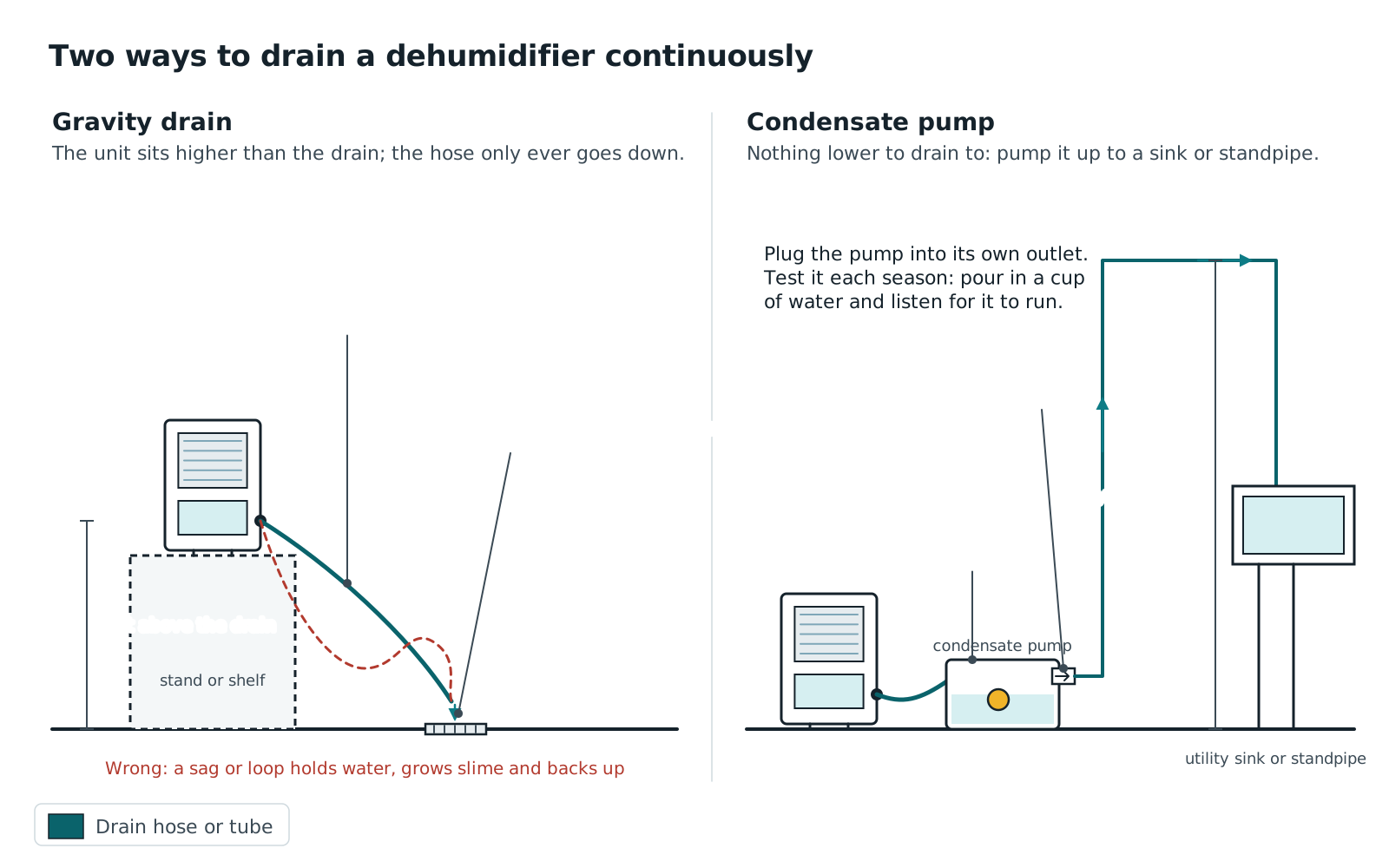
- Continuous drain (gravity). Every unit here has a port for a garden hose or a 5/8-in. drain hose. If there is a floor drain, a sump pit or a utility sink lower than the port within hose reach, this is the answer: set the unit on a stand or shelf, run the hose with continuous fall and no bellies, and the bucket never fills. Midea includes the hose with both Cubes; Frigidaire's pages list the continuous-drain option but not a hose, so budget a few dollars for one. The step-by-step is in our continuous-drain guide.
- Built-in pump. If the only drain is higher than the unit (a utility sink, a window well, a laundry standpipe), buy a unit with a pump: the Frigidaire FHDP5033Y1, or Midea's MAD50PS1QWT pump Cube, which Midea's manual rates to 14 ft of lift (Frigidaire does not publish a lift figure). Keep the pump line short, avoid loops, and run the pump once a month in the off-season; a pump is one more thing to fail.
- Bucket. For a bedroom or a space with no drain at all. If you must, the Midea Cube's extended bucket (about 4.25 gallons per the manual's fill table on the 50-pint, 12 liters or about 3.2 gallons on the 20-pint) cuts trips to one a day. Carry it with two hands; cracked buckets are the most common portable failure we see.
ENERGY STAR and the integrated energy factor
A basement dehumidifier runs for months. Efficiency is reported as the integrated energy factor (IEF) in liters of water removed per kilowatt-hour, and ENERGY STAR certification sets a floor for it by size class; the Most Efficient designation marks the top tier each year. In the 50-pint class the floor is where the market sits: the Midea Cube 50 (current MAD50S1QWT-A revision), the Midea pump Cube and both Frigidaires are all listed at 2.01 L/kWh and 515 to 520 kWh a year on the federal test. The Cube 20 is listed at 1.7 L/kWh, which is normal for small units and the reason a 20-pint running flat out all summer is not cheaper than a 50-pint cycling half the time. None of the five is on the Most Efficient list; if the energy label matters more to you than the bucket, that is where to look.
One more thing the database tells you: the ENERGY STAR specification changed on October 1, 2025 (Version 6.0), and units certified under the old specification dropped off the list unless they were re-tested. The current listings for every pick here are dated August to October 2025 and use R-32 refrigerant. Older stock of the same model numbers with R-410A was certified under the earlier version.
Utility rebates often attach to ENERGY STAR dehumidifiers, and some utilities run recycling bounties for old units; check yours before you buy.
Noise
A portable dehumidifier is a compressor and a fan in a plastic box. Manufacturers publish sound in dBA at the fan settings when they publish it at all. Frigidaire publishes 49 dBA on low fan and 51.5 on high for both the FHDD5033Y1 and FHDP5033Y1; Midea publishes 48 for the Cube 20 and nothing for the 50-pint Cubes, so that cell is empty rather than guessed. In an unfinished basement a few decibels rarely matter. Under a bedroom or in a finished family room they do, so run the unit on low fan once the space is at setpoint, and set it on a rubber mat rather than directly on the slab, which turns the floor into a sounding board.
Cold basements and the 41°F floor
Every pick here is rated to operate down to 41°F (Midea's manual gives 41°F to 95°F; Frigidaire says 'down to 41°F'). Well above that, from about 65°F down, capacity falls and the coil starts to frost; auto-defrost cycles keep the unit alive but it removes little water. In practice this is fine for a seasonal basement problem: a basement at 50°F in January is holding very little moisture, and the dehumidifier can sit idle. It is not fine for a basement that stays at 55°F and damp year-round, or for a walkout basement that is really a crawl space with headroom. For those, a unit rated for cold air (AlorAir's Sentinel line is rated to 33.8°F, Santa Fe and AprilAire to 49 to 50°F) from our crawl space roundup is the right tool, and it comes with a 5- or 6-year warranty instead of 1.
Placement
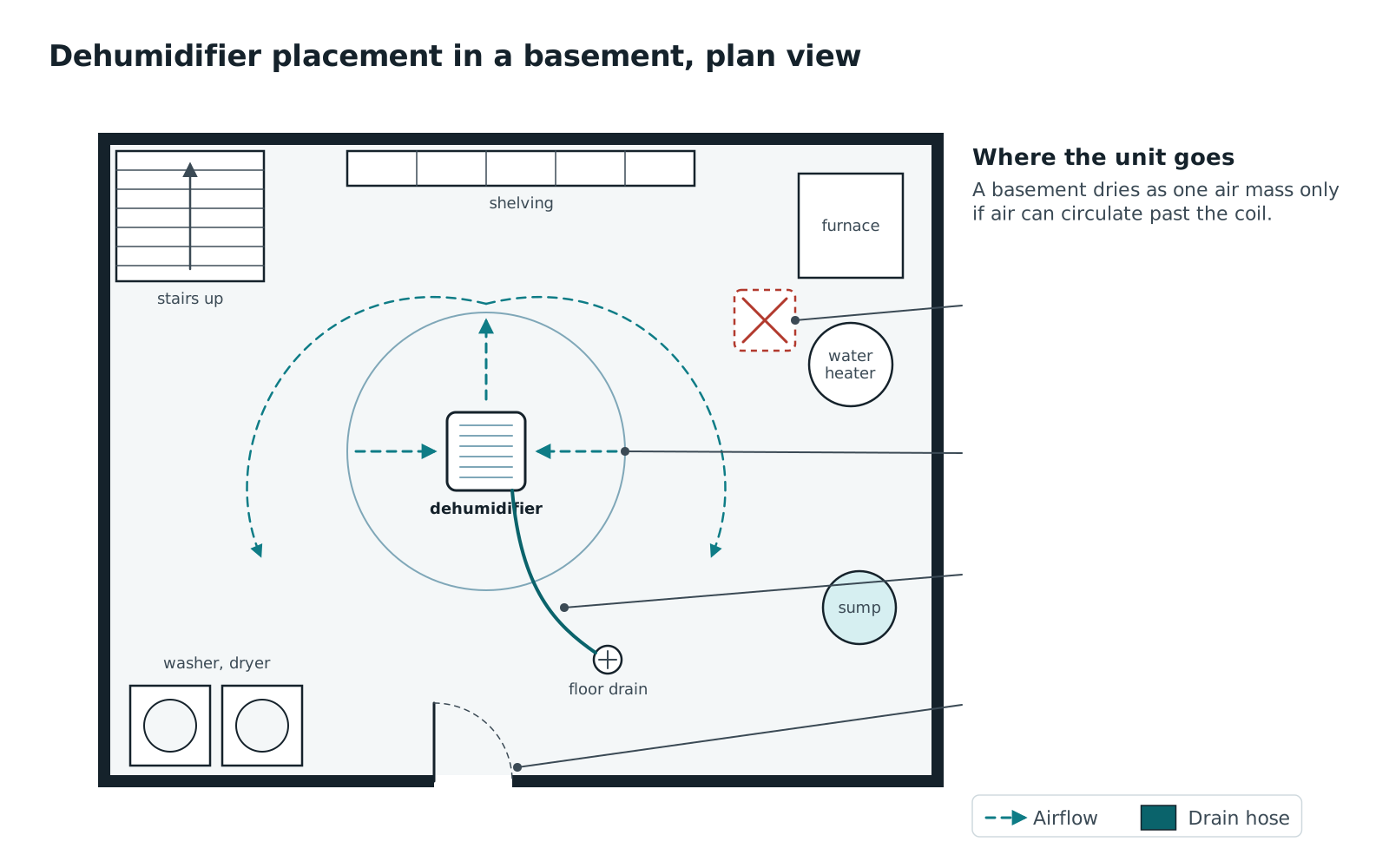
Air has to reach the coil. Put the unit as central as the drain allows, at least 12 in. from any wall on the intake side, away from the furnace (its draft confuses the humidistat) and out of closets and under-stair nooks; the plan view above shows the spot and the corner to avoid. Doors between rooms should stay open, or each room gets its own unit. Keep it off the slab on a mat or a short stand, both for noise and for the day the sump backs up. And put a hygrometer at the far end of the basement; the unit's own sensor reads the air it is standing in.
Humidistat setting
50 percent relative humidity is the setpoint. The EPA's general guidance is to keep indoor humidity below 60 percent and ideally between 30 and 50; below about 45 percent in a basement you are spending electricity for no benefit. Set 50, confirm the far-corner hygrometer agrees within 5 points after a week, and leave it.
Warranty and lifespan
Portable dehumidifiers are a 3- to 7-year appliance, and the warranty tells you what the maker expects: every pick here carries 1 year (Midea's manual says one year full; Frigidaire lists one year of labor coverage). If a unit stops collecting water in year two with the fan running, it has usually lost refrigerant charge, and it is a replacement, not a repair. Clean the filter monthly in season and vacuum the coil each spring; a clogged filter is the leading cause of a frosted coil and a unit that 'quit working'. If you want a 5- or 6-year warranty, you are shopping the crawl space class.
What we skipped and why
hOmeLabs HME020031N. The best-selling 50-pint of the last decade, and the one we see most often on water losses. hOmeLabs' website has blocked our attempts to read its product page and manual in two separate rounds, and we do not copy numbers from retailer listings, so its table is empty and it cannot be a pick. The current ENERGY STAR list carries two newer hOmeLabs models (24 and 32 pints, with Wi-Fi) and not this one. If you own one, run it on a hose; if you are buying, the Frigidaire FHDD5033Y1 is the same kind of box with a spec sheet we can cite.
GE APER50LZ. GE's ENERGY STAR pump unit, with a production run GE's own support page dates from March 2020 to July 2026. GE's product pages render their specs in a way our tools cannot read, and GE's replacement family (ADSE50X) is already on the ENERGY STAR list, so we are waiting for the successor's sheet rather than publishing a thin entry as a pick.
Frigidaire FFAD5033W1 and FFAP5033W1. Frigidaire marks them discontinued; the FHDD5033Y1 and FHDP5033Y1 above are the replacements and are the ones with published tables.
'80-pint' and '120-pint' portables. Some portables are marketed on the pre-2019 AHAM number or a saturation figure far above their DOE rating. We compare on DOE pints only; a unit that will not state its DOE rating does not make the list.
Desiccant and thermoelectric units. Thermoelectric (Peltier) 'dehumidifiers' remove a pint or less a day and are toys for a basement. Desiccant units work in cold rooms but cost two to three times the electricity per pint; useful in an unheated cabin, not in a basement with a furnace.
Whole-home and crawl space units. They are the right answer for a large, cold or divided basement and for anything under a house, but they are a different class with different ratings, so they have their own roundup.
Anything we could only document from retailer listings. We publish manufacturer specifications or we leave the cell empty, and we mark the page accordingly.
How we score
Every product gets a DryHomeLab score out of 10 from a published rubric for its category: the specs that matter (capacity, coverage, flow at head height, sensor response, warranty) are verified against manufacturer documentation and weighted by how much they affect real-world drying and protection. Where our restoration crews have run the gear, field notes can move a score by at most 1.5 points, and the note is published. We never use Amazon star ratings. Read the full methodology.
Frequently asked questions
What size dehumidifier do I need for a basement?
A 50-pint (DOE 2019) unit for most basements: it covers about 1,200 to 1,500 sq ft of real, damp basement with headroom to spare, and the class used to be labeled 70 pints before the 2019 test change. Use a 20- to 35-pint unit only for a small basement that is merely musty or for a single finished room. Over about 1,500 sq ft, or with visible seepage, use two 50-pint units or a commercial unit rated in AHAM pints. Our calculator adds the 25 percent headroom we recommend.
Should I get a dehumidifier with a pump for my basement?
Only if the nearest drain is higher than the dehumidifier's drain port. If you have a floor drain, a sump or a low utility sink within hose reach, gravity is simpler and more reliable than any pump. If the only option is a utility sink, a standpipe or a window well above the unit, a pump model (Frigidaire FHDP5033Y1, or Midea's MAD50PS1QWT pump Cube rated to 14 ft of lift) saves you from emptying a bucket two or three times a day in August. Keep the pump hose short and check it monthly.
What humidity should a basement be?
Set the dehumidifier to 50 percent relative humidity and check it against a separate hygrometer at the far end of the basement. The EPA's general guidance is to keep indoor relative humidity below 60 percent, ideally 30 to 50; above 60 percent, mold can grow on dust and cardboard even with no leak. Going below about 45 percent in a basement costs electricity without benefit. If the unit runs continuously and the far-corner reading will not drop below 60, the unit is undersized or the basement has a water problem the dehumidifier cannot solve.
Why do new dehumidifiers say 50 pints when my old one said 70?
Because the test changed, not the machines. Since mid-2019 the Department of Energy rates portables at 65°F/60% RH, closer to a real basement, instead of the old AHAM 80°F/60%. Cooler air gives up about 30 percent less water, so the unit that was a 70 is now a 50, the 50 is a 35 and the 30 is a 20 to 22. When replacing an old unit, buy about 0.7 times its pint rating; a new 50-pint is the like-for-like replacement for an old 70.
Are these dehumidifiers ENERGY STAR certified?
Yes, all five in the table. The ENERGY STAR database lists the Midea Cube 50 (current MAD50S1QWT-A revision), the Midea pump Cube and both Frigidaires at an integrated energy factor of 2.01 L/kWh, about 515 to 520 kWh a year on the federal test, and the Midea Cube 20 at 1.7 L/kWh and 249 kWh a year. None carries the Most Efficient designation. Because every 50-pint here tests the same, pick on drainage, bucket size and noise rather than the energy label.
Will a dehumidifier work in a cold basement?
Down to about 41°F it will run, but from roughly 65°F downward a compressor portable loses capacity and starts to frost its coil; auto-defrost keeps it alive but it removes little water. Usually that is acceptable, because a cold basement in winter holds little moisture. If the basement stays cool and damp year-round, buy a unit rated for cold air from the crawl space class (AlorAir's Sentinel line is rated to 33.8°F; Santa Fe and AprilAire to 49 to 50°F) and run it on a drain; see the crawl space roundup.
Where should I put the dehumidifier in the basement?
As central as the drain allows, at least 12 in. off the walls on the intake side, not in a closet or under the stairs, away from the furnace's draft, and on a mat or short stand rather than directly on the slab. Keep interior doors open or give each closed room its own unit. Run the drain hose to a floor drain or sump with continuous fall, and put a hygrometer at the far end of the basement to confirm the unit is actually reaching the whole space.
DryHomeLab is written and reviewed by the team behind HelpMeNow.com, a marketplace that connects homeowners with vetted local contractors for water-damage restoration, plumbing and waterproofing. Before HelpMeNow the same team ran a 24/7 water-damage restoration company in the Seattle area; the equipment on this site is what we specified, bought and ran on real water losses. We publish the rubric behind every score.
- Ran a 24/7 water-damage restoration company, Seattle area
- Operate HelpMeNow.com, a contractor marketplace
- Publishes its scoring rubric