
What this calculator does
It turns three things you can measure (floor area in square feet, ceiling height, and how damp the space is) into the dehumidifier capacity to buy, in pints per day. It reports the DOE 2019 rating, which is the number on every portable dehumidifier sold in the US since mid-2019, and for crawl spaces it also reports the equivalent AHAM 80°F/60% rating that Santa Fe, AprilAire and AlorAir still print on their spec sheets. Headroom of 25 percent is built in, because a unit running flat out in July is a unit that fails in August.
You will need: a tape measure, an honest look at the space (puddles? condensation? musty smell only in humid weather?), and, if you have one, a hygrometer reading from the dampest corner. If the space has standing water right now, stop here and read how to dry out a flooded basement in 72 hours; sizing a permanent dehumidifier comes after the water is out.
What size dehumidifier do you need?
Enter the space. We size by the current DOE pint rating (the number on the box since 2019), with the headroom restoration crews build in.
- Minimum removal needed: about 12 pints/day; with 25% headroom, 15 pints/day.
- Estimated running cost: roughly $15/month in season at ~300 W. ENERGY STAR units cut this 10–15%.
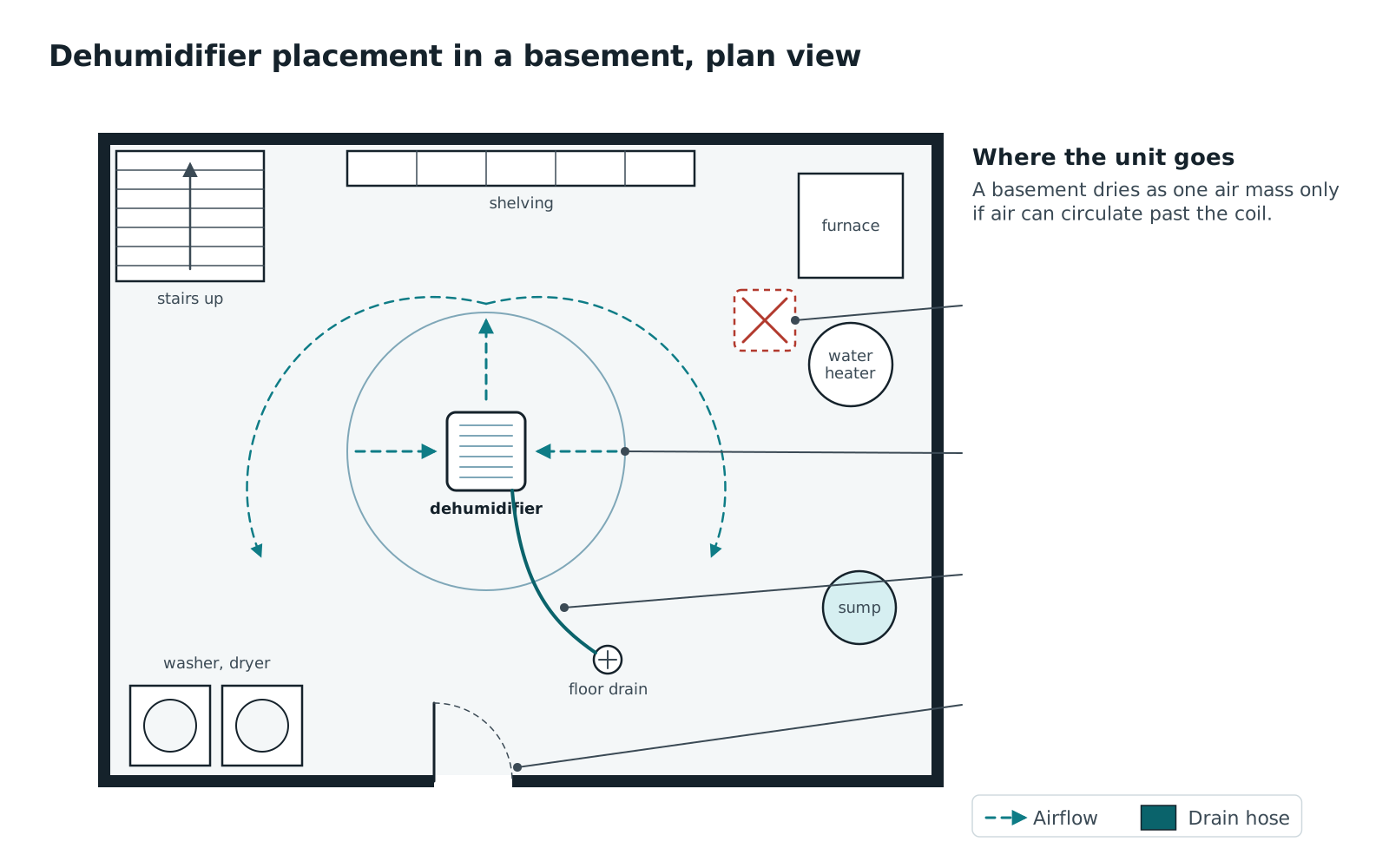
- Route the drain hose to a floor drain or condensate pump so it never stops to empty a bucket.
No catalog match yet for that size — see the picks on this page.
How the math works
Step 1: the base number, from the AHAM and ENERGY STAR method
Dehumidifier sizing in the US descends from a table the Association of Home Appliance Manufacturers published decades ago and ENERGY STAR still reproduces in updated form: floor area down the side, dampness across the top, pints per day in the cells. We use the same structure, restated in DOE 2019 pints and as a formula so the calculator can interpolate instead of jumping between rows.
- Base capacity (moderately damp, 8-ft ceiling): 20 pints per day for the first 500 sq ft, plus 1 pint for every additional 100 sq ft. A 1,500 sq ft basement that is merely musty starts at 30 pints.
- Dampness adders: very damp (60 to 70 percent RH, damp spots on walls or floor) add 5 pints; wet (70 to 85 percent RH, visible seepage or sweating walls) add 10; extremely wet (standing water at times, 85 percent RH and up) add 15.
| Floor area | Moderately damp (50–60% RH) | Very damp (60–70%) | Wet (70–85%) | Extremely wet (85%+) |
|---|---|---|---|---|
| 500 sq ft | 20 | 25 | 30 | 35 |
| 1,000 sq ft | 25 | 30 | 35 | 40 |
| 1,500 sq ft | 30 | 35 | 40 | 45 |
| 2,000 sq ft | 35 | 40 | 45 | 50 |
| 2,500 sq ft | 40 | 45 | 50 | 55 |
All figures are DOE 2019 pints per day before headroom, for an 8-ft ceiling. Retail units come in roughly three sizes (20 to 22, 30 to 35, and 50 pints), so most answers round up to one of those.
Step 2: ceiling height
The table assumes 8-ft ceilings. Dehumidifiers dry a volume of air, not a floor, so a 10-ft ceiling is 25 percent more air. The calculator multiplies the floor area by (ceiling height ÷ 8) before it looks up capacity. A 1,200 sq ft basement with 9-ft ceilings is sized as 1,350 sq ft.
Step 3: 25 percent headroom
We add 25 percent to the table value, and we do it for three reasons we see on jobs. Manufacturer coverage claims assume a sealed room at the test temperature, and basements are cooler than 65°F for much of the year, which cuts real capacity. Compressors that run continuously wear out faster and never let the humidistat cycle. And the week a water heater or washing machine hose fails, the extra capacity is the difference between a damp carpet and a wet one. If the result lands between sizes, buy the larger one.
Step 4: DOE 2019 pints versus the old ratings (about 0.7×)
Before mid-2019, dehumidifiers were rated by the AHAM method at 80°F and 60 percent RH. The Department of Energy's 2019 test procedure (10 CFR 430, Appendix X1) measures portables at 65°F/60%, closer to a real basement, and whole-home units at 73°F/60%. Cooler air gives up less water, so the same machine's number fell by roughly 30 percent: the old 70-pint became today's 50-pint, the old 50 became 35, the old 30 became 20 to 22. Nothing changed inside the box.
That matters in two places. If you are replacing a unit bought before 2019, do not buy the same pint number; buy about 0.7 times it. And if you are reading an older sizing chart (most of the ones online still are), its pints are AHAM pints; divide by 1.4 to get DOE pints, or just use the table above.
Step 5: crawl spaces and commercial units
Crawl space and whole-home dehumidifiers from Santa Fe, AprilAire and AlorAir are still sold on AHAM 80°F/60% ratings, and their published coverage figures already assume a 5-ft crawl space height and a sealed space. The crawl space mode of the calculator therefore does three things differently: it uses the crawl space height you enter instead of 8 ft, it applies a sealing factor (tight, moderate or loose, following Santa Fe's own bracketing of the Compact70 at 2,600, 2,200 and 1,800 sq ft), and it reports the AHAM pints to match the spec sheets, by dividing the DOE result by 0.7. The manufacturers' own numbers show why: Santa Fe rates the Ultra98 at 100 pints at 80°F/60% and 71.4 at 73°F/60%; AprilAire rates the E080 at 80 and 65 at the same two conditions. For the units themselves, see the best crawl space dehumidifiers.
A vented crawl space does not have a correct size. Outside air carries in more moisture than any residential unit removes. Seal it first.
What the calculator does not do
It does not size equipment for drying a structure after a flood or pipe break. That is a different calculation, based on the class of water loss, the materials that are wet, and grains of moisture per pound of air, following the IICRC S500 standard, and it uses commercial LGR dehumidifiers and air movers for days, not a 50-pint portable for years. Our 72-hour dry-out guide covers that, and when it is more than a few hundred square feet of wet material, call a restoration crew.
Common sizing mistakes
Trusting the square footage on the box. '4,500 sq ft' on a 50-pint portable is a rating for a sealed, moderately damp space at test temperature. In a real basement with a slab, a cool wall and a laundry, a 50-pint unit does a good job on about 1,200 to 1,500 sq ft. Size on pints and dampness, and treat the coverage claim as a ceiling, not a target.
Buying small to save electricity. A 22-pint unit running 24 hours a day uses more power and holds a worse humidity level than a 50-pint unit running 10 hours a day, and it dies sooner. Efficiency is in the integrated energy factor (liters per kWh), not in buying the smallest box.
Comparing an old chart to a new box. Any chart or forum post from before 2019 is in AHAM pints. Multiply by 0.7.
Ignoring temperature. Below about 65°F, every compressor dehumidifier loses capacity, and below the manufacturer's minimum (41°F for most portables, 49 to 50°F for Santa Fe and AprilAire crawl space units, 33.8°F for AlorAir's Sentinel line) it stops working. A cold basement needs a larger unit or a unit rated for the cold, not a bigger number on the same box.
Sizing a vented crawl space. See above. There is no number that works.
One unit for two rooms. A dehumidifier dries the air it can reach. Two rooms connected by a doorway share humidity slowly; two rooms separated by a closed door or a foundation wall do not share it at all. Size each space, or duct a commercial unit.
What to buy once you have a number
- 20 to 35 DOE pints: a bedroom, a finished room over a crawl space, a small dry-ish basement. A compact ENERGY STAR portable with a continuous-drain port.
- 50 DOE pints: most basements up to about 1,500 sq ft of real floor area. Our picks are in the best dehumidifier for a basement; a built-in pump if the drain is uphill, a hose to the floor drain if it is not.
- More than 50 DOE pints, or any crawl space: a commercial-grade unit rated in AHAM pints, drained by gravity or pump, with a 5- or 6-year warranty. See the best crawl space dehumidifiers and, if you are choosing between the two most-installed brands, Santa Fe vs AprilAire.
- A recently flooded space: rent or hire. Permanent dehumidifiers are not drying equipment.
How we score
Every product gets a DryHomeLab score out of 10 from a published rubric for its category: the specs that matter (capacity, coverage, flow at head height, sensor response, warranty) are verified against manufacturer documentation and weighted by how much they affect real-world drying and protection. Where our restoration crews have run the gear, field notes can move a score by at most 1.5 points, and the note is published. We never use Amazon star ratings. Read the full methodology.
Frequently asked questions
How many pints per day do I need for a 1,000 sq ft basement?
For a moderately damp 1,000 sq ft basement with 8-ft ceilings (musty in humid weather, no visible water), the table gives 25 DOE pints; with 25 percent headroom you are at about 31, so buy a 35-pint unit, or a 50-pint if the basement is cool or has a laundry. If the walls sweat or you see seepage (wet), start at 35, add headroom, and buy a 50-pint. Most people buying for a basement end up at 50 pints, which is why that size dominates the market.
Is a 50-pint dehumidifier the same as the old 70-pint?
Yes, for practical purposes. The DOE 2019 test measures at 65°F/60% RH instead of the old AHAM 80°F/60%, and the same compressor removes about 30 percent less water from the cooler air, so the units once labeled 70 pints are now labeled 50. If you are replacing a pre-2019 '70-pint', buy a 50. If you are replacing a '50', buy a 35. The machines did not get smaller; the test got more realistic.
Does ceiling height change the dehumidifier size?
Yes. Sizing tables assume 8-ft ceilings, and a dehumidifier conditions a volume of air. Multiply your floor area by the ceiling height divided by 8 before using the table: a 1,000 sq ft room with 10-ft ceilings sizes as 1,250 sq ft. Crawl spaces run the other way; at 3 to 5 ft of height they hold less air per square foot, which is already built into manufacturers' crawl space coverage figures and into the calculator's crawl space mode.
What size dehumidifier for a crawl space?
Crawl space units are rated in AHAM pints at 80°F/60%. For a sealed crawl space, about 50 to 55 AHAM pints covers up to roughly 1,200 sq ft, 70 to 90 pints covers 1,800 to 2,600 sq ft, and 100 pints or ducting covers larger or divided spaces; those brackets follow the published coverage of the AlorAir HD55, Santa Fe Compact70, AlorAir HDi90, AprilAire E080 and Santa Fe Ultra98. Switch the calculator to crawl space mode for the conversion, and read the crawl space roundup for the sealing step that has to come first.
Can a dehumidifier be too big?
Rarely, in a basement. An oversized unit cycles on the humidistat and uses little more energy than a right-sized one, since the work (pints removed) is the same. It costs more up front and, in a small bedroom, a 50-pint unit is louder and makes more heat than you want. In a crawl space, oversizing by more than about 50 percent mostly wastes money. Undersizing is the expensive mistake, because the unit runs continuously, never reaches setpoint, and wears out.
DryHomeLab is written and reviewed by the team behind HelpMeNow.com, a marketplace that connects homeowners with vetted local contractors for water-damage restoration, plumbing and waterproofing. Before HelpMeNow the same team ran a 24/7 water-damage restoration company in the Seattle area; the equipment on this site is what we specified, bought and ran on real water losses. We publish the rubric behind every score.
- Ran a 24/7 water-damage restoration company, Seattle area
- Operate HelpMeNow.com, a contractor marketplace
- Publishes its scoring rubric