
What this planner computes
You give it four things: the room's length, width and ceiling height; the linear feet of wall that are wet (walk the room and add up the wet runs, including closets); the class of the loss, which the planner helps you pick; and the type of dehumidifier you have or can rent. It returns the number of air movers to place, the dehumidifier capacity in pints per day at the AHAM 80°F/60% rating, and a rough count of how many fans fit on a 15 A circuit alongside the dehumidifier.
It is a starting point, not a drying log. On a real job the counts are adjusted from moisture readings every 24 hours. If you have not read our 72-hour basement drying guide, start there; the planner assumes standing water is already extracted and the wet pad and saturated drywall are already out.
Drying planner: how many fans and how much dehumidifier
The same math our crews use on a water loss. It also tells you when to stop and call someone.
- Run 5 air movers aimed along the walls at 15–45°, one every 10–16 ft of wet wall, with a large dehumidifier rated at least 48 pints/day in the closed room.
- Pull the carpet pad if it is wet; pad does not dry in place. Lift carpet edges and float air under it.
- Check with a moisture meter daily; you are done when readings match an unaffected area, usually 3–5 days.
Air mover picks are on the drying guide.
See our dehumidifier picks.
How the math works
Step 1: class of water loss
The IICRC S500 standard groups losses by how much water the materials are holding and how hard it is to get out.
- Class 1: water touched a small part of the room, less than about 5% of the floor, walls and ceiling combined, and the wet materials are low-porosity or small. A leak under a sink caught the same day.
- Class 2: a significant part of the room is wet, roughly 5 to 40% of the surfaces, typically a wet floor with water wicked less than about 2 ft up the walls. Most supply-line and water-heater basement losses.
- Class 3: more than about 40% of the surfaces are wet, usually because water came from above and soaked ceiling, walls, insulation and floor.
- Class 4: water is bound in dense, slow-drying materials: hardwood, plaster, concrete, brick, or a saturated subfloor under finished flooring. These need specialty drying (heat, desiccants, mat systems) and are not a homeowner job regardless of size.
The planner uses the class twice: to set the dehumidification factor and to decide whether to add floor-area air movers on top of the wall count.
Step 2: dehumidifier size
The long-standing S500 approach is to divide the room's volume in cubic feet by a factor that depends on the class and the type of dehumidifier, which gives the initial capacity in pints per day at the AHAM rating. The factors we use for a low-grain refrigerant (LGR) dehumidifier are 100 for Class 1, 50 for Class 2, and 40 for Class 3; for a conventional refrigerant unit, 100, 40 and 30. A 20 x 15 ft room with an 8 ft ceiling is 2,400 cu ft; as a Class 2 loss with an LGR that is 2,400 ÷ 50 = 48 pints per day. The same room as Class 3 needs 60, and with a conventional unit 80. Newer editions of the S500 ask you to confirm the number with psychrometric readings as the job runs, and so do we: if the room's humidity is not falling after the first day, the dehumidifier is too small or the room is not sealed.
Two cautions on the number. It is in AHAM pints (80°F, 60% RH), which is how commercial and LGR units are rated; consumer dehumidifiers since 2019 carry a DOE rating taken at a cooler, less humid condition, so a 50-pint consumer unit removes much less on an active loss than a 50-pint LGR. And the factor assumes the room is closed off from the rest of the house with the HVAC in that room taped off.
Step 3: air mover count
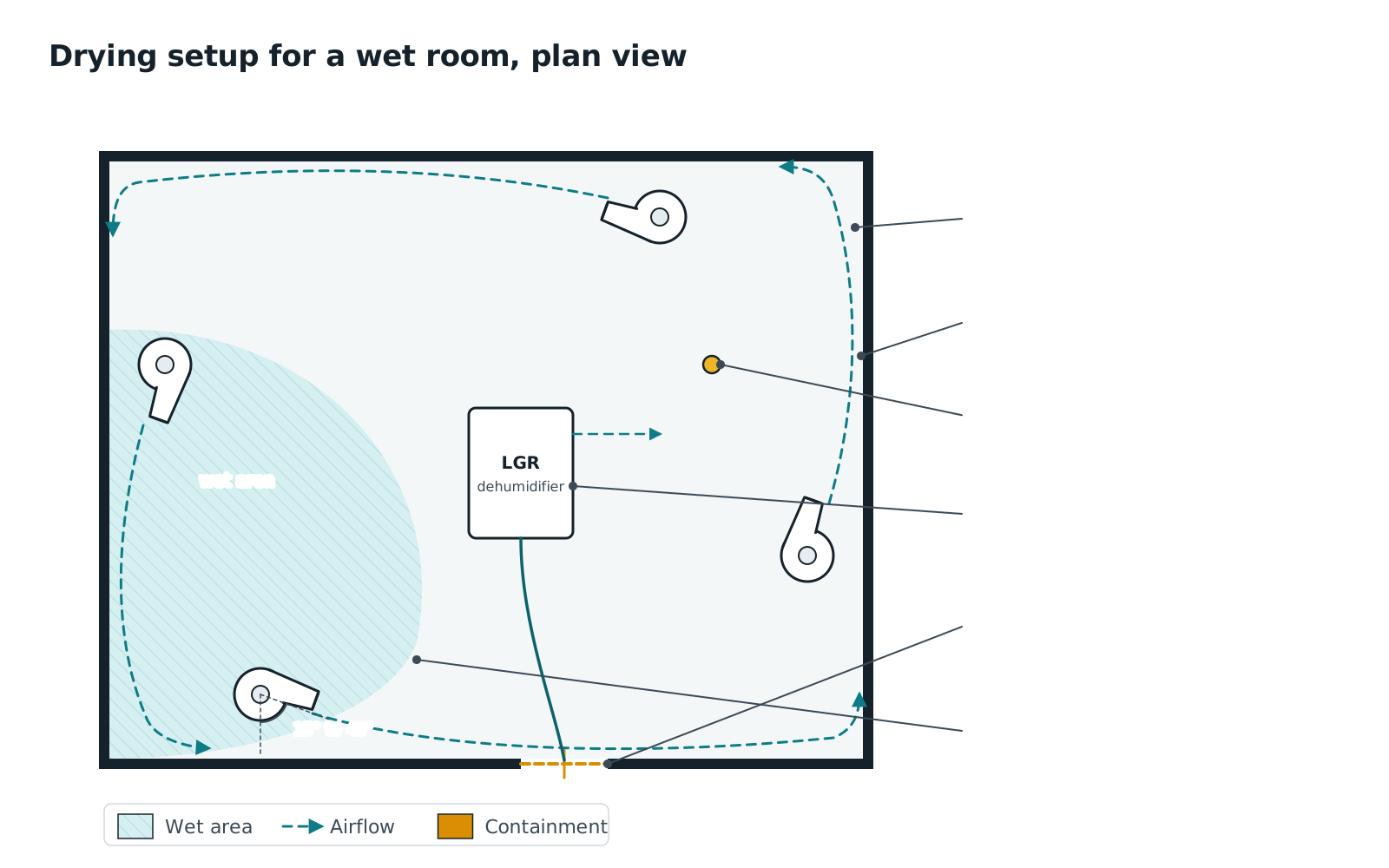
The S500 sizes air movers by placement. The planner starts with one air mover per 10 to 16 linear feet of wet wall, using the lower spacing when the walls wicked higher or the materials are denser. It adds one air mover for each closet, alcove or offset you tell it about, because the main airflow does not turn corners. For Class 3 losses it adds floor coverage at one fan per 50 to 70 sq ft of wet floor. It then rounds up: on a drying job an extra fan costs a day of rental, and a missing fan costs a wall.
Place each fan at 15° to 45° to the wall, all pointing the same direction around the room, and see the air mover guide for which ones to rent or buy.
Step 4: circuits
A 15 A breaker should carry no more than 12 A continuously. The planner divides 12 A by the amp draw of the fan you pick (1.9 A for a Dri-Eaz Velo Pro on high, 2.3 A for an XPOWER P-230AT, 4.0 A for a Sahara Pro X3) and tells you how many circuits you need with the dehumidifier on its own. If the answer is more circuits than the basement has, that is a signal to call rather than to overload a breaker.
When not to DIY
The planner will happily size a job it should not be sizing. Do not use the numbers to dry any of the following yourself:
- Category 3 water: sewage, ground water from outside, or water that has been standing for days. The materials come out under containment before anything is dried.
- Class 4 materials: hardwood floors, plaster, concrete with flooring over it, or a subfloor under tile. These need specialty equipment and monitoring.
- More than one room or wet walls on more than two sides. The equipment count climbs past what a homeowner can rent and power.
- Water at the furnace, the panel or a gas appliance.
- A loss going through insurance where the adjuster wants a moisture map and daily psychrometric logs. A crew produces those as a matter of routine.
If any of these apply, the number the planner gives you is the number a crew will bring on day one, and the right move is to call them.
Frequently asked questions
How many air movers do I need per square foot?
Air movers are counted by wall length, not floor area, for most losses: one per 10 to 16 linear feet of wet wall plus one per closet or offset, per the IICRC S500. Floor-area counts (one per 50 to 70 sq ft) are added for Class 3 losses where the floor, walls and ceiling are all wet. A 12 x 14 ft bedroom with two wet walls needs three or four fans, not the one big fan most people buy.
What size dehumidifier do I need for water damage?
Divide the room's cubic feet by the S500 factor for your class and dehumidifier type. For an LGR: 100 (Class 1), 50 (Class 2), 40 (Class 3). A 2,400 cu ft room as a Class 2 loss needs about 48 pints per day at the AHAM rating. That is an LGR or a large commercial unit; consumer dehumidifiers are rated at the cooler DOE condition and remove far less on an active loss than their box number suggests.
What is the difference between Class 2 and Class 3 water damage?
Class 2 means a significant part of the room is wet, typically a wet floor with water wicked less than about 2 ft up the walls, which covers most basement losses from a supply line or water heater. Class 3 means most surfaces are wet, usually because the water came from above and soaked the ceiling, the walls, the insulation and the floor. Class 3 needs roughly 25% more dehumidification and extra floor-area air movers.
Can I run the dehumidifier and air movers on one circuit?
Only for a very small job. A 15 A circuit should carry 12 A continuously; a compact LGR draws about 5.4 A and a large one 7 to 9 A, which leaves room for two or three low-profile fans at most. Plan on the dehumidifier on its own circuit and fans on a second, using 12-gauge extension cords from another room if the basement has only one.
DryHomeLab is written and reviewed by the team behind HelpMeNow.com, a marketplace that connects homeowners with vetted local contractors for water-damage restoration, plumbing and waterproofing. Before HelpMeNow the same team ran a 24/7 water-damage restoration company in the Seattle area; the equipment on this site is what we specified, bought and ran on real water losses. We publish the rubric behind every score.
- Ran a 24/7 water-damage restoration company, Seattle area
- Operate HelpMeNow.com, a contractor marketplace
- Publishes its scoring rubric