
Our picks
Dri-Eaz Velo Pro Low Profile Air Mover
The fan restoration crews buy by the pallet, with an amp dial that fits ten on one circuit.
Adjustable amps, five positions and a daisy-chain outlet: the fan our crews run ten to a circuit.
XPOWER P-230AT Mini Mighty Air Mover
A 10 lb centrifugal with a timer and daisy-chain outlets, for the price of a good box fan.
925 CFM at 2.3 A with a timer and daisy-chain outlets, in a 10 lb housing you can store under a sink.
B-Air Vent VP-25 1/4 HP Air Mover
A compact air mover with a 25 ft cord and a two-year warranty.
900 CFM, a 25 ft cord and a two-year warranty; the one to keep on a shelf for the next leak.
Dri-Eaz Sahara Pro X3 TurboDryer
The classic snail-shell carpet dryer, now 27 lb and 4 amps.
2,700 CFM of centrifugal airflow that floats a carpet and dries the pad underneath.
Who this is for
You have water on a floor or in a wall and a box fan pointed at it, and you are wondering whether a real air mover is worth buying. We dry houses for a living in the Puget Sound area, where a basement that gets wet once usually gets wet again, so we have opinions about which fans earn a place in a garage.
The short version: a homeowner with a single wet room should own one or two compact air movers and a dehumidifier. A homeowner with a flooded basement should rent professional fans for a week and spend the money on a moisture meter instead. A landlord, a building manager or anyone on their second flood should buy the Dri-Eaz Velo Pro and never think about it again.
What an air mover does that a box fan doesn't
Water leaves a wet material only from its surface, and it leaves faster when the air touching that surface is moving and dry. A box fan moves a lot of air slowly through a big circle. An air mover moves air fast through a narrow slot and aims it along the surface, which strips away the thin layer of saturated air sitting on top of wet carpet or drywall and replaces it with drier air. That boundary-layer effect, not raw airflow, is the whole job.
The second difference is pressure. A centrifugal air mover like the Dri-Eaz Sahara Pro X3 develops enough static pressure to lift the edge of a carpet and push air under it, drying the pad and subfloor. A low-profile axial unit like the Velo Pro trades some pressure for a wide, low airflow pattern and far lower power draw. A box fan does neither: it cannot float a carpet, and in a closed room it mostly stirs humid air in a circle.
The third difference is that air movers are built to run for 72 hours straight, tipped on their sides, on a wet floor, with other fans plugged into them. A box fan is not.
Air movers do not remove water from the room. They move it from the material into the air. Without a dehumidifier or a lot of outdoor ventilation on a dry day, that water condenses on the next cool surface it finds, usually a window or the back of a closet. Fans and dehumidification are one system; see our 72-hour basement drying guide for the sequence.
Compared at a glance
Scroll sideways on small screens. Scores are DryHomeLab scores out of 10; specs are from manufacturer documentation.
| Product | Score | Type | Airflow (CFM) | Current draw (A) | Positions / angles | Daisy-chain outlet | Weight (lb) | Warranty (years) | |
|---|---|---|---|---|---|---|---|---|---|
| Dri-Eaz Velo Pro Low Profile Air Mover Best overall (and best low-profile) | 6.2 | low-profile | 885 | 1.9 | 5 | Yes | 18.6 | — | See it at Sylvane |
| XPOWER P-230AT Mini Mighty Air Mover Best value | 6.6 | centrifugal | 925 | 2.3 | 4 | Yes | 10.2 | — | See it at Sylvane |
| B-Air Vent VP-25 1/4 HP Air Mover Best for homeowners (one or two fans) | 4.5 | centrifugal | 900 | — | — | Yes | 11.3 | 2 | See it at Sylvane |
| Dri-Eaz Sahara Pro X3 TurboDryer Best for wet carpet | 6.6 | centrifugal | 2,700 | 4 | 3 | — | 27 | — |
Paid links.
Dri-Eaz Velo Pro Low Profile Air Mover
The fan restoration crews buy by the pallet, with an amp dial that fits ten on one circuit.
Score breakdown
| Airflow | 885 | 0.4 |
| Amps per fan | 1.9 | 8.9 |
| Warranty | n/a | — |
| Positioning options | 5 | 10.0 |
| Daisy-chain outlets | true | 10.0 |
| Portability | 18.6 | 6.6 |
| Durability | plastic | 5.0 |
| Stackable | true | 10.0 |
| Quietness | 69 | 4.4 |
- Adjustable 1.2–1.9 A draw lets you balance several fans on one 15 A circuit
- Five operating positions cover floors, walls, stairs and cabinets
- Daisy-chain dual outlet; Dri-Eaz says up to ten units per 15 A circuit
- 18.6 lb with a built-in handle, and they stack six high on a hand truck
- 69 dB average is quiet for a professional air mover
- 885 CFM maximum is far less than a centrifugal unit; it needs company on big carpet
- Priced for contractors, roughly three times a hardware-store utility fan
- Dri-Eaz does not publish the warranty term on the product page; check the warranty document before buying
The Velo Pro is a low-profile axial air mover built for structural drying rather than for blowing air across a room. Dri-Eaz rates it at 500 to 885 CFM on a variable-speed dial, and the dial also sets the current draw anywhere from 1.2 to 1.9 A in 0.1 A steps. That second number is why crews like it: on a 15 A household circuit you can run eight to ten of these through their daisy-chain outlets without tripping a breaker, where a full-size centrifugal fan limits you to three.
The five operating positions matter more than the airflow figure. Laid flat it sweeps a wide, low path across carpet and subfloor. Tilted on its kickstand it hits the lower 2 ft of a wall where water wicks into drywall. Stood on end it dries a stairway or the inside of a cabinet. An hour meter tracks runtime, which is useful when you are logging a job for an insurance claim.
Where it falls short: it is not cheap for a homeowner who will use it once, and 885 CFM is a third of what a snail-shell centrifugal moves, so a single Velo Pro on a soaked 20 x 20 ft carpet is slow. It wants to be one of several fans working with a dehumidifier. At 69 dB it is quieter than most centrifugals but still not something you sleep next to.
Buy it if you own rental property, manage a building, or have had water in the same basement twice. For a one-time loss, rent this exact model from an equipment yard instead; it is what they stock.
XPOWER P-230AT Mini Mighty Air Mover
A 10 lb centrifugal with a timer and daisy-chain outlets, for the price of a good box fan.
Score breakdown
| Airflow | 925 | 0.6 |
| Amps per fan | 2.3 | 7.7 |
| Warranty | n/a | — |
| Positioning options | 4 | 10.0 |
| Daisy-chain outlets | true | 10.0 |
| Portability | 10.2 | 9.9 |
| Durability | plastic | 5.0 |
| Stackable | true | 10.0 |
| Quietness | n/a | — |
- 925 CFM at only 2.3 A, so six fit on a 15 A circuit
- Daisy-chain outlets for up to four units and a 3-hour timer
- 10.2 lb and stackable; easy to store between leaks
- Four positions including a 20° kickstand for wall bases
- 10 ft cord is short for basements
- Airflow suits one room, not a whole floor
- Polypropylene housing is lighter duty than rotomolded professional units
- Warranty term is not on the spec sheet; confirm with XPOWER before buying
The P-230AT is the compact air mover we recommend most often to homeowners who want something better than a box fan without paying contractor prices. XPOWER's spec sheet lists a 1/5 HP motor rated at 925 CFM, 2.3 A, three speeds, and four drying positions (0°, a 20° kickstand, 45° and 90°). It weighs 10.2 lb, so it goes up a stairway in one hand.
Two features punch above the price. The daisy-chain outlets let you link up to four units on one cord, which is how you dry a whole room from a single outlet, and the 3-hour timer means you can set it under a sink cabinet and let it shut itself off. It stacks for storage.
The limits are the ones you would expect from a small housing. At 925 CFM it dries a bathroom, a closet or a 10 x 12 ft room; a flooded basement needs several of these or a bigger fan. The 10 ft cord is short for basement work, so plan on a heavy-gauge extension cord. The housing is polypropylene, fine for a garage shelf but not the rotomolded shell a crew throws in a van every day. XPOWER lists an older rating of 800 CFM for this model on some retailer pages; the current manufacturer sheet says 925 CFM. Treat the airflow as modest either way and buy two if the wet area is bigger than a bathroom.
Buy it if you want a real air mover for a one-room leak, a rental unit, or a crawl space hatch, and you want to spend about what a decent dehumidifier filter costs per year.
B-Air Vent VP-25 1/4 HP Air Mover
A compact air mover with a 25 ft cord and a two-year warranty.
Score breakdown
| Airflow | 900 | 0.5 |
| Amps per fan | n/a | — |
| Warranty | 2 | 2.5 |
| Positioning options | n/a | — |
| Daisy-chain outlets | true | 10.0 |
| Portability | 11.3 | 9.5 |
| Durability | plastic | 5.0 |
| Stackable | n/a | — |
| Quietness | n/a | — |
- 25 ft cord, the longest in the compact group
- Two-year warranty
- Daisy-chain capable for up to five units
- 11.3 lb and easy to carry one-handed
- Lasko does not publish the amp draw or position count on its page
- 900 CFM is one-room airflow
- Plastic housing, not rotomolded
The VP-25 is B-Air's compact 1/4 HP centrifugal, rated at up to 900 CFM with three speeds. B-Air is a Lasko brand, and Lasko's listing gives the two numbers homeowners should care about most: a 25 ft cord and a two-year warranty, both better than the compact XPOWER. It weighs 11.3 lb and daisy-chains up to five units.
That cord length is the practical difference. Most basement floods happen 20 ft from the nearest outlet, and a long factory cord is one fewer extension cord lying in water. Five units on a chain also covers a typical finished basement room from one outlet, provided the total draw stays under the circuit rating.
What we could not verify from the manufacturer is the current draw and the number of positions; the Lasko page omits both. Field experience says compact 1/4 HP units draw in the low 2 A range, but we do not score what we cannot confirm, so plan conservatively and do not put more than four compact fans on one 15 A circuit until you have read the nameplate. The plastic housing is adequate for occasional use.
Buy it if you want one or two fans to keep for the next leak and you value cord length and warranty over the lightest possible weight. Rent bigger equipment for a whole-basement loss.
Dri-Eaz Sahara Pro X3 TurboDryer
The classic snail-shell carpet dryer, now 27 lb and 4 amps.
Score breakdown
| Airflow | 2700 | 8.6 |
| Amps per fan | 4 | 2.9 |
| Warranty | n/a | — |
| Positioning options | 3 | 6.7 |
| Daisy-chain outlets | n/a | — |
| Portability | 27 | 3.2 |
| Durability | roto-molded polyethylene | 10.0 |
| Stackable | true | 10.0 |
| Quietness | n/a | — |
- 2,700 CFM with the static pressure to float a carpet and dry the pad underneath
- Rotomolded polyethylene housing is the most durable construction in the category
- Three positions including a 90° setting for ceilings
- Stackable for transport and storage
- 4.0 A per fan means only three on a 15 A circuit
- Loud compared with low-profile axial units
- Dri-Eaz does not list noise, cord length or warranty in the spec comparison we could verify
The Sahara Pro X3 is the centrifugal air mover most people picture when they think of a restoration fan: a roto-molded polyethylene snail shell that throws a fast, concentrated sheet of air along the floor. Dri-Eaz rates the current F351 version at 2,700 CFM on high with three speeds, drawing 4.0 A. The three positions (0°, 45° and 90°) let you float a carpet, aim up a wall, or point at a ceiling.
This is the fan for wet carpet and pad. A centrifugal unit develops more static pressure than an axial fan, so it will lift the edge of a carpet and drive air underneath it, which an axial fan does poorly. On a hardwood or tile floor the advantage shrinks and the extra noise is harder to justify.
The trade-offs are power and sound. At 4.0 A you get three of these on a 15 A circuit, so a larger loss means spreading fans across several breakers or running cords from another room. It is louder than a low-profile fan; expect to close the door on the room. At 27 lb it is lighter than the previous generation but still twice the weight of a compact unit, and the rotomolded housing is the reason it survives being thrown in a truck for a decade.
Buy it if carpet is what gets wet in your house. If your losses are on hard floors and walls, a low-profile fan dries the same area with less noise and electricity.
How to choose
CFM matters less than placement
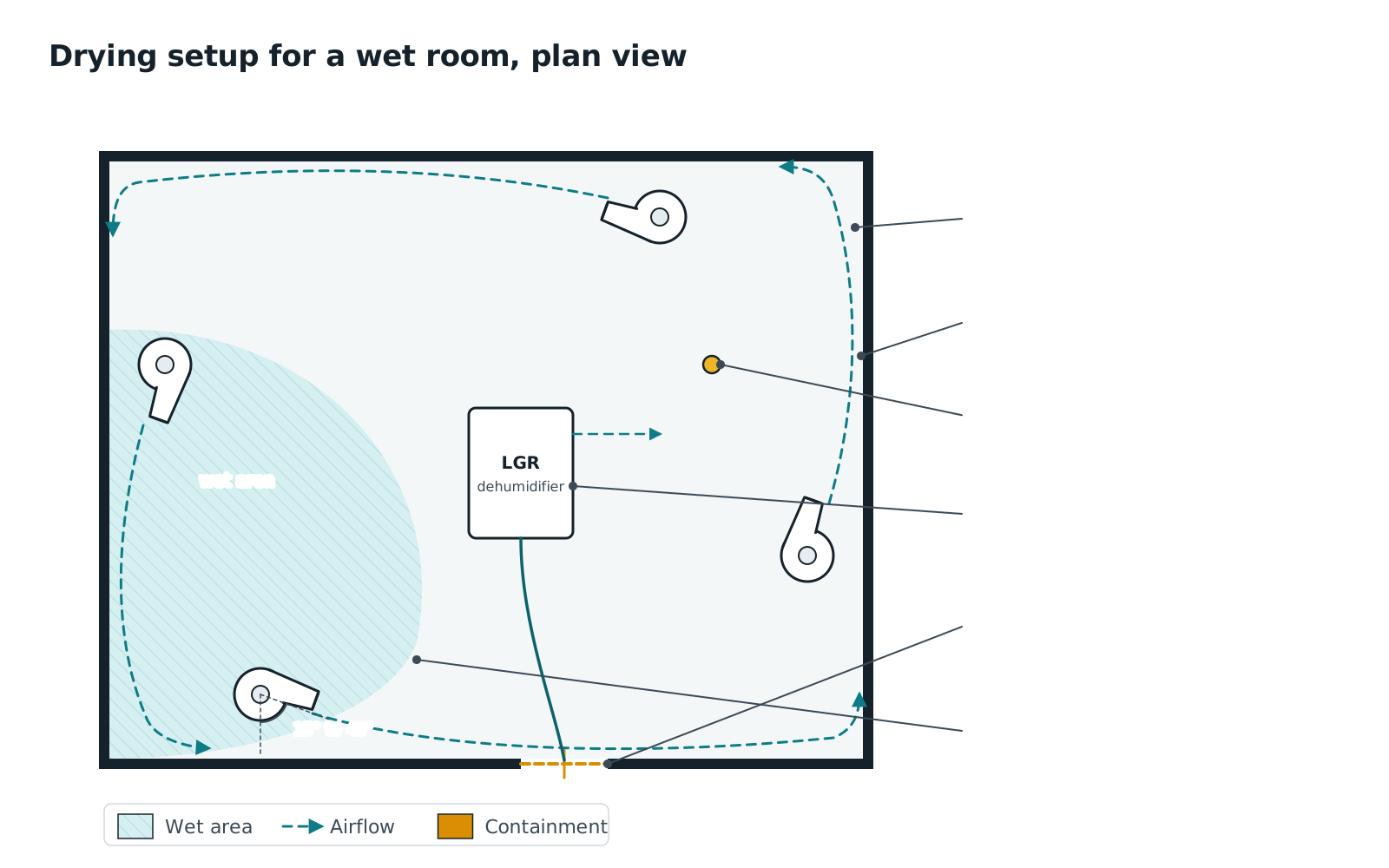
Airflow ratings on the box range from about 900 CFM for compact units to 3,200 CFM for a full-size centrifugal. That number is measured at the outlet with nothing in front of it, and it tells you less than you think. The IICRC S500 standard, which is the document insurers and restoration contractors work from, sizes drying by placement rather than by total CFM: one air mover per 10 to 16 linear feet of wet wall, plus one for every 50 to 70 sq ft of wet floor in the heavier classes of loss, plus one for each closet or offset the main airflow cannot reach. Position each fan at a 15° to 45° angle to the wall so the air runs along the surface rather than slamming into it, and point them all the same direction around the room so the airflow circulates.
What that means in practice: a 12 x 14 ft bedroom with water on the floor and wicking into two walls wants three or four air movers, not one big one. Three 900 CFM fans placed right dry that room faster than one 3,200 CFM fan in the corner. Use the drying planner to get counts for your room.
Amps per circuit
This is the spec most people ignore and the one that stops drying jobs cold. A 15 A household breaker should carry no more than 12 A continuously, and a 20 A breaker no more than 16 A. Count fans accordingly:
- Dri-Eaz Velo Pro, 1.2–1.9 A: six per 15 A circuit on high, ten with the dial turned down to 1.2 A, which is the figure Dri-Eaz quotes.
- XPOWER P-230AT, 2.3 A: five per 15 A circuit.
- Dri-Eaz Sahara Pro X3, 4.0 A: three per 15 A circuit.
- XPOWER P-800, 7.5 A: one per 15 A circuit if it will run for days.
- B-Air VP-25 and the Lasko utility fans: the manufacturers do not publish amps, so read the nameplate and assume the low 2 A range for the B-Air until you have.
A dehumidifier is the other load. A compact LGR like the AlorAir Storm Extreme draws 5.4 A, a large one around 7 to 9 A. On a one-bedroom loss, that is one circuit for the dehumidifier and one for the fans, and most bedrooms have one circuit. Plan on running a 12-gauge extension cord from a second room, and never from a GFCI outlet that is already tripping on the wet floor.
Daisy-chaining
Most professional air movers have one or two outlets on the back so the next fan plugs into the last, which lets you put five fans around a room from a single wall outlet. The outlet does not add capacity; the whole chain still draws through one cord and one breaker, so the counts above still apply. Look for a GFCI or a breaker on the chain outlet, and check the manufacturer's stated chain limit: Dri-Eaz says up to ten Velo Pros on a 15 A circuit, XPOWER says four P-230ATs, B-Air says five VP-25s. The XPOWER P-800 has no outlet at all.
Positions and stackability
Water wicks up walls and pools in corners, under cabinets and on stairs. A fan that only sits flat dries floors. The Velo Pro's five positions and the four positions on the XPOWER units let you tilt the outlet at the base of a wall, stand the fan on end for a stairway, or point it at a ceiling. The Sahara Pro X3 has three positions, which is enough for carpet and a wall. The Lasko-style pivoting blowers aim anywhere but do not develop the pressure to make the aim count.
Stackability matters if you own more than two. The Velo Pro stacks six high on a hand truck; the XPOWER P-800 stacks three on its side; the Sahara Pro X3 and P-230AT stack for storage. If you are buying one fan for a shelf, ignore this.
Noise
Nobody sleeps in a room with air movers running, and the job takes three days. The Velo Pro is the only fan in our group with a manufacturer-published figure, 69 dB, which is about a vacuum cleaner. Centrifugal units are louder, and three of them in a basement are heard on the second floor. If the wet room is a bedroom you will be sleeping in, choose low-profile fans, close the door, and run the dehumidifier on the far side of the room from the bed. Do not turn fans off at night; the first 24 hours set the pace of the entire dry-out.
Housing
Rotomolded polyethylene (the Dri-Eaz Sahara) survives being dropped down stairs for a decade. Injection-molded housings on the Velo Pro and XPOWER units are fine for occasional use. The ABS shells on hardware-store utility fans crack at the pivot after a few seasons. For a homeowner, housing is the least important spec; for a landlord with six units, it is the one that decides what you own in year five.
Drying planner: how many fans and how much dehumidifier
The same math our crews use on a water loss. It also tells you when to stop and call someone.
- Run 5 air movers aimed along the walls at 15–45°, one every 10–16 ft of wet wall, with a large dehumidifier rated at least 48 pints/day in the closed room.
- Pull the carpet pad if it is wet; pad does not dry in place. Lift carpet edges and float air under it.
- Check with a moisture meter daily; you are done when readings match an unaffected area, usually 3–5 days.
- XPOWER P-230AT Mini Mighty Air MoverScore 6.6 · 925 CFMCheck price
- Dri-Eaz Sahara Pro X3 TurboDryerScore 6.6 · 2700 CFM
- Dri-Eaz Velo Pro Low Profile Air MoverScore 6.2 · 885 CFMCheck price
- XPOWER P-800 Air MoverScore 4.7 · 3200 CFM
- Paid links.
See our dehumidifier picks.
Rent or buy?
An equipment rental yard rents a professional air mover for roughly the price of a nice dinner per day, and a large LGR dehumidifier for a few times that. A one-room loss dried in three days with three fans and a dehumidifier rents for a few hundred dollars total. Buying the same equipment costs well over a thousand dollars and it then sits in your garage, where the pump seals in the dehumidifier dry out.
Rent if this is the first time water has been in the house, the wet area is bigger than one room, or you need a dehumidifier bigger than a consumer unit. Rental yards stock the Dri-Eaz and Phoenix equipment on this site; ask for low-profile air movers and an LGR dehumidifier by name.
Buy if you own rental property, you have a basement or crawl space that has gotten wet more than once, you live where a rental yard is an hour away, or you want something on hand for the small stuff: a dishwasher overflow, a window left open in a storm, a water heater that drips rather than bursts. For that owner, two compact air movers and a decent dehumidifier handle most of what happens, and the best basement dehumidifiers are good enough between events.
If you are reading this with water on the floor right now and the area is bigger than a bathroom, or the water came from a sewer line or from outside, stop shopping and call. Fans do not fix a Category 3 loss and the clock on mold is 48 to 72 hours.
What we skipped and why
XPOWER P-800. It moves the most air of anything we looked at, 3,200 CFM, for a reasonable price. We left it off the picks because 7.5 A per fan means one fan per circuit, it has no daisy-chain outlet, and a flooded basement is better served by more small fans than one big one. It remains the right choice for a single large wet area with its own circuit.
Lasko U15617 and the Stanley 655704. These are the pivoting utility blowers at every hardware store, and the Lasko is the successor to the X12900 people ask about. Lasko publishes no CFM or amp rating for the U15617, and we could not find a manufacturer specification sheet for the Stanley at all, so we cannot score either against the others. They ventilate well and dry a damp bathroom. They do not float carpet or sweep wall bases. If you already own one, use it as an extra fan beside a real air mover.
Consumer fans sold as air movers. Several brands sell snail-shell fans with no published amps, no listed warranty and no distributor we could find. We only list equipment whose manufacturer publishes specifications we can check.
Axial drum fans. A 24 in drum fan moves enormous volume at low velocity. Useful for ventilating a garage on a dry day, nearly useless for drying a wall.
How we score
Every product gets a DryHomeLab score out of 10 from a published rubric for its category: the specs that matter (capacity, coverage, flow at head height, sensor response, warranty) are verified against manufacturer documentation and weighted by how much they affect real-world drying and protection. Where our restoration crews have run the gear, field notes can move a score by at most 1.5 points, and the note is published. We never use Amazon star ratings. Read the full methodology.
Frequently asked questions
How many air movers do I need for one room?
Use the IICRC S500 placement rule rather than the CFM on the box: one air mover for every 10 to 16 linear feet of wet wall, one for every 50 to 70 sq ft of wet floor in a heavier loss, and one more for each closet or alcove the main airflow misses. A 12 x 14 ft bedroom with wet carpet and two wet walls usually needs three or four fans at a 15° to 45° angle to the walls, all pointed the same direction. Our drying planner does the count for you.
How long should I run air movers after a leak?
Until a moisture meter says the materials are back to their dry standard, which is usually three to five days for drywall and carpet in a Class 1 or 2 loss with a dehumidifier running, longer for subfloor and hardwood. Run them continuously; turning fans off at night roughly doubles the dry time. Stop when readings match an unaffected area of the same material, not when the surface feels dry. See the best moisture meters for what to measure with.
Can I use a box fan instead of an air mover?
For a damp bathroom floor, yes, with a dehumidifier and the door closed. For carpet, pad, drywall or subfloor, no. A box fan does not generate the velocity to strip the saturated air layer off a wet surface or the pressure to drive air under carpet, and it is not built to run on a wet floor for three days. It will dry the top of the carpet and leave the pad wet, which is how basements end up smelling like mildew a month later.
How many air movers can I run on one circuit?
Keep the continuous load under 80% of the breaker rating: 12 A on a 15 A circuit, 16 A on a 20 A circuit. That is six Dri-Eaz Velo Pros on high (ten turned down to 1.2 A), five XPOWER P-230ATs, three Sahara Pro X3s, or one XPOWER P-800. Daisy-chain outlets do not add capacity; the whole chain still runs through one breaker. Put the dehumidifier on a different circuit.
Should I point the air mover at the wet spot?
No. Aim it along the surface. Set the fan at a 15° to 45° angle to the wall so the air runs parallel to it, and arrange the fans so the airflow circles the room in one direction. Blowing straight at a wet wall creates a dead spot behind the impact zone and drives moisture deeper into the wall cavity instead of out of it.
Do I need a dehumidifier with the air movers?
Yes, unless it is a small area and the weather outside is dry enough to ventilate. Air movers move water from the material into the air; a dehumidifier takes it out of the air. Without one, the room humidity climbs, evaporation slows to a crawl, and the moisture condenses on windows and cold walls. For a single room a good consumer dehumidifier draining to a sink is enough; for a basement, rent an LGR.
Is it better to rent or buy an air mover?
Rent for a one-time loss bigger than a bathroom. Three professional fans and a large dehumidifier rent for a few hundred dollars for the week it takes, and renting gets you the right equipment instead of what fits a budget. Buy one or two compact units if you own rental property, have a basement that has flooded before, or want to handle small leaks the same day they happen.
Which air mover is quietest?
Of the fans with a manufacturer-published figure, the Dri-Eaz Velo Pro at 69 dB. Low-profile axial fans in general are quieter than centrifugal snail-shell units at the same airflow. None of them are quiet enough to sleep beside; plan on closing the door, and do not turn them off overnight.
DryHomeLab is written and reviewed by the team behind HelpMeNow.com, a marketplace that connects homeowners with vetted local contractors for water-damage restoration, plumbing and waterproofing. Before HelpMeNow the same team ran a 24/7 water-damage restoration company in the Seattle area; the equipment on this site is what we specified, bought and ran on real water losses. We publish the rubric behind every score.
- Ran a 24/7 water-damage restoration company, Seattle area
- Operate HelpMeNow.com, a contractor marketplace
- Publishes its scoring rubric